Luganville
"The dive master said: 'You ready?' I said yes. She said: 'You sure?' I said maybe. She laughed and jumped in anyway."
Luganville was built by the Americans during World War II as a massive staging base for the Pacific campaign — at its peak in 1943, it housed around 500,000 Allied troops and was one of the largest military installations in the Pacific. When the war ended, the Americans left with such thoroughness and speed that they drove an estimated 40 million dollars of surplus equipment into the sea rather than negotiate a fair price with the colonial authorities. The town that remained is the result: wide, practical streets designed for military convoys, a deep-water port, and a sprawling, unhurried energy that suggests a place that once expected more of itself and made its peace with the outcome.
A Town That Works for You
Luganville is Vanuatu’s second city and functions as the main base for exploring Espiritu Santo. It has supermarkets, guesthouses, restaurants, and a produce market on the main road where the fruit is extraordinary — pawpaw, mangosteen, pamplemousse the size of footballs. The pace is slower than Port Vila and the vibe is correspondingly more relaxed. Nobody is trying to sell you anything particularly hard.
I stayed at a guesthouse run by a woman named Josephine who made fresh bread every morning and left it outside the room door. I cannot explain how much this improved my days on Santo.
Diving the Channel
The Segond Canal — the wide strait between Espiritu Santo and Aore Island — contains the President Coolidge, the best accessible wreck dive in the world, and a cluster of smaller wrecks and reef systems within a short boat ride. Every morning I watched groups of divers heading out from the various dive operators clustered near the canal, and every evening they came back looking like people who had just witnessed something they needed time to process.
I went out three times. The first dive was a shallow reconnaissance of the Coolidge’s outer hull — a wall of rust and coral at fifteen meters, covered in giant sea fans and schools of fish that moved through the wreck’s windows like weather. The second dive went deeper into the ship’s interior, through corridors that were once first-class passenger cabins, past a field gun still pointed at a horizon that is now vertical. The third day I dove the “Swimming Pool,” a large covered section of the ship’s stern where a natural shaft of light falls in from above and illuminates a dining room table still set with crockery. Completely absurd. Completely real.
The Aore Channel at Dusk
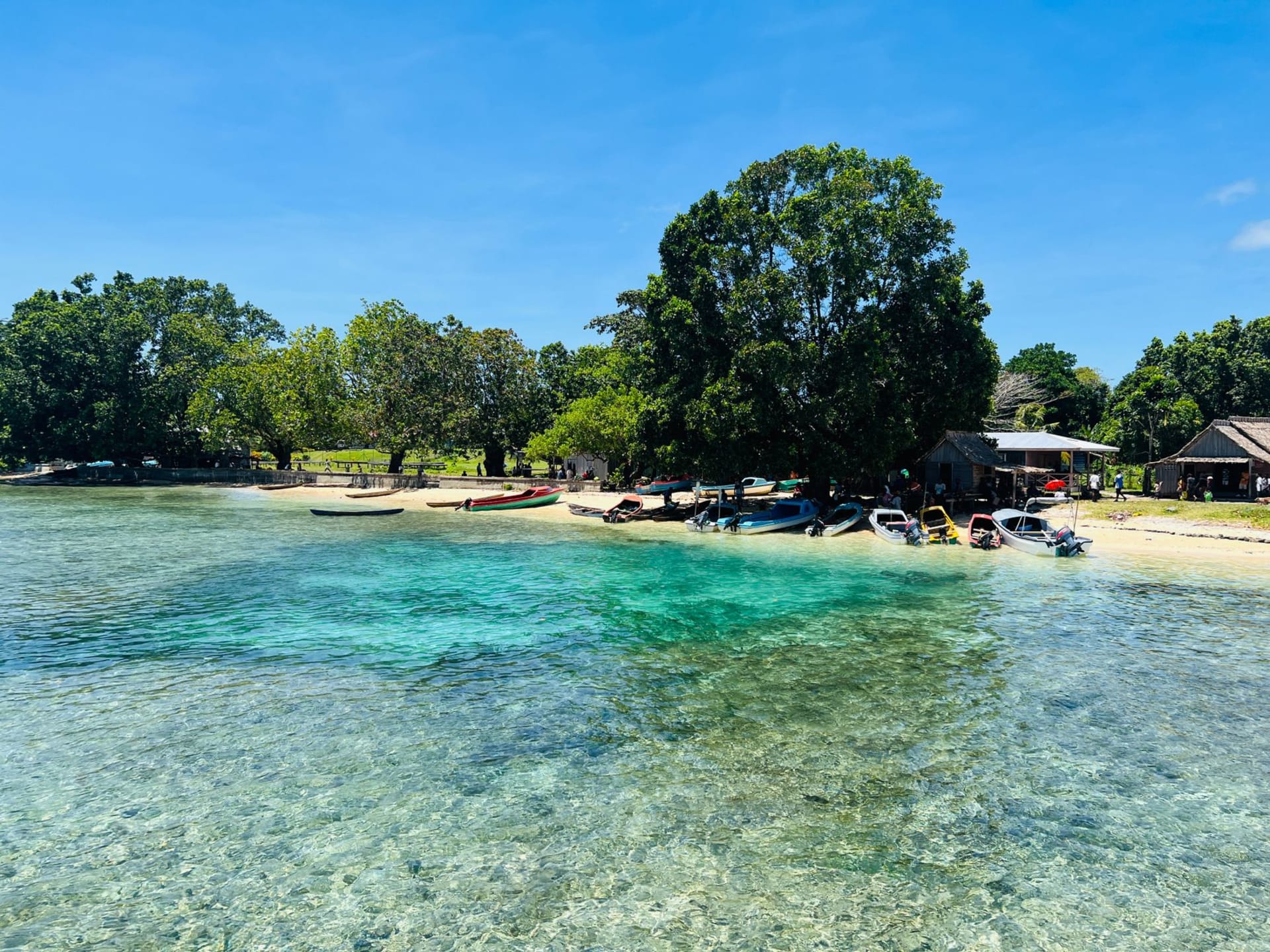
The canal between Santo and Aore Island has a quality of light in the late afternoon that I found myself going back to repeatedly. The water is the deep green-blue of deep things, and the palms on the far shore catch the low sun in a way that turns them briefly gold. There is a bar on the Luganville waterfront — concrete floor, plastic chairs, cold Tusker — where you can watch this happen while the fishing boats come in. I did this on my last three evenings and have no regrets.
Eating in Luganville
The Chinese restaurants along the main road do solid, cheap food. The market produces fresh vegetables and cooked snacks in the morning. There is a cluster of slightly more ambitious restaurants near the waterfront catering to the dive-tourist crowd — decent fish, good salads, the kind of place where you debrief your dive over two beers and talk to people who have just come from the same hole in the ocean as you.
When to go: Luganville and the Coolidge can be visited year-round, but April through November offers the best diving visibility and the lowest cyclone risk. The canal is diveable even during light rain — the wreck doesn’t care about the weather above the surface.