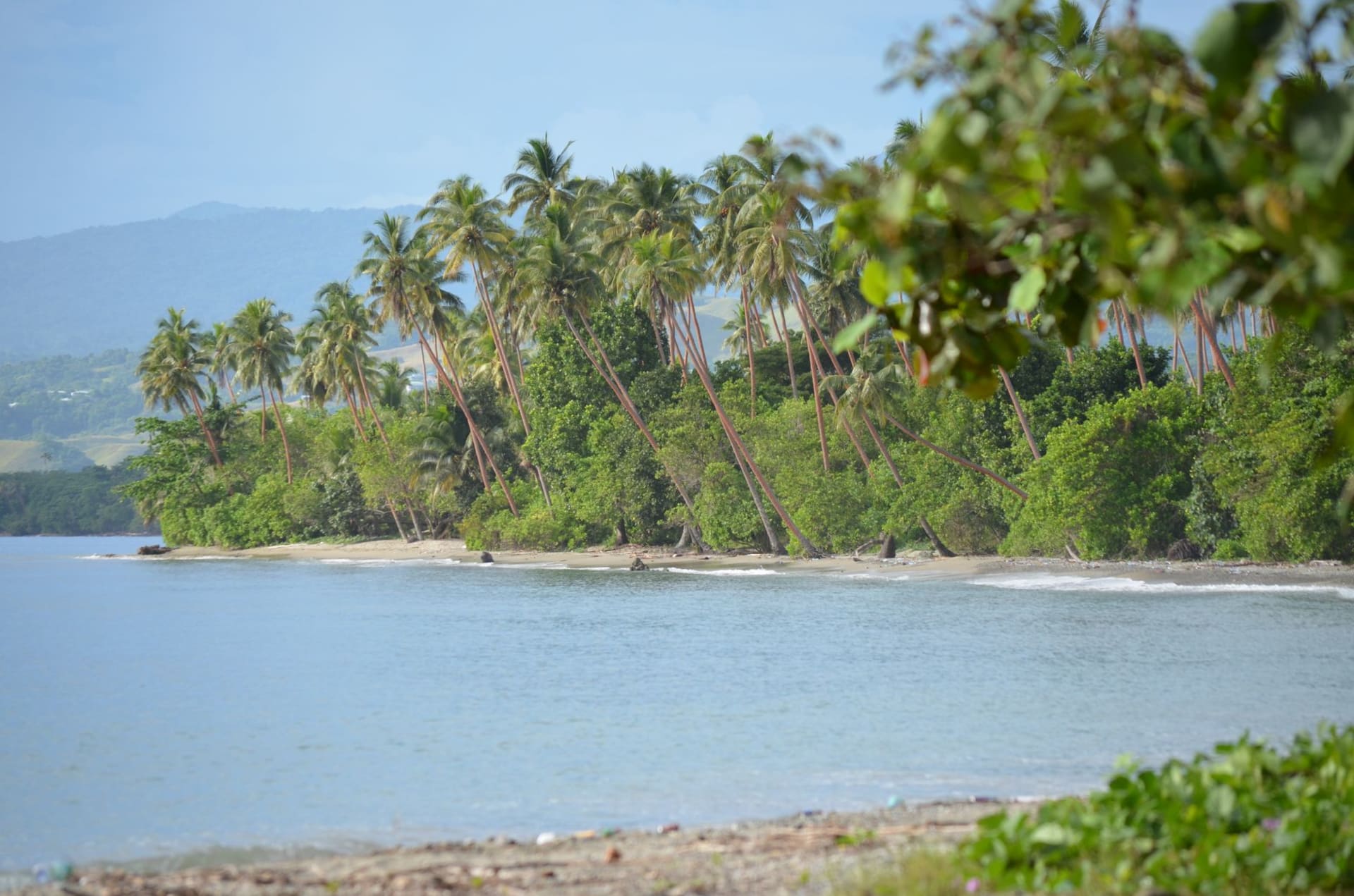
Espiritu Santo
"The sand was so fine it made noise when I walked on it — a faint squeaking, like new shoes."
Santo, as everyone calls it, is the largest island in Vanuatu and the one that contains the most concentrated argument for coming here at all. It has the best beach in the South Pacific — a claim I am making carefully, having spent enough time on beaches to distrust superlatives — and directly offshore from Luganville, at the bottom of sixty feet of warm water, sits the wreck of the SS President Coolidge, one of the great accessible dive sites on earth. The combination is almost unfair.
Champagne Beach
Champagne Beach is in the northeast of the island, a two-hour drive from Luganville on roads that transition gradually from paved to optimistic. The beach is long and curves in a gentle arc with sand the color of powdered sugar and the texture to match — it makes a faint squeak underfoot, the kind of sound that means the silica content is very high and the beach is genuinely extraordinary. The water is shallow for a long way out and transitions through four distinct shades of blue before hitting the reef.
A small fee is paid to the custom landowners when you arrive. There is a shack selling coconuts and cold drinks. There is very little else, which is exactly the point. I swam out past the sand bar and floated on my back looking at the clouds and felt with some certainty that I was in the right place.
The SS President Coolidge
The Coolidge was a luxury liner converted to a troopship that struck two American mines at the entrance to Luganville harbor in October 1942. She sank in about two hours, listing slowly enough that almost all the crew escaped. She now lies on her side in thirty to sixty meters of water, fully intact, still loaded with Jeeps, artillery pieces, gas masks, and personal effects. One stateroom has a mosaic on the wall — a ceramic deer in a garden — called “The Lady.” Finding it in the dark water is a kind of ritual.
I am a recreational diver with about fifty dives to my name. I hired a guide from one of the Luganville dive operations and went twice. The sheer scale of the wreck is what gets you first — you swim along a hull that stretches beyond the edge of visibility. Then the details accumulate: a row of helmets on a rack, a field gun, a cargo hold still filled with ammunition crates. The water is warm, the visibility is excellent, and the whole thing feels like swimming through a very expensive museum that no one locked properly.
Million Dollar Point
At the end of the war, the American military faced a choice: ship their surplus equipment back to the US, or sell it to the French and British colonial authorities who wanted it. When negotiations broke down over price, they drove it all into the sea — trucks, bulldozers, forklifts, Jeeps — in a gesture of magnificent pique. Million Dollar Point is now a shallow snorkeling and dive site covered in rusting American hardware. The scale of the waste is staggering. The fish don’t seem to mind.
Luganville
Luganville is the island’s main town and Vanuatu’s second city, which means it has one main road, several Chinese stores, a good produce market, and the kind of unhurried pace that feels like a physical property of the air. I ate excellent lap lap at a roadside spot every morning and spent evenings at the nakamal near the waterfront, where the kava was dark and serious and the conversation, once the kava hit, became slow and very honest.
When to go: April through November for diving and beach conditions. The Coolidge can be dived year-round but visibility peaks in the dry season. Cyclone risk is highest December through March.