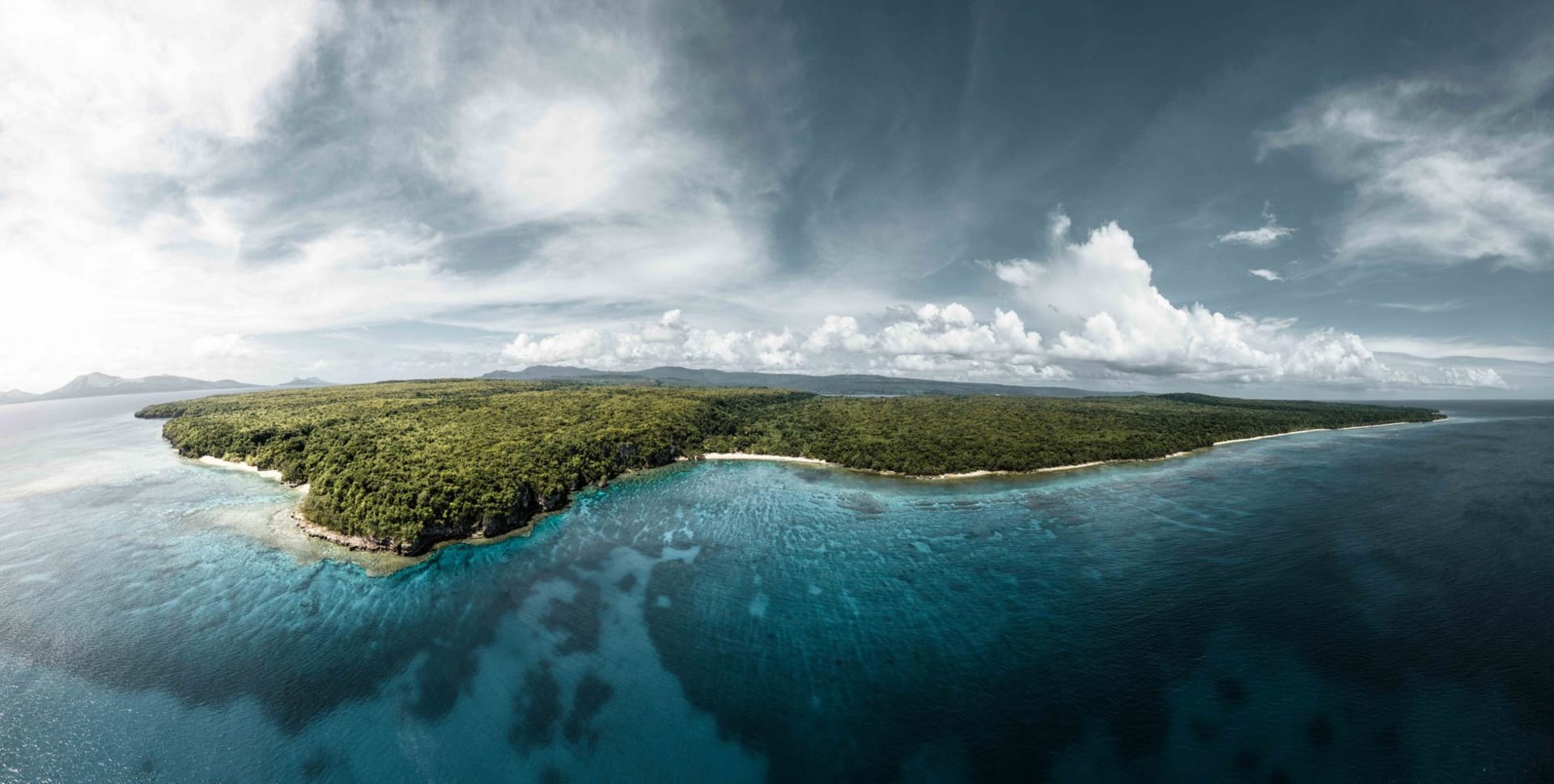
Banks Islands
"The pilot counted passengers twice, counted the bags, shrugged at neither, and took off into the cloud."
The Banks Islands lie at the northern end of the Vanuatu archipelago, close enough to the Solomon Islands that on a clear day you can see the arc of weather systems moving between them. There are six main islands in the group — Gaua, Vanua Lava, Santa Maria, Mota, Mota Lava, and Ureparapara — and between them they contain active volcanoes, lake systems hidden in calderas, waterfalls falling directly into the sea, and a total of roughly 12,000 people spread across villages that maintain some of the most intact traditional practices in the country. Tourist arrivals in the Banks, in a good year, are measured in the low hundreds.
Gaua
Gaua (also called Santa Maria) is the largest island in the Banks group and has one of the more extraordinary geographical arrangements I have encountered: a large freshwater lake, Lake Letas, sitting inside a volcanic caldera at 450 meters altitude, with an active vent — the Garet volcano — rising from the lake’s surface. The lake drains via a river that falls off the caldera rim in a 120-meter waterfall, the Siri Falls, which drops directly into the coastal forest below.
I reached the lake after a two-hour hike from the coast with a guide named Thomas, who was also responsible for his village’s kava garden and managed both responsibilities with equal seriousness. The lake surface, when we reached it, was olive-green and still, with a permanent column of white gas rising from the Garet vent in the center. Seabirds circled the vent at high altitude. The contrast between the steaming volcano and the flat water around it was completely unexpected.
Vanua Lava
Vanua Lava is the second-largest island in the Banks and has hot springs on its eastern coast where freshwater and seawater mix in pools at the sea’s edge — you can slide between hot and cold in about two meters of lateral movement. The island’s Sola village is the administrative center for the Banks group and has a simple guesthouse and a weekly plane service. From Sola, it is possible to organize boat transport to the smaller islands of Mota and Mota Lava, which have populations of a few hundred people each and no formal tourism infrastructure whatsoever.
Ureparapara
Ureparapara is the strangest-looking island in the group — the remnant of a massive volcanic caldera, partially collapsed, so that the sea has flooded one side of the crater to create a deep horseshoe bay. The island is perhaps four kilometers across and home to about 250 people. I had no particular reason to go there and went anyway, on a cargo boat from Vanua Lava that took seven hours and delivered me to a village that responded to my arrival with the pleasant bemusement of people who had not been expecting anyone.
I stayed two nights. The guesthouse was a room in someone’s house. The food was garden produce and fish. The village had a generator that ran for three hours in the evenings, during which everyone charged their phones and watched a single television together in a room with no chairs. On the second night they let me join them.
Getting North
The Banks Islands are served by Air Vanuatu twice weekly from Port Vila via Santo. The planes are small and the schedules are subject to considerable flexibility. Cargo boats run between the islands irregularly. The correct approach is to arrive with a loose itinerary and enough time to accommodate the reality of island time, which is not laziness but a different relationship to the value of waiting.
When to go: May through October for the driest and calmest conditions — the Banks sit in the cyclone belt and the wet season (November through April) makes inter-island boat travel genuinely risky. Gaua’s caldera lake and Siri Falls are best after recent rain, so early dry season is the sweet spot.