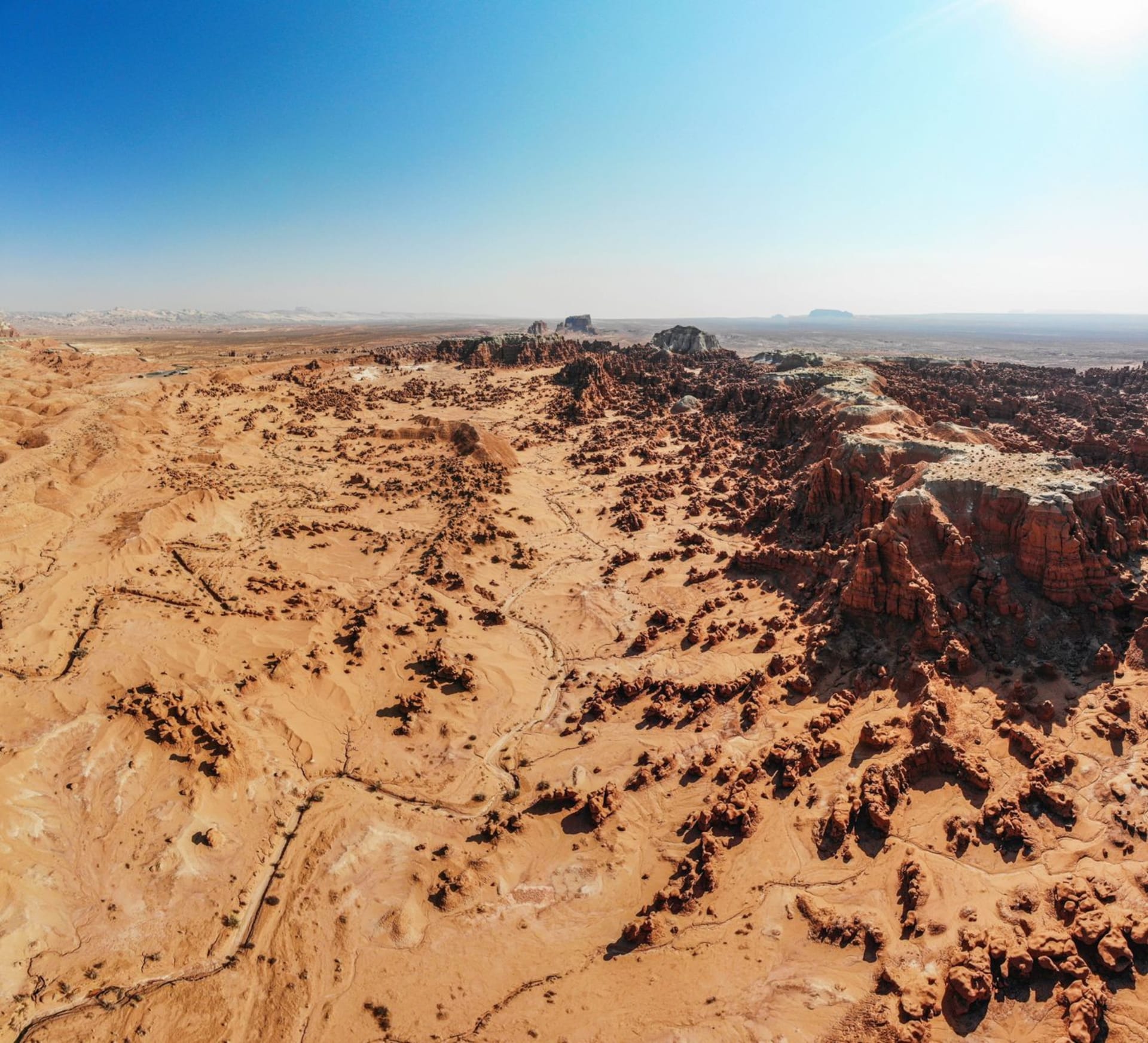
Goblin Valley & San Rafael Swell
"Goblin Valley is the only place I've been where children and geologists are equally delighted for different reasons."
Goblin Valley State Park is a detour you make because it’s on the way to Capitol Reef or the San Rafael Swell, and then it becomes the thing you tell people about first. The park is named for the Entrada sandstone formations that cover the valley floor — thousands of them, roughly human-height, smoothed by wind and water into rounded shapes that cluster and lean and occasionally look disconcertingly like they’re watching you. They’re not, obviously. But the valley has an atmosphere.
The defining feature of Goblin Valley compared to virtually every other geological attraction in Utah is that there are no designated trails on the valley floor. You walk among the formations freely, scrambling over them, ducking between them, sitting on them, eating your lunch with your back against one that’s roughly the shape of a mushroom with ambitions. This is rarer than it sounds in a landscape of heavily managed parks.
The Valley Floor
I spent three hours on the valley floor and covered maybe a quarter of it. The goblins — the park’s own name for the formations — vary from knee-height to twenty feet, and the light between them in mid-morning creates a maze of shadow and rust-orange that plays with scale constantly. Walk fifty meters from the observation deck and the formations are suddenly in all directions, equal height to your eyes, and the parking lot is invisible. The disorientation is gentle and pleasant.
Lia found one formation that looked exactly like a sitting figure with its hands on its knees and spent ten minutes photographing it from every angle. I found the whole section near the three buttes called The Sentinels — larger formations at the valley’s southern end — where you can climb to a flat-topped section and look back at the goblin field spread below. The scale from above is completely different from the scale within it.
The San Rafael Swell
The San Rafael Swell is a massive dome of eroded sandstone covering roughly 75 miles in diameter in central Utah — a landscape of canyons, mesas, and reefs that makes up what many experienced Utah travelers consider the state’s best-kept secret. It sits north and west of Goblin Valley, mostly undeveloped, managed jointly by the Bureau of Land Management and no particular tourist infrastructure.
The Swell rewards anyone with a high-clearance vehicle and a tolerance for dirt roads, a paper map (cell service is nonexistent), and the kind of patience that knows what to do with an empty afternoon. The Little Wild Horse Canyon slot canyon, accessible without permits from a trailhead on the Swell’s edge, is a six-mile loop through narrows that rival Zion’s Narrows in drama but typically host a fraction of the visitors.
Little Wild Horse Canyon
The name is better than it deserves to be and the canyon itself is better than the name suggests. The narrows sections require mild scrambling — over boulders, through water in wet seasons — and the walls close to shoulder-width in places. I did the full loop solo in a half day, meeting perhaps twelve other hikers total, which by Utah national park standards felt practically solitary.
The canyon opens into Bell Canyon for the return half of the loop, wider and more open, with flat sandstone slabs to rest on and a view of the Swell rising to the south that gives the whole excursion a sense of geographical context missing from slot canyon walls.
Camping Under Actual Dark Sky
The state park campground at Goblin Valley is small but positioned so that a walk to the valley edge at midnight puts you above the goblin formations with approximately zero light pollution. I did this once and sat on a sandstone ledge for an hour watching the Milky Way arc over the formations below. The goblins at night, lit only by starlight, are shapes in darkness that shift slightly as your eyes adjust. It was unsettling in the best possible way.
When to go: March through May and September through November. Goblin Valley is accessible year-round, but summer temperatures in the valley reach 40°C and the lack of shade becomes significant. Spring wildflowers appear in April on the surrounding mesas. The San Rafael Swell roads can become impassable with flash flooding — check conditions with the BLM office in Price before any dirt-road excursion.