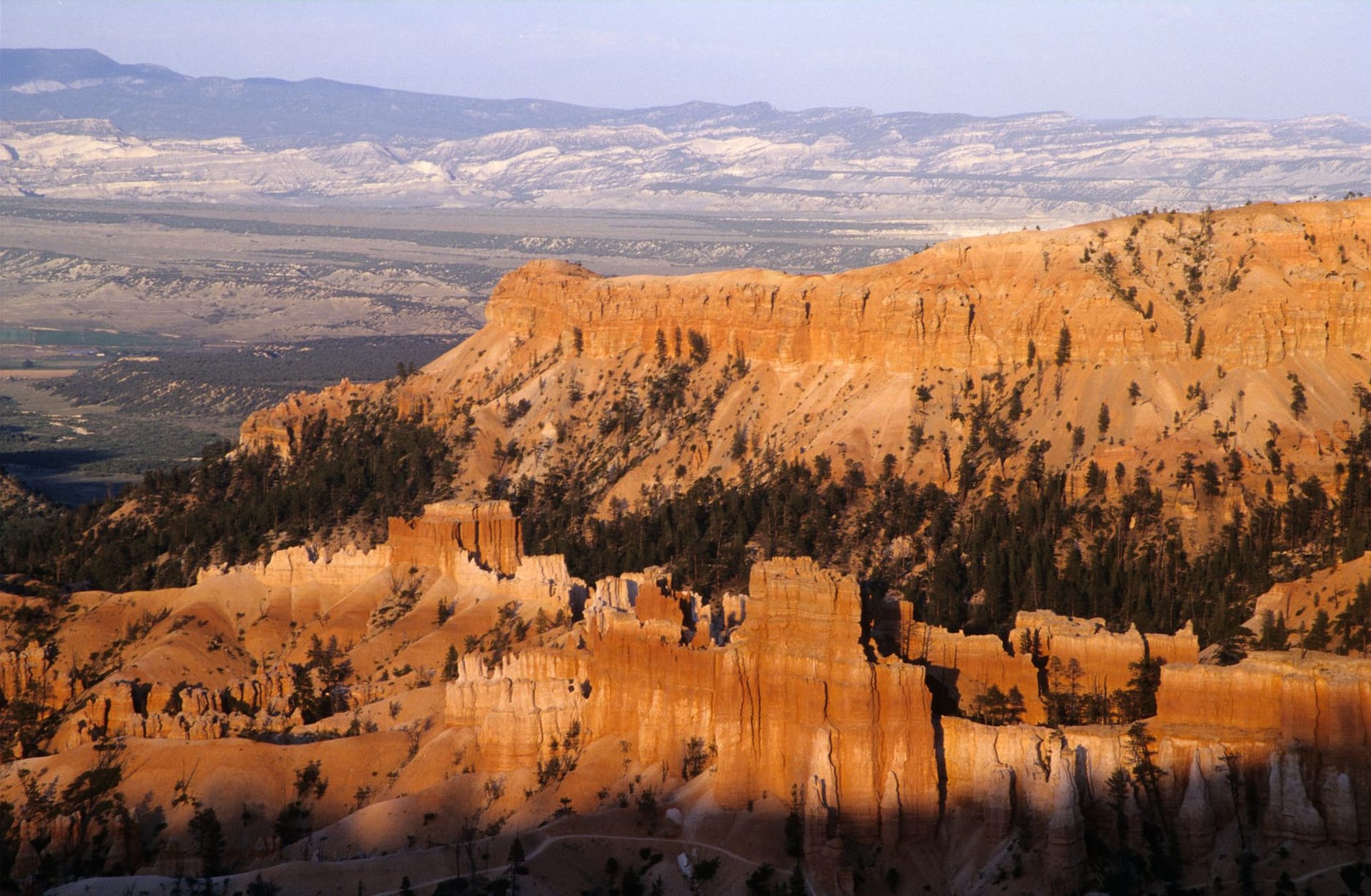
Bryce Canyon National Park
"Standing at the rim, I felt certain someone had glued this landscape together from a dream I'd half-forgotten."
Bryce Canyon is not technically a canyon. It’s a series of natural amphitheaters carved into the edge of the Paunsaugunt Plateau, and the rock formations inside — called hoodoos — are the result of frost wedging and erosion working on limestone over millions of years. I’m sharing this not because the geology matters to the experience, but because I kept repeating it to myself at the rim, trying to ground myself in something rational while the landscape in front of me was doing everything it could to resist rational explanation.
The colors are the first problem. I’ve seen red rock in Mexico, in Sardinia, in Morocco. Bryce is something else — a palette that runs from cream to pale pink to deep rust to an almost purple-orange, all in the same spire, all shifting as the angle of light changes across the day. We arrived at Bryce Point at 7am with coffee still warm in our hands and watched the amphitheater below us turn from grey shadow to something incandescent in about twelve minutes.
On the Rim
The Rim Trail connects the main viewpoints along the canyon edge for about eleven miles, though you can do the essential stretch — from Fairyland Point south to Bryce Point — in a more manageable section. What I’d do again: walk the rim in the morning light, find a bench at Inspiration Point, and just sit. The wind at the plateau edge comes in cold even in September and smells faintly of pine, and the hoodoos below catch shadow in ways that make them look like they’re moving.
Sunset Point at — unsurprisingly — sunset is genuinely worth the effort even though it sounds like a trap for tourists. The low angle turns everything amber and then, for about four minutes before the sun drops below the horizon, briefly coral. I’ve taken worse photographs in my life.
Into the Amphitheater
The Navajo Loop and Queen’s Garden trails drop you down into the hoodoos themselves, which completely changes the experience. From the rim they look small and decorative. Walking among them, you realize they’re taller than buildings, and the narrow passages between them funnel the wind into something that sounds almost like voices.
The Queen’s Garden trail is the gentler option — longer but less steep — and it connects with the Navajo Loop to make a circuit that takes about two to three hours. The Wall Street section of the Navajo Loop passes through a slot barely wide enough for two people walking abreast, with Douglas fir trees growing impossibly from the canyon floor. Worth every step down, which means worth every step back up.
After Dark
Bryce sits at over 8,000 feet elevation and has minimal light pollution. The park runs ranger-led stargazing programs, but even without the program, the sky on a clear moonless night is staggering. I walked out to the Sunset Point rim after dinner one evening and stood there long enough that my eyes fully adjusted, which takes longer than you think, and longer than most people are willing to wait. Wait anyway.
The Milky Way arc over the hoodoos is the kind of image that doesn’t fully photograph but lives very cleanly in memory.
When to go: Late spring (May–June) and early fall (September–October) offer mild temperatures and manageable crowds. Winter is genuinely spectacular — the hoodoos capped with snow against a blue sky is iconic — and snowshoe rentals are available at the visitor center. Avoid July and August unless you arrive before 8am and leave by noon; the rim parking lots fill completely by mid-morning and the shuttle becomes mandatory.