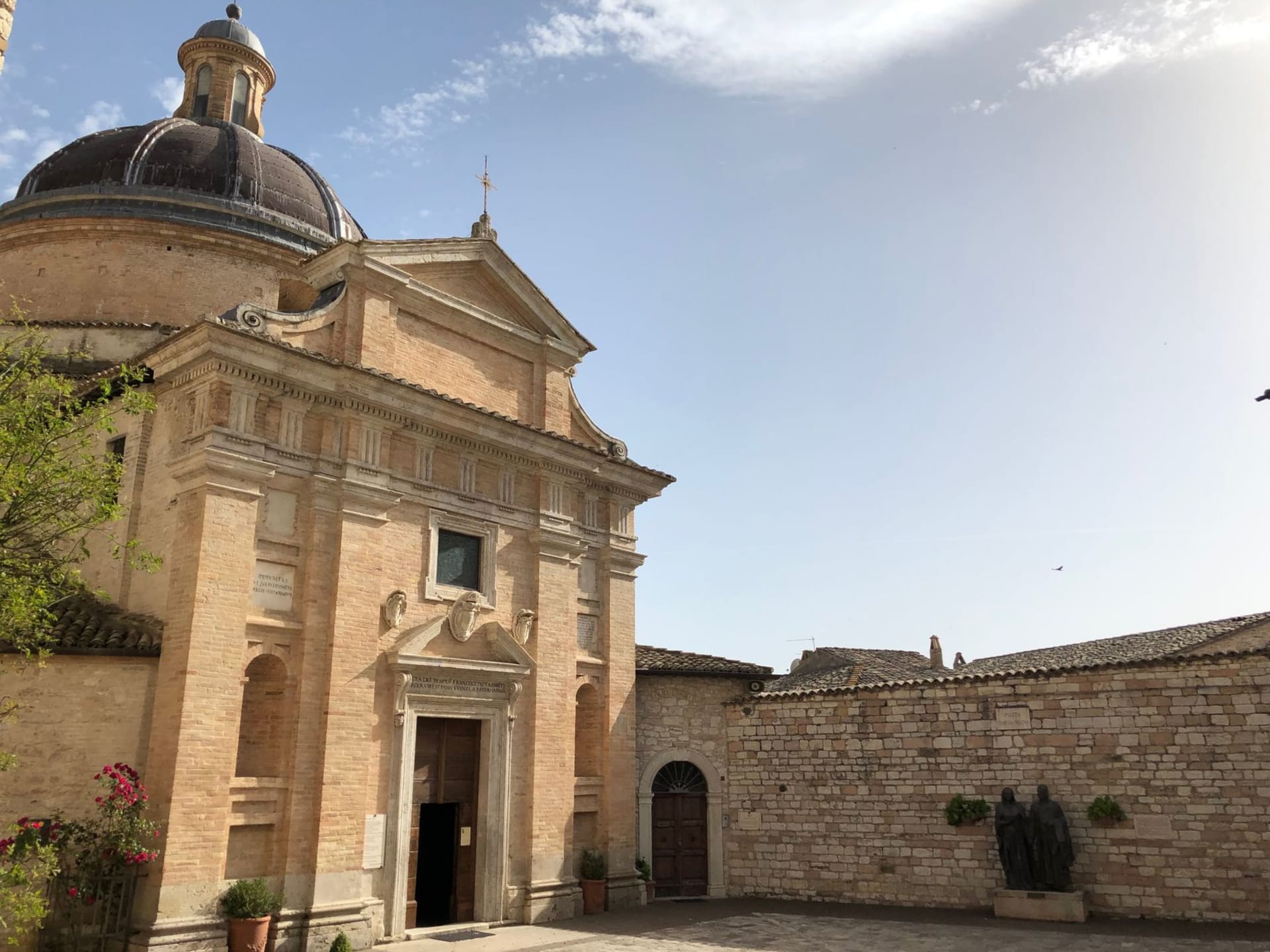
Todi
"The piazza is so well-calibrated that standing in it feels like an argument for medieval urban planning."
In 1990, a Kentucky professor published a study ranking Todi as the world’s most livable city. The claim was immediately questionable and permanently attached to the town’s identity. Todi itself seems mildly entertained by this. The people who actually live there are largely concerned with the same things people in small Italian hilltowns have always been concerned with: coffee, local politics, the quality of that year’s olive oil. The piazza is excellent regardless of any ranking system.
The Piazza del Popolo
The civic center of Todi is one of the most coherent medieval piazzas in Italy — three Gothic palaces arranged around the cathedral steps with a spatial logic that feels deliberate in retrospect and, at the time it was built, probably felt inevitable. The Palazzo del Capitano and Palazzo del Popolo are connected by an external staircase and together form a facade of Gothic arches that frame views over the valley. On the morning I arrived, a produce market was dismantling itself from the lower piazza, the vendors wrapping unsold fennel in newspaper, and the whole square smelled of earth and cut herbs.
Views Over the Tiber Valley
Todi’s position above the Tiber gives it views in three directions, and the various belvederes around the upper town present them with different emphasis. The best is from the public gardens above the town, where the valley appears as a wide agricultural basin with the river threading through it, lined with Lombardy poplars and scattered farmhouses. From here Umbria’s green-and-gold palette makes a kind of sense that it doesn’t when you’re in the middle of it. I sat there for longer than I planned. Lia was reading; I was watching a hawk circle something in the valley a long way below.
Santa Maria della Consolazione
A five-minute walk below the old walls brings you to a Renaissance church that the architectural historian Rudolf Wittkower called one of the most perfect examples of Renaissance ecclesiastical design. It was begun in 1508 and not completed until 1607, which perhaps explains its unusual self-containment — a Greek-cross plan with four apses and a central dome, standing alone in a grove of trees outside the town, as if it needed distance from the medieval city to be properly itself. The interior is whitewashed and severe. The proportions are correct in a way that takes a moment to register and then is impossible to ignore.
Living Slowly in a Small Town
Todi has positioned itself — partly accidentally, partly with the cynical savvy of a town that read the livability coverage — as a place for the considered life. There are good restaurants, a handful of excellent small hotels, and wine from the surrounding Todi DOC zone that doesn’t receive the attention it deserves. I stayed two nights, which is one more than most visitors manage, and the second day moved differently than the first: I knew which bar made the better macchiato, which route from the parking area to the piazza passed the view I liked best, which restaurant had the shorter menu that meant someone was paying attention to what was in season.
When to go: May and September are ideal — mild, uncrowded, and the valley light is good for most of the day. The Todi Arte Festival in late July and August fills the piazza with theater and music. Olive harvest runs October into November; the new oil arriving in restaurants is worth timing around. December and January are quiet and cold, which is its own valid reason to visit.