Spello
"I've seen a lot of flower-decorated Italian towns. Spello made the others feel like an approximation."
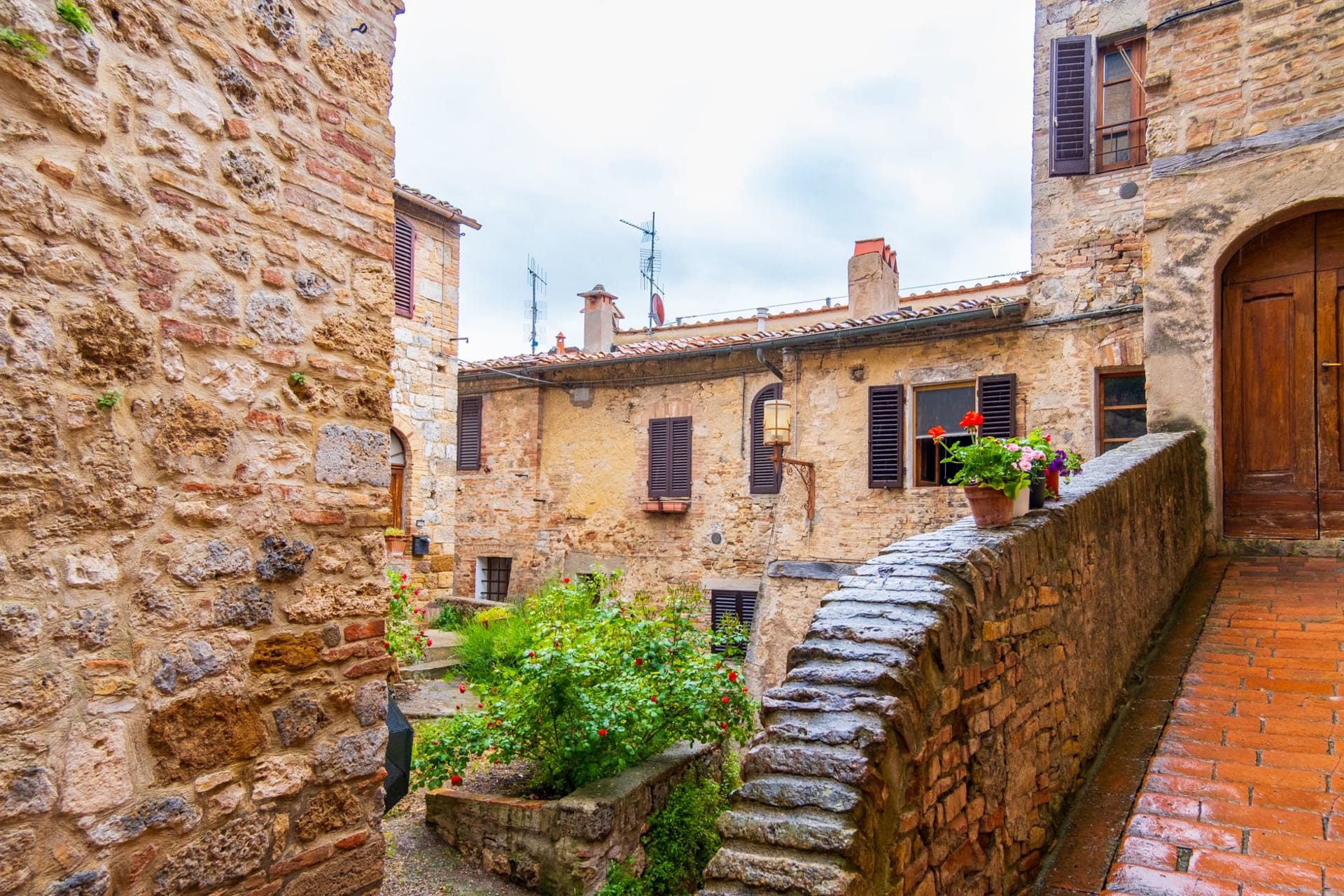
Every Italian hilltown has flowers. Spello has made flowers into a municipal obsession that borders on competitive. The lanes of the upper city are lined with terracotta pots and hanging planters maintained by residents with the seriousness of a regulated sport. In late May and early June the Infiorata transforms the main street into a flower-petal carpet — designs laid in jasmine, broom, rose petals, and whatever else happens to be blooming — that is frankly preposterous in scale and beauty. I was there in October, when the flowers were thinning out and the vines on the stone walls had gone red, and I still couldn’t stop taking pictures of doorways.
Roman Infrastructure Still in Use
Spello was a Roman colony called Hispellum, and the evidence hasn’t gone anywhere. Three Roman gates remain intact: the Porta Consolare, still the main entrance from the valley, with a first-century relief of toga-clad figures carved above the arch; the Porta Venere, flanked by two intact cylindrical towers; and the Arco di Augusto, which has been folded into the city wall so completely you might walk under it twice before registering what you’re passing through. The Roman road from Porta Consolare runs straight uphill and becomes the main medieval street — eleven centuries of different paving stones laid over the same Roman route.
The Pinturicchio Chapel
The Collegiata di Santa Maria Maggiore holds the Chapel of the Magi, painted by Pinturicchio between 1500 and 1501. Pinturicchio worked at the Vatican, painted for popes, and produced frescoes across Umbria that have been quietly extraordinary for five centuries. This chapel is his and it’s in Spello, which is the kind of geographical fact that keeps rewarding travel in this region: the best thing in a town isn’t always in the most famous town. The Sibyl in the annunciation scene, the naturalistic landscape details in the Nativity, the portrait of Pinturicchio himself among the Magi — all of it painted in a room the size of a medium living room in a town of three thousand people.
The Walk Up to Sant’Andrea
From the upper reaches of the town, a path climbs through olive groves toward the Romanesque church of Sant’Andrea and then continues up Monte Subasio toward Assisi. I didn’t go all the way — just far enough to clear the last rooftop and see the valley open below: the railway line cutting across the flat, Assisi visible on its own ridge further north, the green and grey geometry of the agricultural plain. The olive groves this high still had fruit on them in October, and the light through the leaves was the particular silver-green that means Umbria regardless of what the map says.
Staying Small
Spello has enough good accommodation and restaurants to justify a night, and the Umbrian plain is easy to traverse — Assisi is fifteen minutes away, Perugia forty. The cucina is straightforwardly Umbrian: thick pasta, good olive oil, truffle when it’s in season. I ate well at a place on the main lane that had been there long enough to trust the regulars over the menu. The house wine was from local grapes I didn’t recognize. I didn’t need to.
When to go: The Infiorata in late May or early June is singular — book accommodation weeks ahead. April is the quiet alternative: flowers starting, no festival crowds. October for the vine colors and olive harvest, when the whole slope of Subasio goes amber. Avoid August weekends when Perugia empties toward the hilltown.