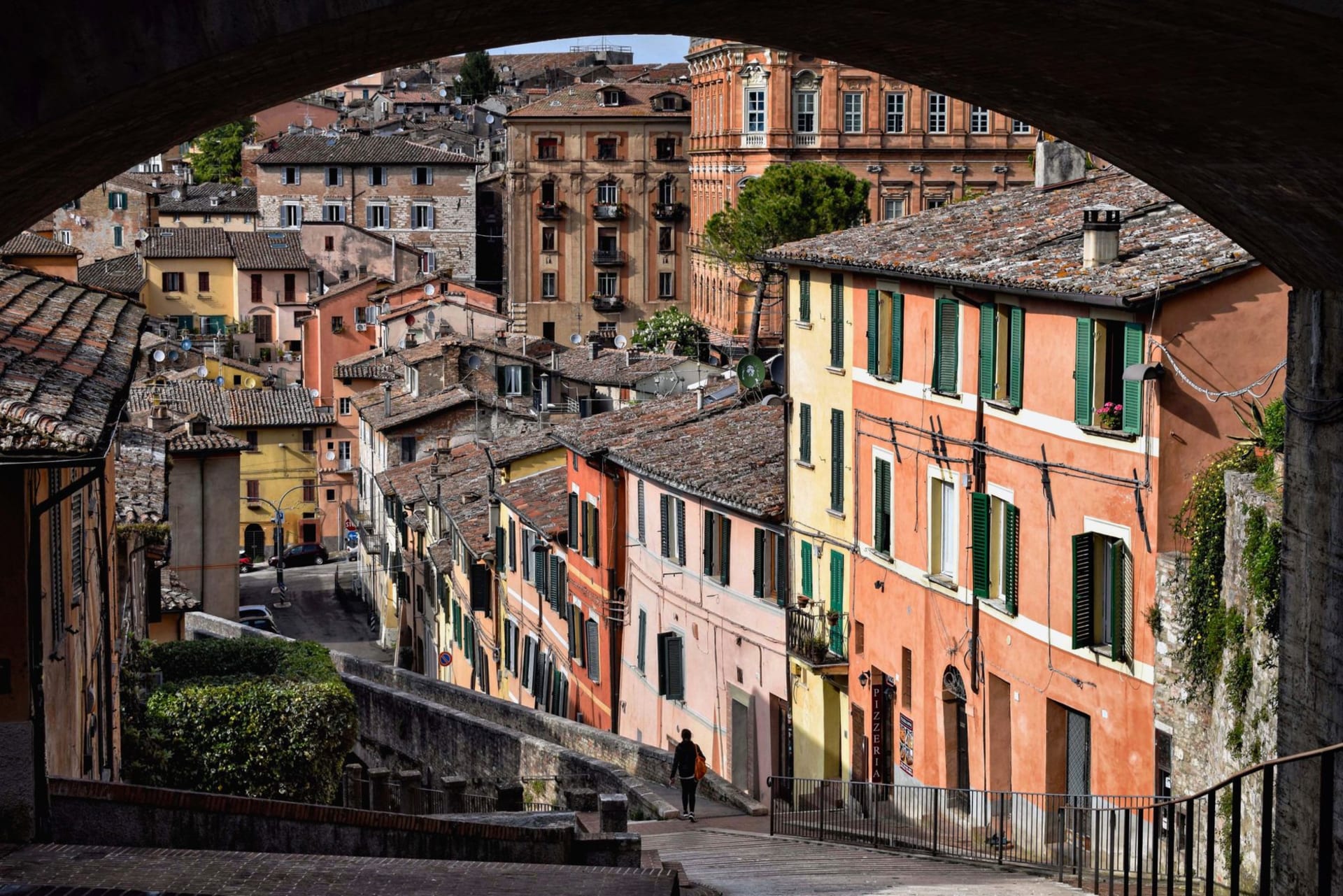
Perugia
"The best espresso I've had in Italy came from a bar with no name, wedged between two Etruscan stones."
Perugia sits on a ridge like something assembled over a very long argument — layers of Etruscan, Roman, medieval, and Renaissance architecture stacked so densely that you lose track of which century you’re walking through. I arrived by train, took the escalator that tunnels up through the old city’s underbelly, and emerged blinking into a piazza that felt less like tourism and more like actual life happening at an inconvenient altitude.
The Corso and the Piazza
The main street, Corso Vannucci, is the kind of pedestrian spine that Italian cities do better than anyone: wide enough for evening passeggiata, flanked by palaces housing banks and pastry shops in equal measure. It dead-ends at Piazza IV Novembre, which is where I spent most of my first afternoon. The Fontana Maggiore sits in the center, a 13th-century sculpted basin that looks too delicate for the centuries it’s survived. Lia traced the carved reliefs while I ate a porchetta sandwich from a stand nearby, the fat still warm, the herbs aggressive in the best way.
Etruscan Bones
Beneath the medieval city there’s an older one. The Rocca Paolina, a fortress the pope built by literally entombing an entire medieval quarter, now contains those same streets preserved in eerie suspension — arches, doorways, staircases going nowhere. Walking through it feels like an architectural autopsy. Then there’s the Etruscan Arch, a gate so massive it makes the buildings around it look provisional. Perugia has always sat on top of something older, and it doesn’t bother hiding this.
Università per Stranieri Energy
Perugia’s foreigners’ university fills the city with students learning Italian from every country on earth. The result is a strangely cosmopolitan energy for a hilltop Umbrian town — bars open late, a mix of languages in the piazzas, a general sense that the evening hasn’t peaked by nine. I found this refreshing after weeks of towns that felt preserved for visitors but not quite inhabited. Here people were arguing in bad Italian, falling in love badly, eating at weird hours. It felt real.
Chocolate and the Long Descent
The city produces Perugina chocolates — Baci, specifically — and the October chocolate festival takes over the entire corso for a week. Outside festival season, the shops along the main drag still sell them by the bag, and I bought more than I needed. The descent back to the train station, via the long medieval passageway, is one of those transitional experiences that makes arriving feel earned. Umbria appears in the distance: green hills, distant hilltowns, the whole region laid out like a proof that some places really do look like their postcards.
When to go: April through June for mild weather and uncrowded streets. October brings the Eurochocolate festival — chaotic and worth it. Avoid August when the university is empty and heat makes the stone city swelter. November and March are underrated: the light goes golden and the bars are full of locals.