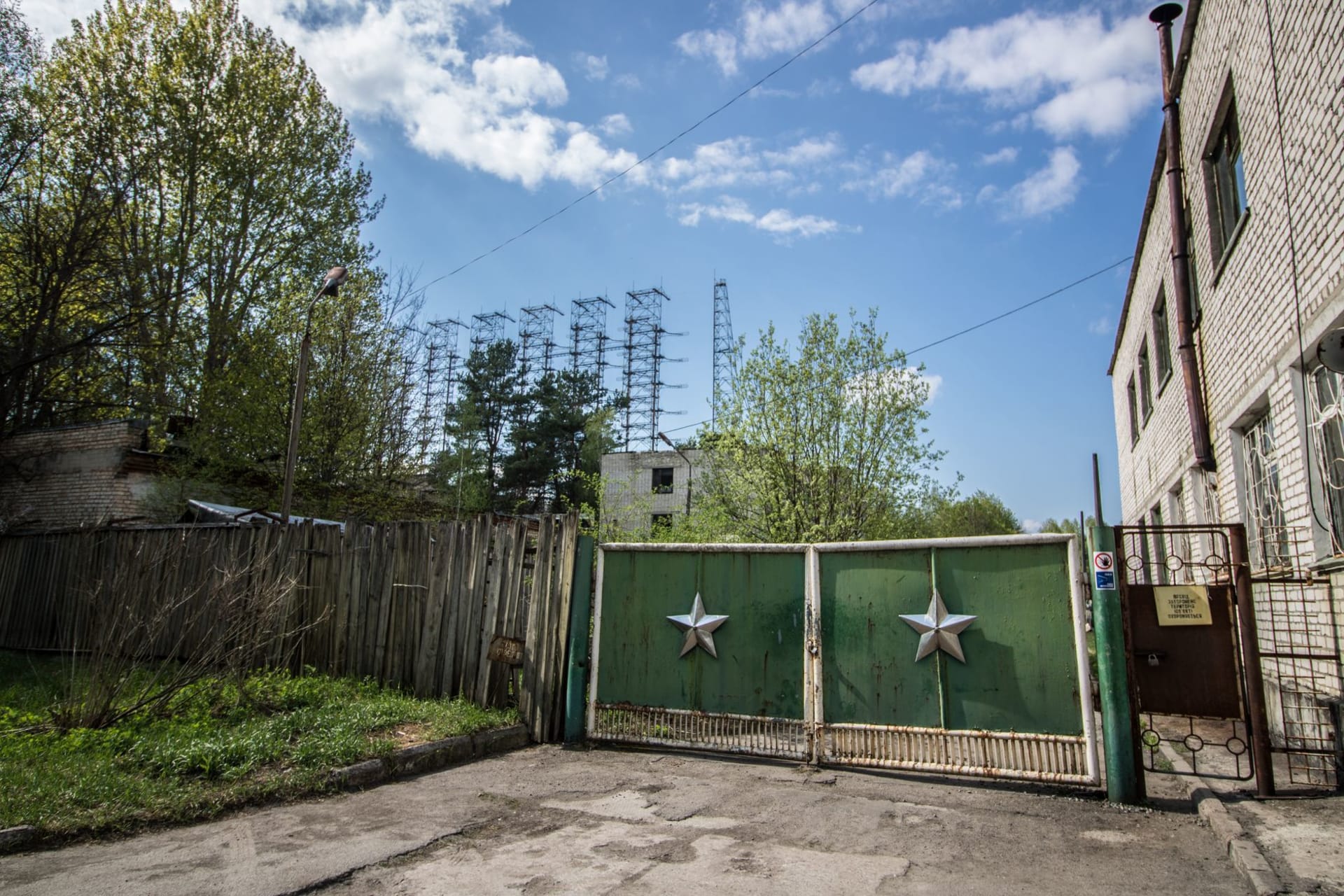
I went to Chernobyl because I was curious and stayed uncomfortable the whole time, which I think is the honest outcome of this kind of tourism. The exclusion zone around Reactor No. 4 — the 30-kilometer ring that was evacuated in 1986 after the explosion and fire — has been opened to guided tours since the early 2000s, and the volume of visitors has increased substantially since the HBO series aired in 2019. Going now means going with a crowd, which changes the experience in ways worth thinking about before you book.
The Zone and What It Feels Like
The checkpoint at Dytyatky marks the boundary. You surrender your passport, sign a document acknowledging radiation risk, and drive into a landscape that reads, from the bus window, as simply rural Ukraine: birch and pine forest, overgrown fields, a two-lane road in reasonable condition. The Geiger counter your guide carries provides a running soundtrack. Background radiation in most of the zone is low — elevated but not dangerous for a day visit — and the guide tracks it with a practiced nonchalance that is both reassuring and faintly theatrical.
The Reactor and the New Safe Confinement
The sarcophagus — now enclosed in the vast steel arch of the New Safe Confinement, completed in 2016 — is visible from a designated viewing area roughly three hundred meters from the reactor building. At that distance it reads as industrial architecture, enormous and grey. The scale of the containment structure is hard to process; it was built to cover the original concrete sarcophagus and is large enough to enclose Notre-Dame de Paris. I stood there for a long time trying to feel the appropriate gravity of the thing and felt mostly the gap between the physical scale and the cognitive scale of what the building represents.
Pripyat
Pripyat is why people come. The Soviet model city built to house Chernobyl’s workers — completed in 1970, population 50,000, evacuated in 1986 in thirty-six hours — has been in the process of returning to forest for four decades. The results are photogenic in a way that creates its own ethical ambiguity: the fairground (never opened — the inaugural May Day festival was cancelled by the explosion), the hotel lobby, the indoor swimming pool, the school with textbooks still on the desks — all of it constitutes an involuntary museum of a specific moment in Soviet life. Walking through the school hallway with gas masks scattered across the floor, I felt simultaneously the genuine weight of the history and the discomfort of finding it aesthetically compelling.
The Ethical Weight of Visiting
I don’t think tourism to Chernobyl is inherently wrong, but it asks for something more than the usual tourist attention. The people who lived in Pripyat didn’t choose to become a museum exhibit. The liquidators who died cleaning up the disaster didn’t consent to dark tourism. The local guides, many of whom have deep personal connections to the zone, navigate this with a seriousness that the visitor should try to match. Avoid the posed Instagram shots in the kindergarten. Listen to the briefings. Let it be uncomfortable.
When to go: Tours run year-round from Kyiv, typically as day trips (five to six hours there and back) or overnight excursions. Spring and autumn offer the most photogenic conditions — in spring the undergrowth is still low and the structures are fully visible; in autumn the birches turn gold against the concrete ruins. Summer can be oppressively overgrown. Book with a licensed operator and check current zone access regulations, which change periodically.