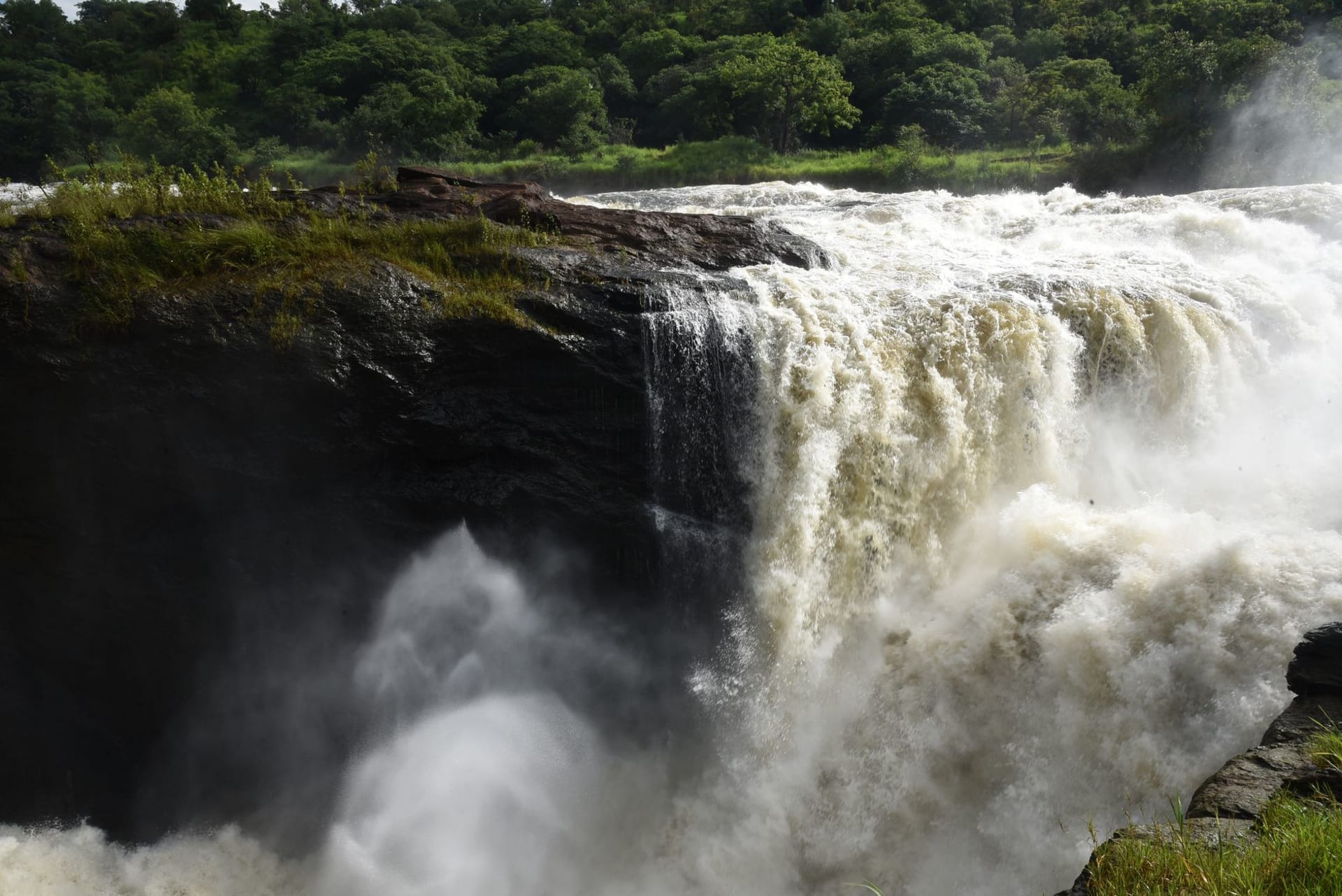
Murchison Falls
"I had read 'the world's most powerful waterfall' so many times the phrase had stopped meaning anything. Then I stood twenty meters from the gap."
Ernest Hemingway survived two plane crashes near here in 1954. The second one involved Murchison Falls itself — the rescue plane taking him to medical care clipped a telegraph wire on takeoff and burned. He walked away from both, apparently drank a beer, and then spent years telling people about it. Standing at the top of the falls, watching the Nile force itself through a crack in the earth only seven meters wide, I thought: yes, this is the kind of place that leaves a mark on people.
The Falls Themselves
Murchison is not the tallest waterfall in Africa, not even close. What it is, is violent. The Victoria Nile, carrying the full drainage of Lake Victoria, reaches this point in northern Uganda and finds a fault in the rock that allows only seven meters of passage. Everything that doesn’t fit becomes spray and thunder that you feel in your molars. The top viewpoint is a short walk from the park road and offers a view of water hitting the plunge pool below with what I can only describe as an attitude. A rainbow appears most mornings in the mist, which feels almost too on-the-nose.
The boat trip from Paraa up to the base of the falls is one of the better half-days in East African travel. Hippos surface on both banks in numbers I hadn’t expected — thirty, forty at a time in certain pools. Nile crocodiles lie on sandbars with the expressionless patience of creatures that have been winning for 200 million years. Elephants sometimes come to the water’s edge in the late afternoon. The guide on our boat called the names of the birds calmly and without showmanship: African fish eagle, goliath heron, giant kingfisher.
The Park Beyond the River
Murchison Falls National Park is Uganda’s largest and contains savanna, woodland, and riverine forest in roughly equal proportion. The northern bank of the Nile is where most game drives happen, and the animals here — Uganda kob, topi, giraffe, lion, leopard — operate on a completely different spatial scale than the gorilla or chimp encounters in the south. This is big-sky Africa: flat light in the morning, red dust, the smell of dry grass warming.
The Budongo Forest Reserve, which connects to the park’s southern edge, is less visited and has one of Uganda’s best chimpanzee populations. It functions as a day trip from Paraa camp and pairs well with the northern game drives as a counterweight — dense forest versus open plain, chimps versus lions, green versus gold.
Getting Oriented
Paraa is the main camp hub on the north bank, reachable by a small ferry that crosses the Nile and runs on a schedule that feels approximate. The drive from Kampala is five to six hours on tarmac that turns to red murram after the town of Masindi. The road from Masindi is rough but passable in a standard 4WD.
Flying is a reasonable option — there’s an airstrip at Pakuba and another near Chobe on the northern boundary. Several lodges operate their own light aircraft transfers from Entebbe.
When to go: The dry seasons of December through February and June through September are best for game viewing — grass is shorter, animals concentrate near the river, and the park roads are more passable. The boat trip runs year-round, but the Nile is highest and brownest during the April–May and October–November rains.