Kidepo Valley
"Six hours of bad road from the nearest proper town, and then the valley opened up and I understood why people make this drive."
The consensus among Ugandan wildlife guides is that Kidepo Valley is the best park in the country. They say this carefully, aware that it contradicts the marketing material, which focuses on gorillas and Murchison, but they mean it. The combination of remoteness, landscape, animal density, and the near-absence of other tourists creates a wildlife experience that has a different quality from the more visited parks — more immediate, less mediated, less likely to have another vehicle parked at the same sighting.
Getting There
Kidepo is in Karamoja, Uganda’s northeastern region, which spent decades in conflict and poverty that kept it off most itineraries. The road from Kampala to Kidepo is roughly 700 kilometers, takes nine to ten hours on a good day with a 4WD, and passes through terrain that shifts from lush central Uganda to a progressively drier, browner landscape as you climb into the north. The last two hours through Moroto to Kaabong are on road that earns the word “road” only on technicality.
Flying is the sane option: there are scheduled and charter flights to Apoka airstrip inside the park from Kampala’s Kajjansi airfield. They take 90 minutes and land you directly in the kind of landscape that takes an hour to adjust to.
The Landscape
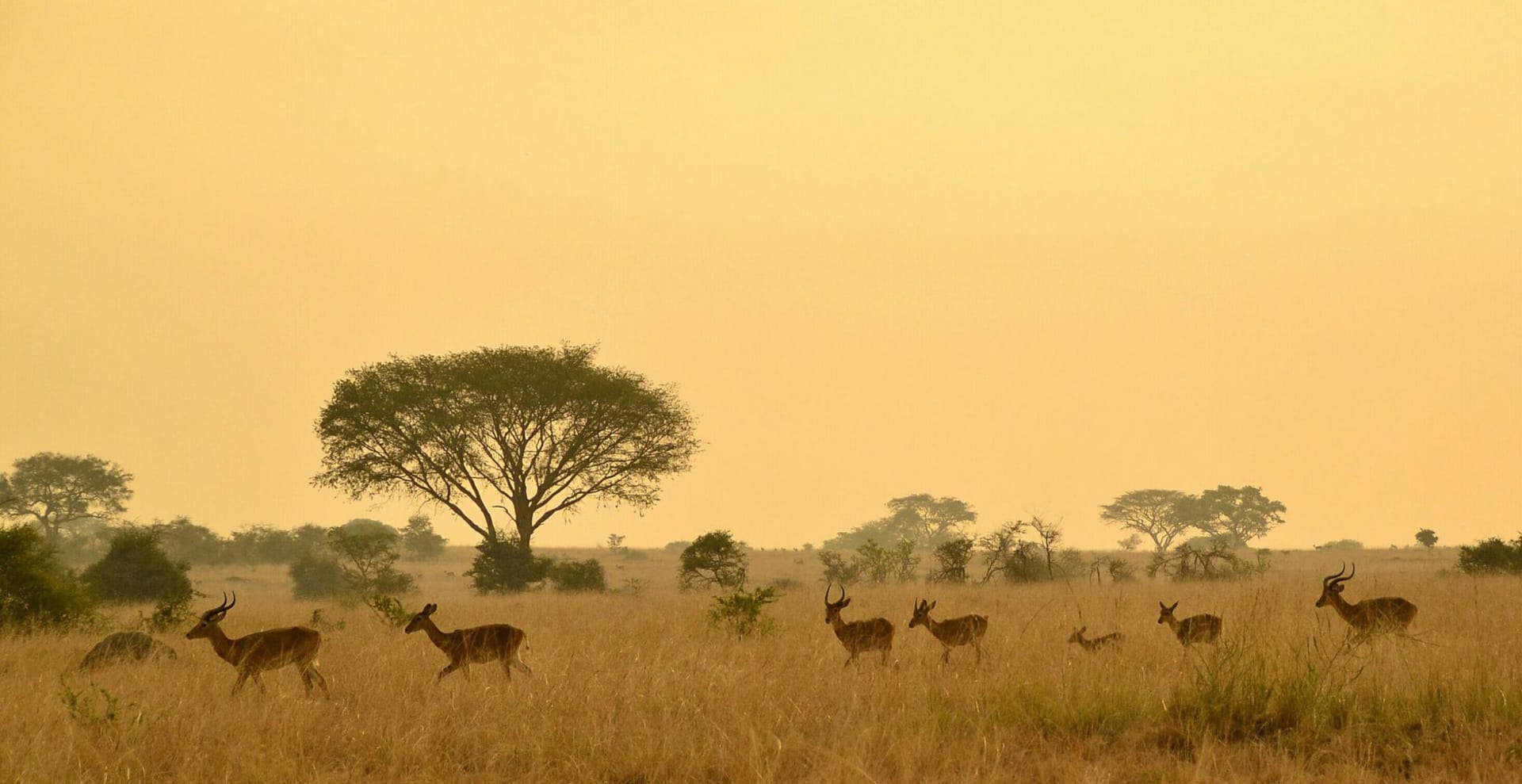
Kidepo Valley is semi-arid and feels unlike the rest of Uganda in ways that go beyond climate. The mountains on the South Sudanese and Kenyan borders form distant walls on three sides, making the valley feel enclosed despite its vastness. The vegetation is sparse enough that animals are visible from distance, silhouetted against dry grass and flat-topped acacia. Cheetah are present in numbers not found elsewhere in Uganda. Ostrich, which disappeared from the rest of the country, still exist here. The lions of Kidepo have a reputation for being bold and apparently undeterred by vehicles.
Dawn drives here have a quality I find hard to describe without sounding like the word “spiritual,” which I’m reluctant to use. The light comes up flat and golden over the valley and everything it reveals — a herd of Jackson’s hartebeest moving in the distance, a hyena trotting purposefully back to wherever hyenas come from at dawn, the mountains purple behind it all — arrives with no fanfare, no crowds, no other engine sounds.
The Karamojong
The Karamojong are a Nilotic pastoralist people who have inhabited this region for centuries and who maintain a relationship with the land that long predates the national park designation. Young men traditionally undertake cattle raids as a rite of passage, a practice that the government has spent decades trying to manage or redirect. The community around Apoka has organized cultural visits that I approached with appropriate skepticism and found unexpectedly honest — less performance than explanation, facilitated by a community member who spoke Karimojong, Swahili, and functional English and who answered direct questions directly.
The elaborate jewelry worn by Karamojong women — layered bead necklaces, arm rings, elaborate headwork — is not decorative in any simple sense. It marks status, kinship, and specific social information. What reads as pattern from a distance is, up close, biography.
Apoka and Accommodation
Apoka Rest Camp is the Uganda Wildlife Authority facility and covers the basics adequately. Apoka Safari Lodge, the main private option, sits on a kopje with views across the valley that make the remoteness feel earned. There is no cell service at the lodge. The quiet at night — stars visible to the horizon, hyena calling somewhere in the middle distance — is the kind that requires acclimatization.
When to go: June through August is the best period — dry, cooler, animals congregate near the Narus and Namamukweny rivers. December through February is also good. Avoid the April–May rains when roads become impassable and the park’s internal tracks flood. The drier north means Kidepo is more accessible than southern parks even in its wet season.