Nanumea sits at the northern extreme of Tuvalu’s nine-atoll chain, roughly 480 kilometers from Funafuti, and getting there requires either a seat on the government vessel Manu Folau — a three-day Pacific crossing that operates on its own logic — or chartering a flight that most visitors can’t easily arrange. The difficulty of arrival is not incidental to the experience. It is the experience, or at least the frame around it.
What the Crossing Costs You
I took the inter-island ship on the southbound leg, which meant Nanumea was my first stop outbound from Funafuti. The sea between the northern atolls runs in long rolling swells that the Manu Folau handles without elegance but with conviction. On deck at night, the Southern Cross wheeled overhead with no competing light source for two hundred kilometers in any direction. I slept badly and arrived hungry and very awake.
The atoll has two islands: Nanumea and Lakena, linked by a reef flat that’s crossable on foot at low tide. The main village clusters at the southern end of Nanumea island, its houses set back from the beach in the shade of breadfruit and pandanus. The sand is raked clean around each house in the early morning. That, more than anything, told me this was a place where daily ritual still held.
A Village Without Tourism Infrastructure
There are no hotels in Nanumea. Visitors stay with families, arranged through the island council. I was placed with an older woman named Lauti, who fed me taro and fish twice a day and asked, through her granddaughter who translated, what France was like in winter. We sat on woven mats on her porch most evenings. She had never left Tuvalu. I had, at that point, visited forty-something countries and struggled to explain why any of them were worth the bother.
The community here is tight in the way that 500 people on an atoll have to be. Disputes are mediated by elders. Fishing grounds are shared and governed by traditional rules that predate any written law. The young people, those who haven’t moved to Funafuti or New Zealand or Fiji, work the island’s taro pits — sunken plots dug below the water table to reach moisture — and fish the outer reef with handlines at first light.
The Lagoon at Low Tide
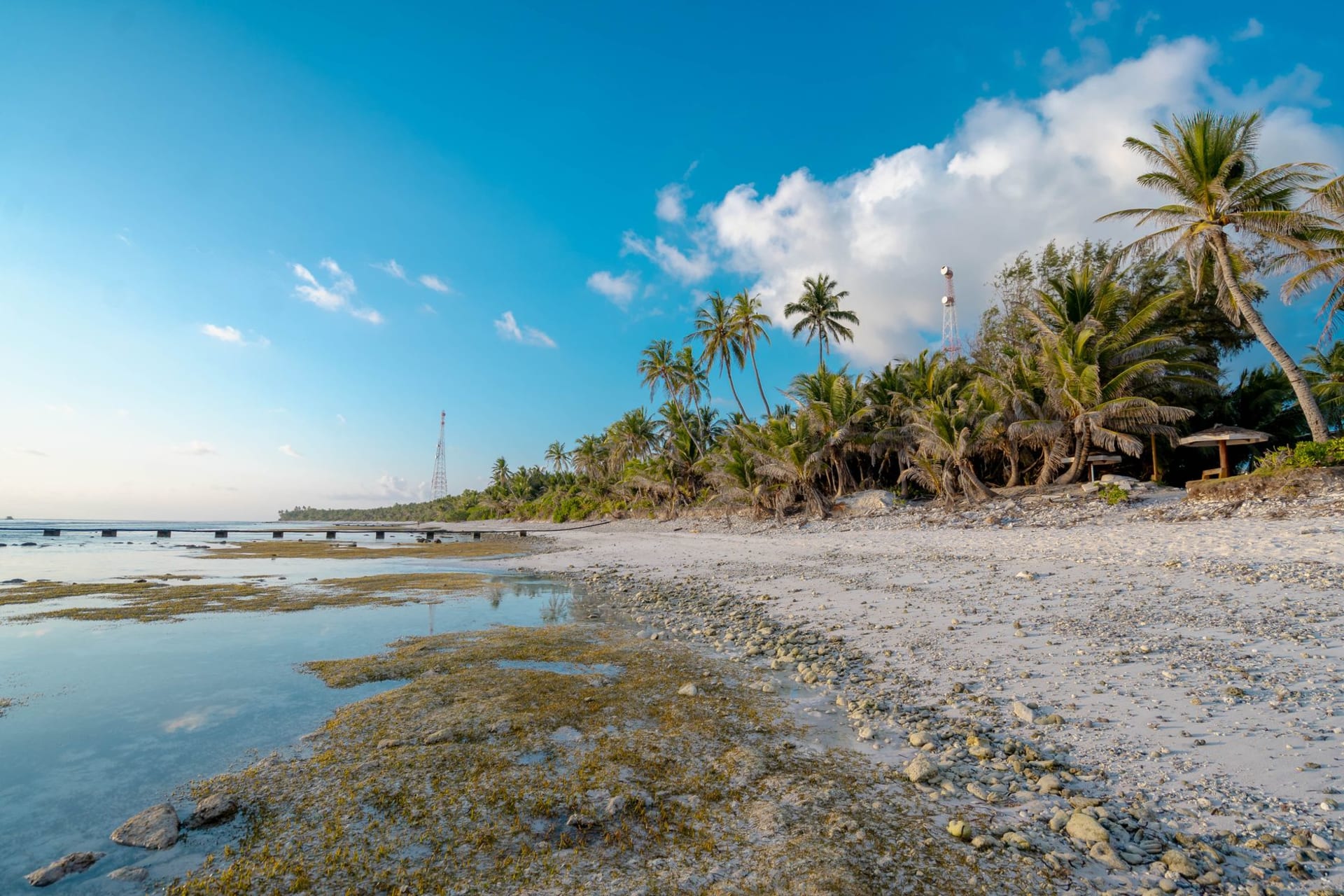
Nanumea’s lagoon is smaller than Funafuti’s but the water running over the reef flat at low tide has a quality I have not seen replicated anywhere. Sunlight refracts through moving water onto white sand and coral rubble, producing a pattern of shifting gold lines — the kind of thing photographers try to produce artificially and that occurs here every afternoon for free.
I waded the reef flat to Lakena at low tide, water to my knees for most of the crossing, with a dozen small reef fish darting ahead of each step. Lakena itself is uninhabited: a few coconut palms, a rusted wartime artifact half-buried in the vegetation, and the particular silence of a place no one visits.
What the Pacific War Left Behind
Nanumea was occupied by Allied forces during World War II as a staging point, and the island still carries physical traces: concrete foundations, a water cistern, the memory of a runway that has long since been reclaimed by vegetation. The elders speak of the wartime period not with pride or resentment but with a kind of measured pragmatism. People came with machinery and changed things and then left. The atoll continued.
When to go: May to October is optimal, with calmer seas that make the inter-island crossing more manageable. Check the Manu Folau schedule in Funafuti before committing — the vessel runs on a roughly monthly circuit but delays are common and rescheduling around weather is a local art form.