Le Balze and the Eroding Edge
The approach to Volterra from the northwest takes you past Le Balze — a landscape of eroded gullies and crumbling cliff edges that look like someone applied water and centuries of neglect to the western plateau. The erosion is real and ongoing; the Etruscan necropolis that once extended here has largely fallen into the ravines, and the edge of the modern town is held back from the drop by retaining walls.
I stopped the car and stood at the edge for twenty minutes. The wind was consistent and cold, the erosion patterns looked almost deliberate in their variety — pale clay, ochre, grey — and the silence was complete except for a hawk working the thermals above the nearest gully. It was the kind of place that makes you think about time in units larger than the usual ones.
The Etruscan Inheritance
Volterra was a major Etruscan city — Velathri in their language — long before Rome arrived, and the Museo Etrusco Guarnacci contains one of the largest collections of Etruscan funerary urns in existence. The urns are alabaster and terracotta, relief-carved with scenes from mythology and everyday life, and they range from crude to sophisticated in ways that suggest a long tradition with variable practitioners.
The piece I couldn’t stop returning to was the Ombra della Sera — the Evening Shadow — an elongated bronze figure, stretched vertically to a height that shouldn’t work and does, its surface worn smooth by age. It dates to the third or second century BC and it looks like something a twentieth-century sculptor might have made on purpose. Alberto Giacometti, who later made very similar thin figures, reportedly saw it and was shaken by the coincidence.
The Alabaster Workshops
Volterra has been carving alabaster since the Etruscans, and the tradition continues in workshops scattered through the town. The stone comes from quarries in the surrounding area — it’s translucent, ranging from white to honey to grey, and when carved thin enough it glows faintly when held to light.
Most of the tourist-facing alabaster production is undistinguished — vases and chess sets that could be from anywhere. But the serious workshops, most of them still family-run, produce work that’s worth looking at carefully. I watched one craftsman thin a bowl down to near-translucency with a slow rotary tool, the alabaster dust settling on his forearms, and the patience in it was the kind you can’t fake.
The Roman Theatre
Below the northern edge of town, outside the walls, the remains of a Roman theatre from the first century BC have been partially excavated and partially reconstructed. The seats are gone, but the stage building — two stories of columns, now restored — gives you the geometry of the original. It’s accessible for free from a public viewing platform, and it’s best seen in the early morning when the light comes from the east and the columns cast long shadows.
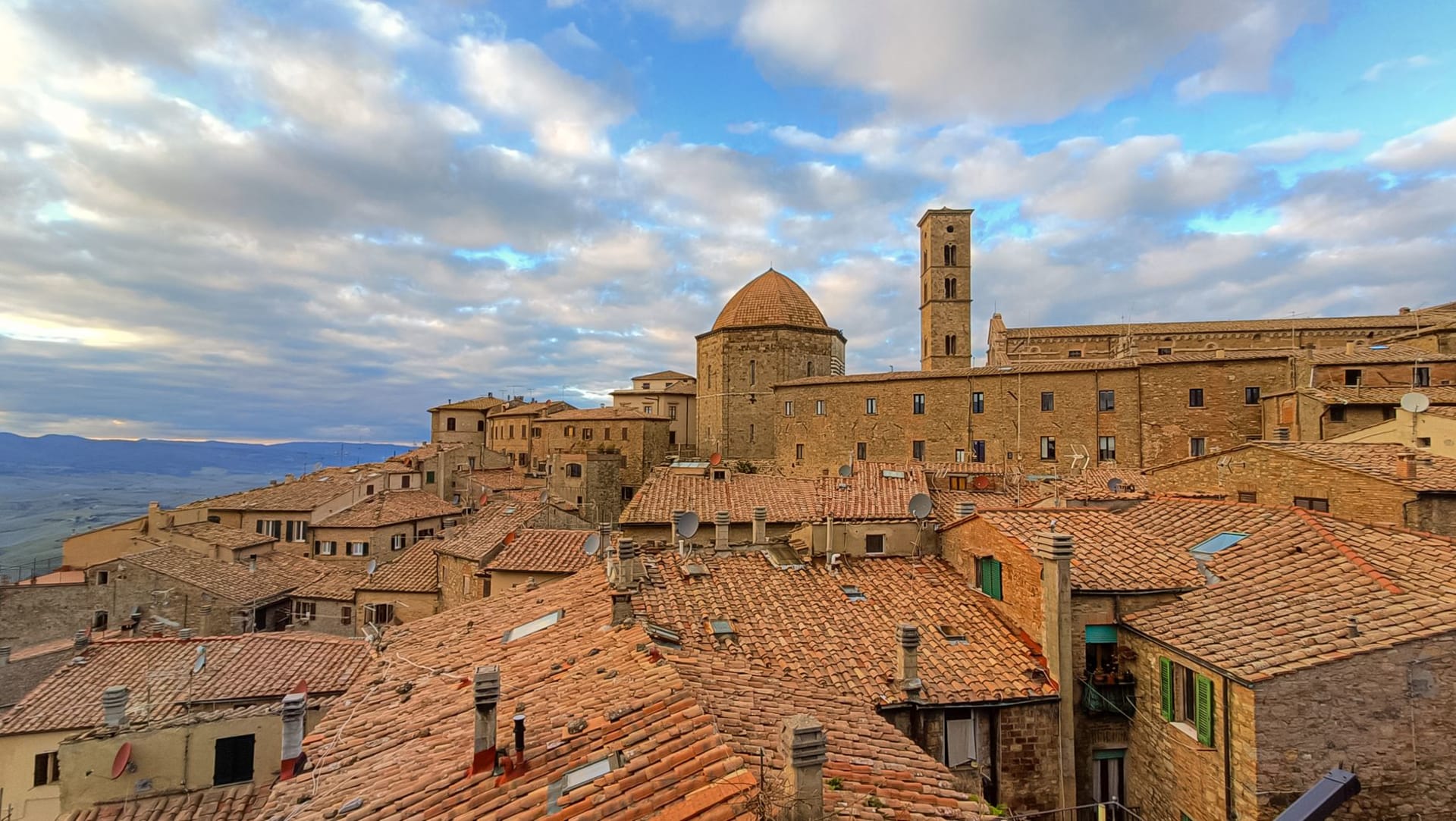
The city itself, within the walls, has the tight, slightly defensive street pattern of a place that has been under siege at various points and planned accordingly. The Piazza dei Priori is the medieval centre — a palazzo of the correct age and seriousness, a few bars, a weekly market. The shops close for three hours at midday with absolute commitment.
When to go: April through October, with May and September being ideal for weather and manageable crowds. Volterra is less visited than Siena or San Gimignano, which means almost any time of year is workable. The winter visits have a particular bleakness to them — wind off the plateau, almost no tourists, the alabaster workshops quietly running — that I imagine is either exactly right for you or completely wrong.