The Other Great Silk Road City
Most Central Asia itineraries fixate on Samarkand and Bukhara, and fairly — but Konye-Urgench (ancient Gurganj) was their equal for centuries, the capital of the Khwarazmian Empire at a time when that empire stretched from the Caspian to the Indus. The Mongols destroyed it so thoroughly in 1221-1222 that the city was never rebuilt on the same scale. What the desert preserved instead is a scattered collection of mausoleums, a minaret, a portal, and a caravanserai — each one a piece of architecture so refined it stops you cold.
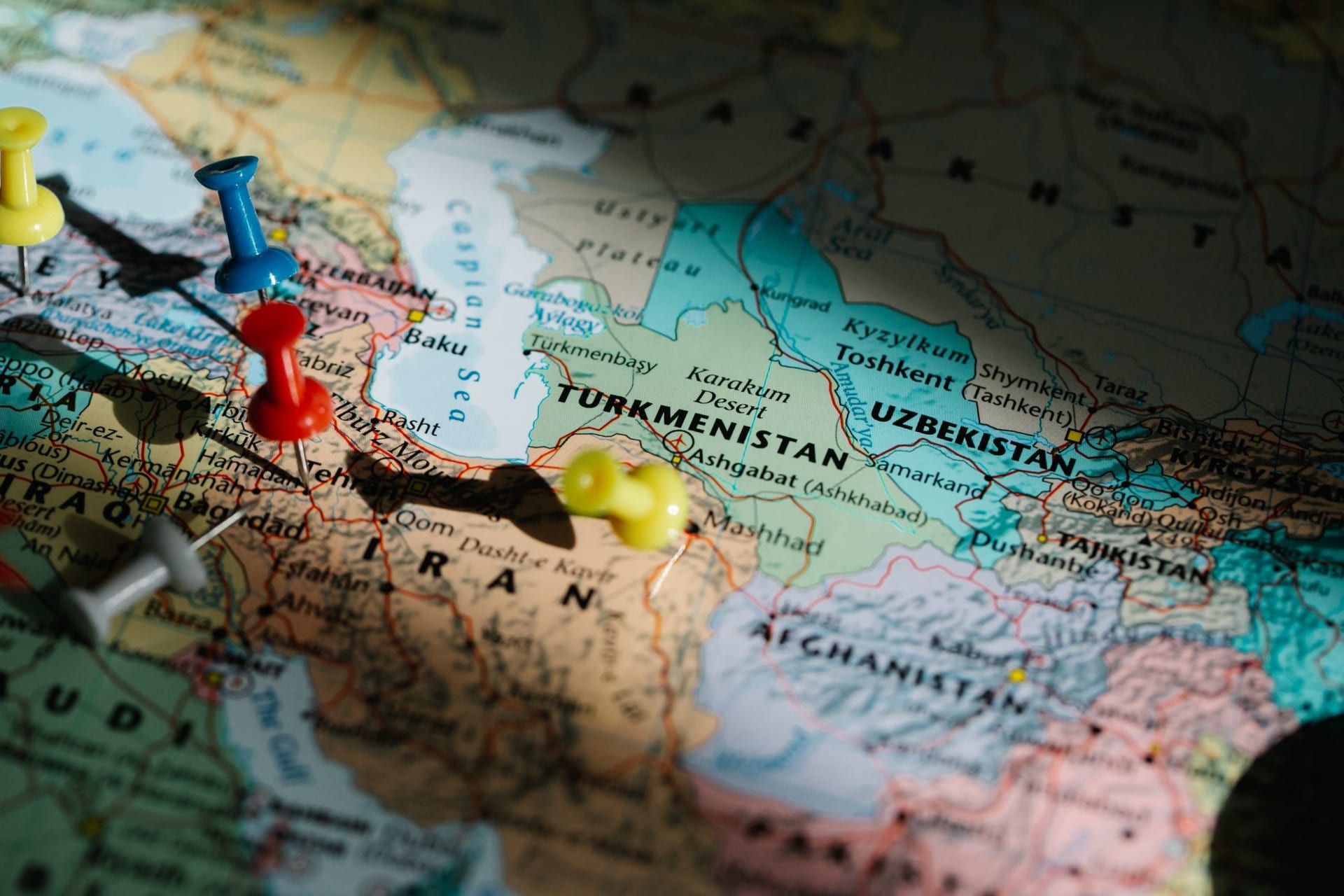
The site is a UNESCO World Heritage property and lies near the town of Koneurgench in the far north of Turkmenistan, close to the Uzbek border. Getting there from Ashgabat requires commitment — a domestic flight or a full day of driving through the Karakum. That distance acts as a filter: the crowds you’d find at Bukhara’s monuments simply don’t materialize here.
Kutlug-Timur Minaret
The minaret is what you see first, rising 60 meters from the flat steppe in a shape that tapers slightly toward the top, its surface covered in a brickwork pattern that changes register every few meters — herringbone, then diagonal lattice, then something almost basketwoven. It was built in the 11th or early 12th century and is the tallest minaret in Central Asia. Standing directly beneath it, the perspective is dizzying enough that I took a step backward involuntarily. Lia laughed at me for it.
The brick is a warm honey color in morning light, almost orange at midday, and the shadow it casts across the surrounding grass is perfectly straight, a sundial at architectural scale.
The Mausoleums
Several medieval mausoleums survive in varying states, the finest being the Turabeg Khanum complex — a 14th-century building whose interior dome is decorated with a geometric tile mosaic of such intricacy that it took me several minutes to understand what I was looking at. The pattern is a calendar: 365 geometric elements representing the days of the year, arranged in concentric registers. The mathematics embedded in medieval Islamic architectural ornament consistently astounds me, and this is one of its finest examples.
The Tekesh mausoleum nearby is older and more austere — a barrel-vaulted portal in fired brick, partly collapsed, the ornament mostly worn away. What remains is the proportional logic of the structure, which is still instructive.
The Town and the Border
Koneurgench town is small and straightforward, a grid of Soviet-era apartments with a few teahouses and a market. The Uzbek border crossing at Shavat is nearby, and some travelers combine Konye-Urgench with a crossing into the Uzbek side — Khiva is a relatively short drive from the border. Turkmenistan’s visa situation makes logistics complex, but the combination is worth planning for.
The northern Turkmen steppe has a quality of light unlike anywhere else I’ve been — flat, mineral, diffused through a haze that softens distances without obscuring them. The monuments rise from it like objects placed carefully by a curator who understood exactly how the backdrop would make them land.
When to go: April through early June, or September through October. The north is marginally cooler than the Karakum in summer but still punishing. Spring is the best season: the steppe is briefly green, the light is warm without being harsh, and the mud-brick monuments show their color at its most vivid.