Asia
Turkmenistan
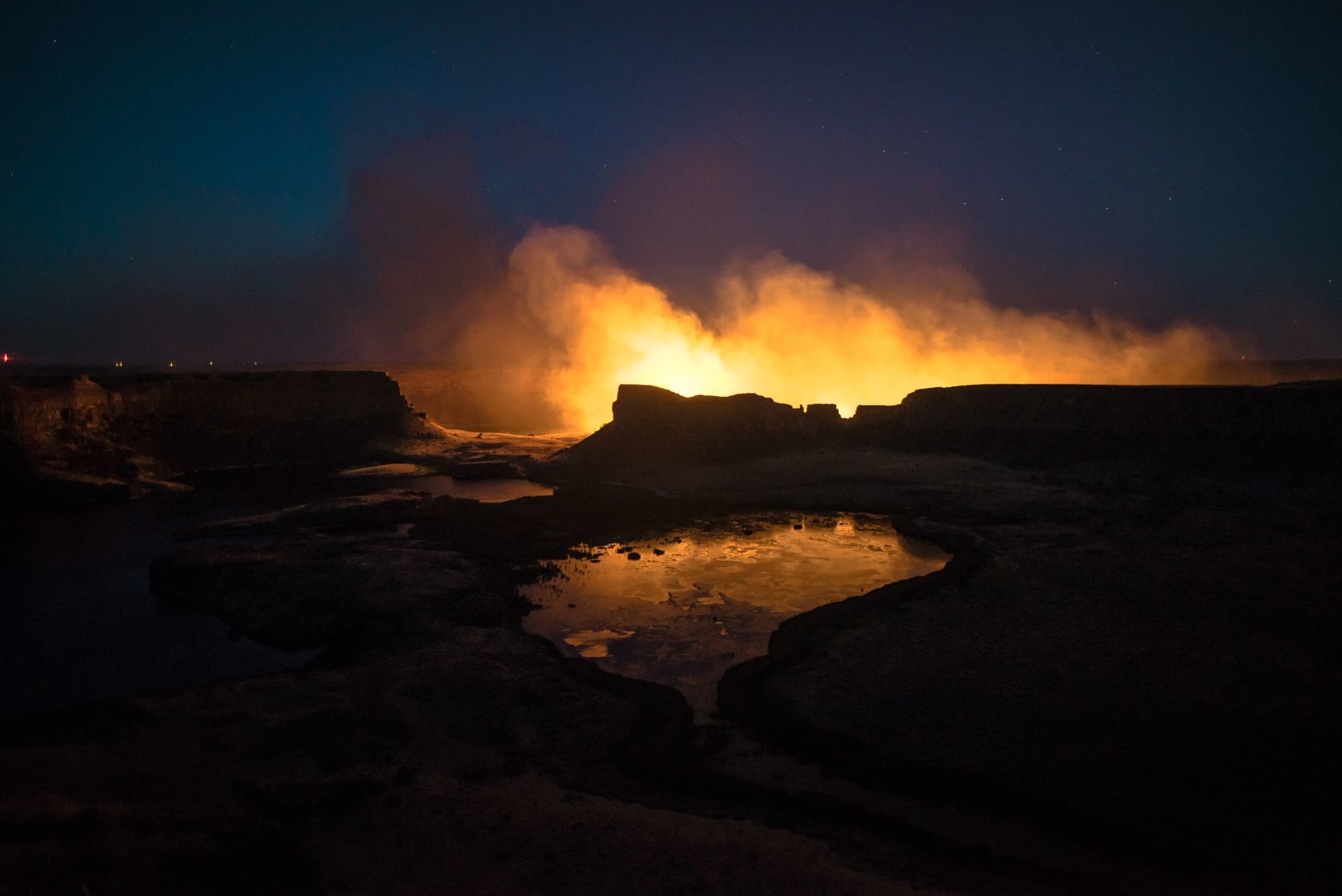
"I stood at the edge of hell and it smelled like petroleum."
The minibus dropped me at the edge of the Karakum Desert sometime past midnight, and I walked toward the glow before I could see anything else. The Darvaza crater — known by every travel writer as “the Door to Hell” — is about ninety meters wide and has been on fire since a Soviet drilling rig collapsed into a gas pocket in 1971. Someone lit it to stop the methane from leaking. They assumed it would burn out in a few weeks. Fifty-some years later, it is still going, and standing at the rim with the heat rising against your face, the sound of flames constant below you, the rest of the desert completely silent, you understand why no one has bothered to put it out. It would be a crime to extinguish something this improbable.
Ashgabat is the other half of Turkmenistan that bends your sense of reality. The capital was rebuilt almost entirely after a catastrophic earthquake in 1948, and then rebuilt again by successive authoritarian presidents who had a particular taste for white marble, gold statues of themselves, and world records. There is a Guinness record for the largest building shaped like an eight-pointed star. There is a monument to a dog breed. There is a golden statue of the former president that used to rotate to always face the sun. Walking through the city center feels like being dropped into a stage set for a country that doesn’t quite exist — the streets are too wide, the buildings too gleaming, the human presence too sparse. It is one of the most surreal urban environments I have ever encountered, and I mean that as high praise.
Between the crater and the capital, the country offers more than most people expect. The ancient Parthian city of Nisa sits in ruins just outside Ashgabat, two thousand years of history with almost no one around. The bazaar in Mary — the closest city to the ruins of Merv, once one of the largest cities in the medieval Islamic world — is loud and crowded and exactly what the white marble city isn’t. Plov, the Central Asian rice dish with lamb and carrots, is eaten everywhere. The naan bread comes out of tandoor ovens that look unchanged from the Silk Road era.
When to go: April to early June and September to October. The desert summer is brutal — temperatures above 45°C in July are common. Winter brings cold that surprises people who picture Turkmenistan as purely hot. Spring gives you the crater at dusk with bearable warmth and occasional wildflowers in the desert scrub.
What most guides get wrong: They frame Turkmenistan as a destination for difficulty — the difficult visa, the mandatory guide, the difficult logistics — as if the point is to suffer for bragging rights. The permits are real, but the country itself is not punishing. The people are curious about you in a way that is completely unguarded. The food is good. The landscape is extraordinary. Go because you want to see one of the strangest places on earth, not because you want to say you went somewhere hard.