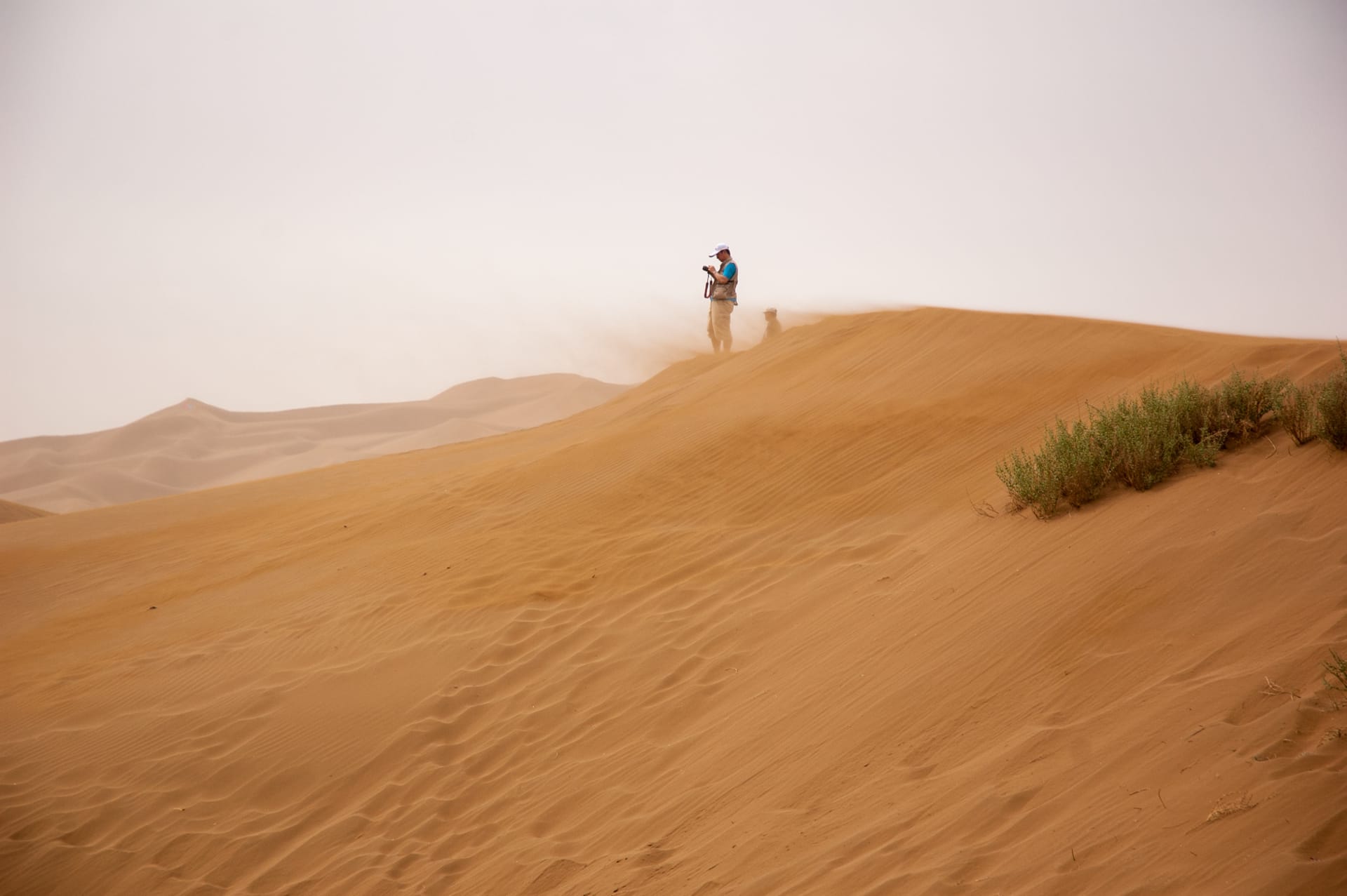
The Desert That Is Most of the Country
The Karakum — literally “black sand” in Turkmen, though the sand is more gray-gold than black — covers approximately 350,000 square kilometers, making it one of the largest deserts in the world and occupying roughly 70 percent of Turkmenistan’s territory. Every road that goes anywhere in this country crosses it. The gas that heats Turkmen homes, the gas that built Ashgabat’s marble facades, and the gas that feeds the Darvaza crater all come from beneath it.
To a first-time visitor the desert presents as featureless. That is a first impression that doesn’t survive closer attention. Within its apparent monotony the Karakum holds extraordinary variety: fixed dunes and shifting ones, salt flats so white they look like snow, saxaul forests (actual trees, knee to chest height, gnarled and leafless in the way that suggests contempt for conditions that would kill other plants), and stretches where the surface is packed clay so hard and flat you could land a small aircraft.
Crossing the Karakum Highway
The highway from Ashgabat to Turkmenabat — the country’s main east-west axis — crosses the desert’s full width, roughly 500 kilometers. Driving it, as I did in the direction of Merv, is an experience in recalibrating your sense of distance. The horizon stays constant. The road is straight. The camel that appears as a small shape in the distance takes twenty minutes to reach and another ten to pass.
Gas stations along the route are spaced in a way that requires attention to the fuel gauge. The few settlements visible from the highway are small — clusters of flat-roofed houses, a water tower, a mosque — and seem to belong to a different relationship with landscape than anything I recognize from European or American experience. People have been living in this desert for millennia, and the architecture reflects a negotiation with heat and scarcity that is both practical and, in its way, beautiful.
Into the Desert Properly
The M37 highway is one thing. Getting off it into the desert proper is another, and requires a guide, a 4WD vehicle, and some preparation. The dunes in the Karakum’s interior are soft enough that the wrong choice of route can strand a vehicle in minutes. Our guide knew where the firmer substrate ran between the soft sections and navigated by memory and by the color of the sand, which apparently tells you something readable if you’ve grown up here.
We camped one night in the open desert, well off any track. The heat of the day was gone within an hour of sunset — the desert cools fast when there’s no humidity to hold warmth. The sky was the thing. This is some of the darkest territory in Asia, and the star field overhead by midnight was dense enough to be disorienting, the Milky Way a genuine structural presence rather than a faint suggestion.
What the Desert Does to Time
I don’t have a clean way to explain what happens to time in the Karakum. Days structured around dawn and dusk rather than clocks. The slowness of everything — of driving, of waiting for tea to steep on a small camp stove, of watching a camel work its way along a ridgeline for fifteen minutes before disappearing. The desert is one of the few places I’ve been where the primary activity is simply being in the place, without monument or narrative to organize the experience. That either suits you or it doesn’t.
When to go: March through April and October through November. Daytime temperatures in May begin climbing toward 35-38°C, and by July the interior regularly exceeds 45°C — survivable with precautions but not comfortable for extended exploration. Desert nights are cold year-round below freezing from November through February; pack accordingly if camping.