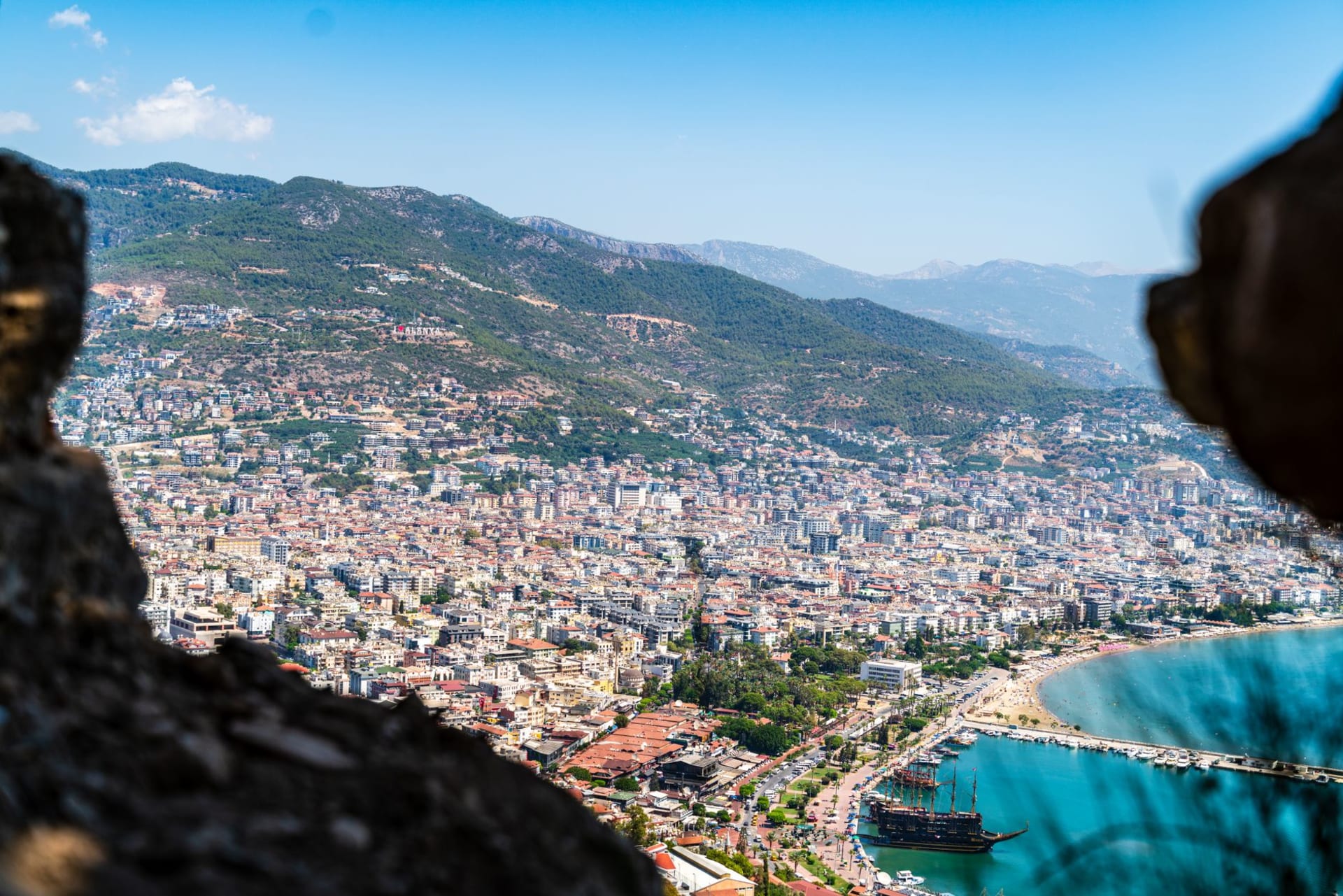
Alanya
"The castle walls have been here since 1226. They've survived crusaders, pirates, and an extraordinary quantity of tourist photos, and they remain unconcerned."
Alanya divides opinion neatly. One side sees a brash beach resort — and it is that — overbuilt, internationalized, catering to a northern European market that wants heat and proximity to the sea without much friction. The other side sees the fortress on the cliff, the Seljuk architecture inside it, the Red Tower at the harbor, and the caves in the rocks below. Both sides are right. Alanya is entirely worth visiting and entirely what you expect, which is a combination that takes some negotiating.
The Castle and the Citadel
Getting up to the castle means either a steep forty-minute walk from the harbor through the old quarter, or a minibus that runs from the tourist district. I walked up and took the minibus down, which is the correct order. The path through the old quarter passes Seljuk-era stone houses, a mosque with a carved doorway that the twelfth century understood better than we’ve managed since, and a series of viewpoints where the coast appears in increments as you climb.
The castle itself — built by Alaeddin Keykubad I, Sultan of the Sultanate of Rum, in 1226 — covers the entire top of the peninsula in a six-kilometer circuit of walls, towers, and internal structures. The enclosed area is large enough that a small community still lives inside it, and the streets within the walls are quieter and older than anything below. The keep at the highest point gives a 360-degree view: Taurus Mountains to the north, the eastern beach running flat and long to the right, the western beach curling away to the left, and the sea straight out in every direction.
The Red Tower
At the harbor’s edge, the Kızıl Kule — Red Tower — is a thirteenth-century octagonal fortress built by Keykubad to protect the shipyard. It’s been restored and now contains a small ethnography museum, but what matters is the structure itself: five stories of dressed red stone, each level stepping slightly inward, finished in 1226 and looking entirely capable of lasting another eight hundred years.
The harbor below still functions as a working port alongside the tourist gulets. In the early morning the fishing boats come in and the catch is sorted on the dock.
The Caves
Damlataş Cave, near the western beach entrance, is a stalactite cave with notably high humidity that local lore holds beneficial for asthma — there’s a waiting room where people sit for the specific purpose of breathing the air. The cave itself is genuinely impressive: formations forty-five meters high, lit in various colors by a lighting system that has clearly not been updated since about 1985, which gives the whole thing an inadvertent retro quality.
Pirate Cave and Lovers’ Cave, accessible only by boat, are sea caves in the cliff face below the promontory where small boats take passengers in to see the chambers inside. The light in the caves, refracted off the water and bounced against the limestone walls, is extraordinary — green and white and shifting in a way that no photograph captures cleanly.
The Eastern Beach
Cleopatra Beach on the western side gets the name and the postcards, but the long eastern beach is quieter and better for an actual swim. It runs for three kilometers with the castle rising above its far end, and in the morning before the sun chairs fill you can walk the waterline with the mountains at your back and the sea ahead and feel that Alanya’s better qualities outweigh its louder ones.
When to go: May through June and September through October. July and August bring the resort at full capacity — prices peak, beaches pack, and the old town feels peripheral to a machine running on a different priority. The castle is worth seeing in any season; the walk up is best done before ten in the morning.