Sousse
"The ribat looks like it was built to last another thousand years. Given that it's already lasted twelve hundred, I see no reason to doubt it."
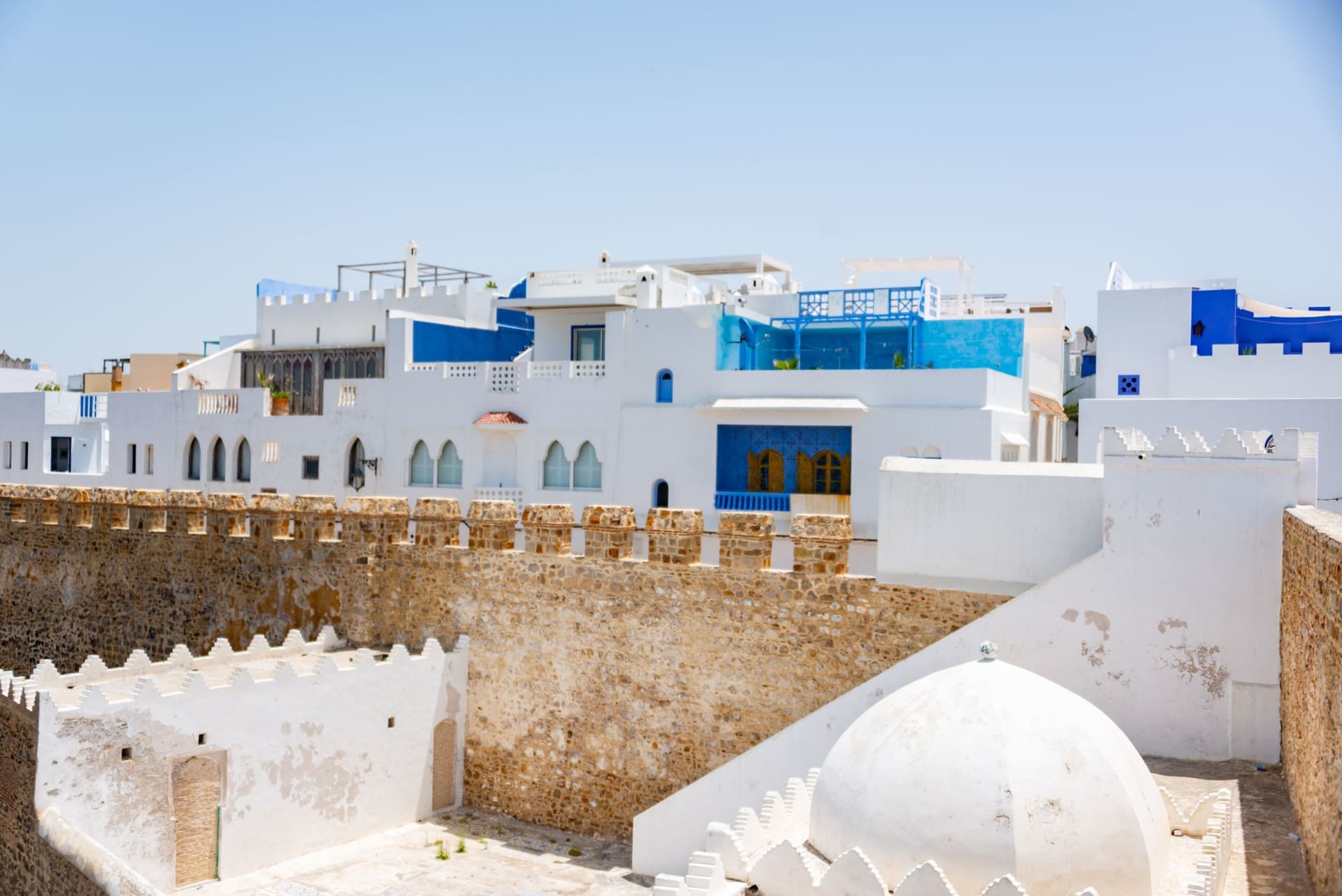
Sousse manages a balancing act that few Tunisian cities pull off convincingly: it is simultaneously a popular beach resort and a genuinely ancient walled medina with a UNESCO designation to prove it. The beach hotel zone runs along the northern coast, purpose-built and self-contained. The medina sits on a headland to the south, dense and functional and operating on its own timetable entirely. I stayed in the medina and walked to the beach when I wanted to. The distinction between the two felt important.
The Ribat
The ribat is where I went first, and it set a standard that the rest of the day kept measuring itself against. A ribat was a fortified monastery — part military garrison, part place of religious retreat — and the one in Sousse dates from 787 CE, making it one of the oldest in the world. The walls are massive, the interior courtyard small and shaded by the towers. I climbed the round watchtower at the corner and looked out over the medina rooftops and then south to the port and then east to the Mediterranean, which was particularly blue on the morning I visited, that deep saturated blue that appears in northern hemisphere winter when there’s no haze to dilute it.
The ribat is not a ruin. It is a standing building that could theoretically still function for the purpose it was built. This solidity — the sheer endurance of the stonework — made it more affecting than more celebrated ruins I’ve visited.
Inside the Medina Walls
The Sousse medina is compact enough to cover in half a day and dense enough to reward a full one. The Great Mosque, like the one in Kairouan, was built by the Aghlabids and carries the same massive authority, though it’s closed to non-Muslim visitors. What surrounds it is entirely accessible: lanes of metalworkers hammering out trays and teapots, carpet shops hung with pieces in every geometry, small restaurants where the menu is written on a chalkboard and you eat whatever was made that morning.
I found a lunch place near the central souk that served lablabi — a thick chickpea soup with a raw egg stirred in at the table, harissa, cumin, and torn bread — for the equivalent of a euro and a half. It was the best thing I ate in Sousse. The restaurant had four tables. Three of them were occupied by construction workers in dusty clothes who ate with the focused efficiency of people who had scheduled thirty minutes for lunch and were honoring the commitment.
The Catacombs and the Museum
Below the city, more than two hundred kilometers of early Christian catacombs were cut into the soft sandstone during the Roman period. You can visit a section of them, walking through the low-ceilinged corridors past the carved niches where an estimated fifteen thousand bodies were interred. The air underground is cool and still and smells of nothing in particular, which after the heat of the medina streets is its own kind of gift.
The archaeological museum in the Kasbah holds mosaics from the region’s Roman-era villas. They are fine work — hunting scenes, mythological narratives, portrait heads — and the museum is quiet enough that you can stand in front of them without interruption and think about what it means that a floor someone walked on in the second century is still here, perfectly legible.
The Coast Road North
The road north from Sousse follows the coast through the resort strip to Port El Kantaoui, an entirely designed marina complex built in the 1980s that has the cheerful unreality of a film set. I walked through it once out of curiosity. It was spotless and oddly calming, the way extremely artificial environments sometimes are. Then I turned around and walked back to the medina, where everything was slightly chaotic and completely real.
When to go: April through June and September through October. The beach infrastructure means Sousse is genuinely pleasant in summer, but the medina becomes very crowded in July and August with package tourists. Spring and early autumn hit the right balance — warm enough for swimming, calm enough for the old city to feel like itself.