Kairouan
"Seven pilgrimages to Kairouan was once said to equal one to Mecca. Standing in the mosque's courtyard at first light, I began to understand the arithmetic."
Kairouan sits on a flat, treeless plain about 150 kilometers south of Tunis, and there is nothing subtle about arriving there. The Great Mosque appears before the city does, its square minaret rising from the flat landscape like something placed deliberately to be visible from a long distance, which is, of course, exactly what it is. I’d been traveling through Tunisia for a week and had started to develop a comfortable relationship with medinas and covered markets. Kairouan reset that complacency.
The Great Mosque
The Mosque of Uqba — founded in 670 CE, rebuilt multiple times since — is the oldest mosque in North Africa and one of the oldest continuously functioning mosques in the world. Non-Muslims are not permitted inside the prayer hall, but you can enter the vast courtyard, which is enough.
The courtyard’s scale does something to the air. It is enormous and almost entirely bare — pale limestone paving, a row of Greco-Roman column capitals recycled from older structures, a central cistern that has collected rainwater for centuries. At the far end, the wooden doors of the prayer hall were open on the morning I visited, and I could see inside: a forest of columns stretching into the dimness, prayer rugs laid in long rows, a man moving through the space at the unhurried pace of someone at home. The call to prayer from the minaret above me was the loudest I’d heard anywhere, and it rolled over the plain with a physical weight that I felt in my chest.
The Medina and Its Craftspeople
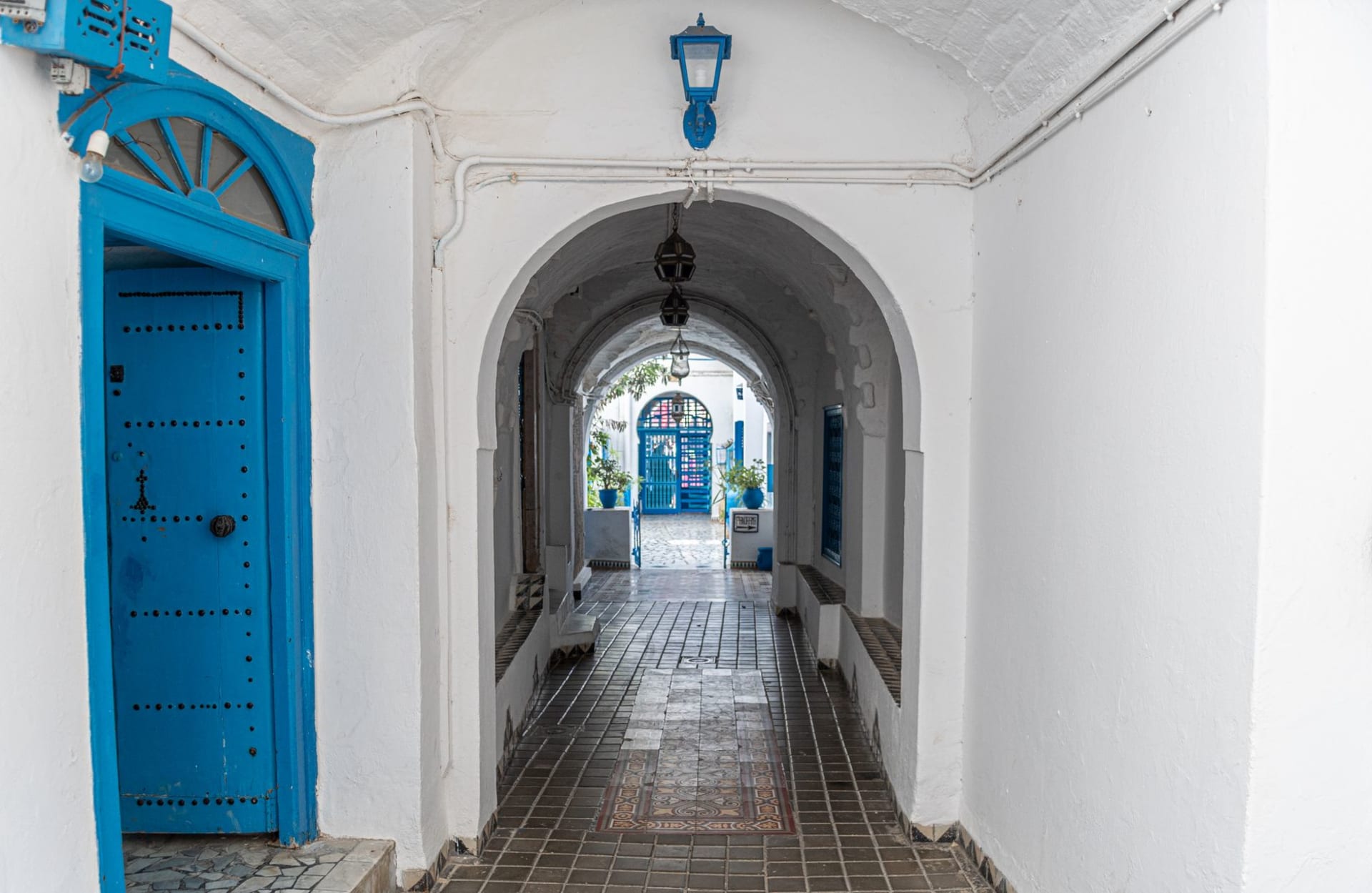
The medina inside the city walls is working and unperformed. The shops sell prayer beads, religious texts, and the wool carpet kilims for which the region is famous, but they sell them to people who use these things, not only to tourists who want them as objects. I watched a carpet weaver at her loom for fifteen minutes before she noticed me and smiled, more amused than annoyed by my attention.
The local specialty confection is makroudh — a pastry of semolina dough filled with date paste and fried in oil, then soaked in honey. They are sold everywhere in the medina, stacked in pyramids behind glass counters, and they are the kind of thing that should be eaten fresh and warm, which vendors will tell you firmly if you hesitate. I ate three in a row outside a tiny shop near the central gate and bought a paper bag of them for the bus south.
The Basin of the Aghlabids
Just outside the medina walls, two enormous circular basins were built in the ninth century to collect and distribute water to the city. They are still intact, which is quietly remarkable — open-air cisterns nearly a thousand years older than the European cathedrals that get all the admiring documentation. I arrived in the late afternoon when the light on the water was turning it the color of weak tea and a family was having a picnic on the bank with no particular interest in the historical significance of where they’d chosen to sit. I liked this very much.
What Kairouan Is Not
It is not Tunis, with its café culture and cosmopolitan friction. It is not a beach town or an adventure destination. It is a deeply religious city that happens to be visitable, and the most honest way to experience it is to arrive early, walk slowly, and not mistake the monuments for the point. The point is that people have been arriving here to pray for thirteen hundred years and have not stopped. That continuity is the thing worth sitting with.
When to go: March through May and September through November. The summer heat on the unshaded plain is severe, and the medina’s narrow lanes offer only partial relief. Spring and autumn bring a drier warmth that makes walking through the old city exactly as pleasant as it should be.