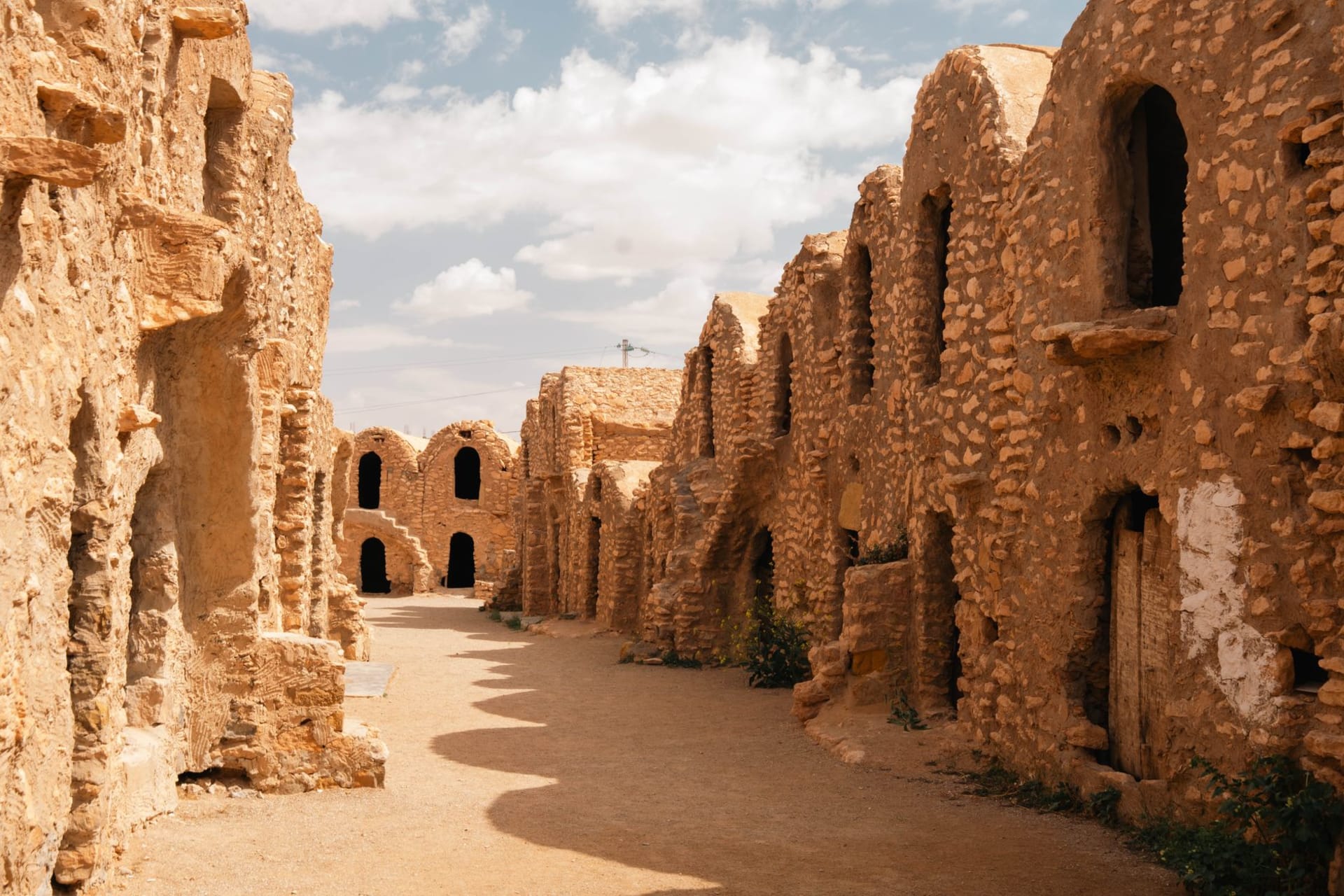
Douz
"I stood at the edge of the erg and understood, for the first time, why people have always been drawn to things that could kill them."
I arrived in Douz at eleven in the morning on a day in late November when the temperature was already climbing past thirty degrees. The town sat at the edge of what Tunisians call the Grand Erg Oriental — one of the largest sand seas in the Sahara — and I could feel its presence before I reached it, a shift in the quality of the air, a dryness that was different from simple heat.
Douz bills itself as the Gateway to the Sahara. It is not wrong.
The Town Itself
Douz is a genuine oasis settlement, not a constructed tourism prop. The central market operates every Thursday and pulls traders from surrounding villages and semi-nomadic communities into a loose, energetic gathering that spills through several streets. I went on a Thursday without planning it and found myself navigating between goat sellers, spice vendors, and a textile section where Berber women traded fabric in colors so bright they seemed to vibrate against the dun background.
The covered market sells dates in varieties I hadn’t known existed — the Deglet Nour is the most famous, semi-translucent and ambered like old glass, but there were earthier, darker varieties sold loose from burlap sacks that tasted nothing like the ones that appear in European supermarkets. I ate too many and felt no guilt about it.
Into the Erg
The dunes that begin at the southern edge of Douz are not the modest undulations you sometimes see in photographs that promise drama and deliver sand hills. They are massive — the first ridge rises eighty meters from the flat desert floor, and behind it, more ridges extend south until they dissolve into the haze. The color shifts constantly. At midday the sand is almost white. In the hour before sunset it turns first gold, then amber, then a deep copper that makes the whole erg look like it’s lit from underneath.
I went out twice: once on a hired dromedary just before sunset (the animal moved with a lurching, arrhythmic gait that made taking photographs impossible and the experience purely physical), and once on foot at sunrise, before the heat made walking on the slope any kind of effort. The second trip was better. I walked up the first ridge in the early light and sat at the crest while the sky turned from purple to orange and the shadow line of the dune moved down the far slope in real time. I don’t have a good way to describe watching a shadow move across a hundred-meter sand face as the sun rises. It’s the kind of thing that does something to your internal sense of scale.
Nomad Culture and What Remains
The region around Douz has been home to the Marazig tribe for centuries, a semi-nomadic people with a deep history of cross-desert trade. The Museum of the Sahara, just off the main square, is smaller than it sounds but covers this history with genuine care — tools, textiles, salt trade routes, the domestication of the dromedary laid out in modest displays that reward attention. A guide who spoke reasonable French explained which exhibits had been contributed by local families. That proximity made it feel less like a museum and more like a collective act of remembering.
Logistics from the North
Douz is roughly four hundred kilometers south of Tunis, connected by a single main road through Kairouan and Gabès. The journey by louage (shared taxi) takes six to seven hours with connections. The reward for making it is a sky at night that has no competition — not a single source of light pollution in any southern direction, just the Milky Way doing its full performance over the erg.
When to go: October through March is the only sensible window. November is ideal — warm enough to enjoy the desert comfortably during the day, cool at night in a way that makes sleeping feel like a reward. April onward it becomes genuinely hot; summer temperatures in the erg regularly exceed fifty degrees.