Salina Turda
"I have never been claustrophobic, but I have never wanted to row a boat 120 metres underground either. Turda fixed that."
I went to Turda braced for a tourist trap and came out genuinely rattled, in the good way. The town itself, ten minutes from the mine, is an unremarkable Transylvanian place of grey blocks and a sleepy main street, and nothing about it prepares you for what is underneath. You buy a ticket, walk into a hillside through a long horizontal gallery dripping with salt efflorescence, and then the floor simply drops away into a void that no photograph had managed to convey to me beforehand.
Down the Rudolf Mine
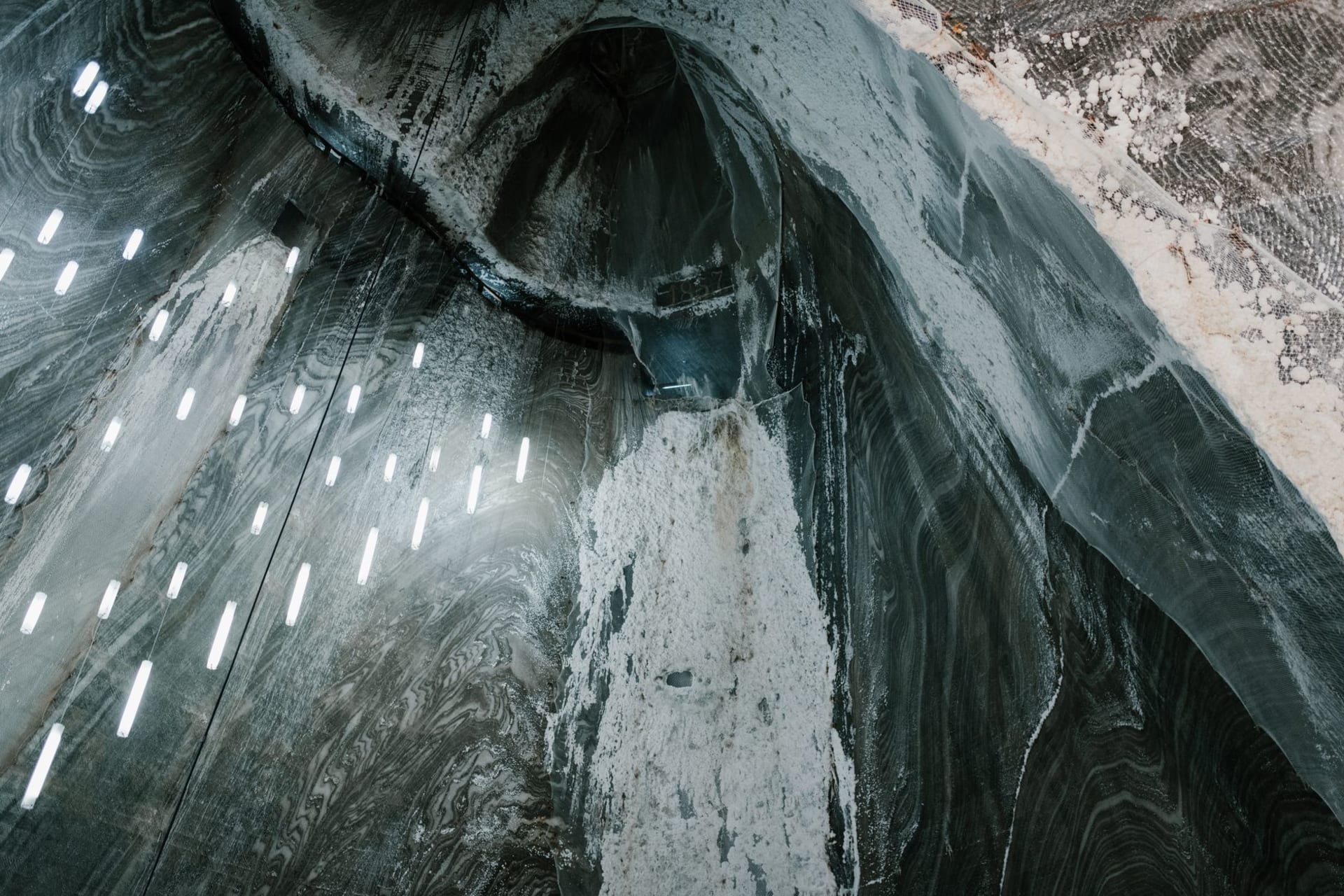
The salt here has been dug since at least Roman times and industrially until 1932, when the operation closed and the mountain was left to do nothing for decades. The Rudolf chamber, the big one, is the result of all that extraction — a hollow roughly the height of a thirteen-storey building, its walls ribbed with the marks of pickaxes and later cutting machines, the salt grey and glassy and oddly warm-looking under the modern lighting.
What the Romanians have done with it is the part that divides people. There is a Ferris wheel at the bottom. There is a mini-golf course, a bowling lane, an amphitheatre. Lia took one look at the hanging chandeliers of light — engineered to resemble strange luminous jellyfish — and declared it the most beautiful thing she had seen all trip, and I, who had been prepared to be cynical, found I agreed. The scale does something to your sense of proportion. People wandering the galleries far below look like punctuation marks.

The Lake at the Bottom
Below the Rudolf chamber, reached by a slightly alarming staircase and a lift, sits the Terezia mine — a deeper bell-shaped cavern with a salt lake at the bottom, and on that lake, rowing boats. You can hire one and paddle around a small salt island formed from a century of mineral drip, the air thick and still and tasting faintly of the sea, the only sounds your own oars and the distant laughter of other people doing the same daft thing.
I rowed us in a slow circle and stopped talking for a while. The humidity is supposed to be good for the lungs — the mine doubles as a halotherapy clinic, and you do see people sitting quietly in the galleries breathing it all in, some of them clearly there for the salt air rather than the spectacle. After fifteen minutes I half believed it. My head, congested since a budget flight two days earlier, had cleared.

Practical Truths
The temperature underground holds at a steady ten or eleven degrees year-round, so bring a jacket even in August when the surface is baking. Wear proper shoes; the stairs are long and the salt underfoot can be slick. Go early or late in the day to dodge the bus tours, which arrive in clots around midday and fill the echoing chambers with a roar you can hear from three galleries away.
When to go: Open all year, which is the point — it makes a perfect rainy-day or midsummer-heat escape. April to June and September are calmest. Combine it with Cluj-Napoca, a forty-minute drive north, for a town that actually has dinner waiting at the end.