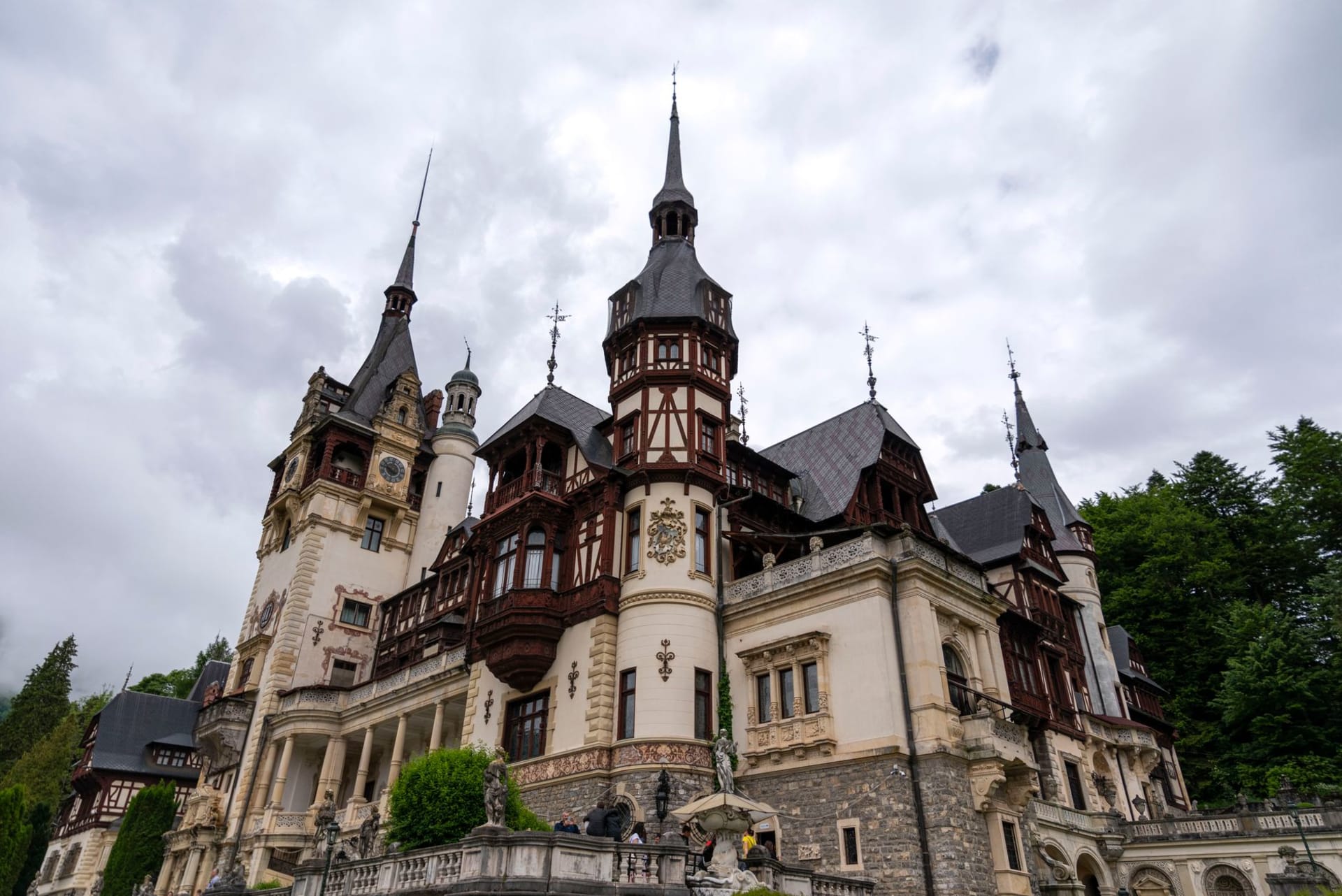
Sinaia sits at the point where the Prahova Valley becomes serious — where the mountains stop being scenic backdrops and start being vertical limestone walls that loom over the town and make you tilt your head back to see their tops. The town exists, essentially, because King Carol I of Romania decided in the 1870s that this was where he would build his summer palace. Peles Castle followed, then a rail connection, then the wealthy Bucharest families who wanted to summer near the king, then the ski lifts, then the current mix of hikers, skiers, and people who drive up from the capital on weekends to eat mici and breathe air that hasn’t been recycled through four million lungs.
Peles Castle and Its Excess
Peles Castle is the most extravagant thing in Transylvania and possibly in Romania. Carol I began building it in 1873 and didn’t stop until 1914, adding wings and towers and outbuildings until the complex had 160 rooms decorated in styles ranging from Florentine Renaissance to Moorish to German Gothic, all of them executed with a budget that reflected a royal commitment to excess. The Main Hall has a retractable glass ceiling; the armory has three thousand pieces; the theater seats 60. The German artist who painted the ceilings did so over a period of decades. The overall effect is not tasteful, but it is absolutely sincere — this was someone’s genuine idea of what a perfect summer residence should look like, and they had the money to find out.
The Monastery and the Town Below
The Sinaia Monastery predates the castle by two centuries, founded in 1695 by the nobleman Mihail Cantacuzino and named for Mount Sinai where he had previously made pilgrimage. The old church has a fresco program that survived intact and a collection of religious objects in gold and silver that the monks received as gifts from princes trying to bank their piety. The monastery sits uphill from the main town, which is a long boulevard of Belle Epoque villas, thermal bath hotels in various states of function, and a casino built in 1912 that looks exactly like you’d expect a 1912 Romanian mountain casino to look, which is to say like something out of a Wes Anderson version of the Habsburg empire.
Above the Tree Line
The cable car from Sinaia runs in two stages to the Bucegi plateau at 2,090 meters, and the transformation between the two stations is dramatic. In the valley it might be a warm September afternoon; at the top it might be foggy and cold with traces of snow in the crevices of the limestone. The plateau is a high alpine landscape with grazing herds, alpine flowers in season, and the strange rock formations — the Sphinx and the Babele — that the Bucegi is known for. These are sedimentary towers eroded into shapes that people have been naming and mystifying for centuries. The Sphinx looks more like a bear than a sphinx. This seems fine.
The Skiing, Such As It Is
Sinaia’s ski area runs down the eastern flank of the Bucegi and is enthusiastically used by Romanian families on winter weekends. The lifts are old, the runs are mostly intermediate, the lift lines on Saturday mornings are genuinely terrible. None of this stops people from coming, which is its own kind of recommendation. The après-ski culture in the town, in the heated terraces of the Belle Epoque hotels, with mulled wine and tripe soup and televisions showing football, has a particular warmth that the mountain itself sometimes lacks.
When to go: Late September and October for the Peles gardens and the beech trees turning gold on the lower slopes. June and early July for wildflowers on the Bucegi plateau. Ski season runs December through March but January and February weekends are crowded; try a weekday if you’re skiing. Avoid August, when the valley road becomes a slow procession of Bucharest-registered cars.