Sighisoara
"You expect a stage set. You find a neighborhood where people still hang their laundry."
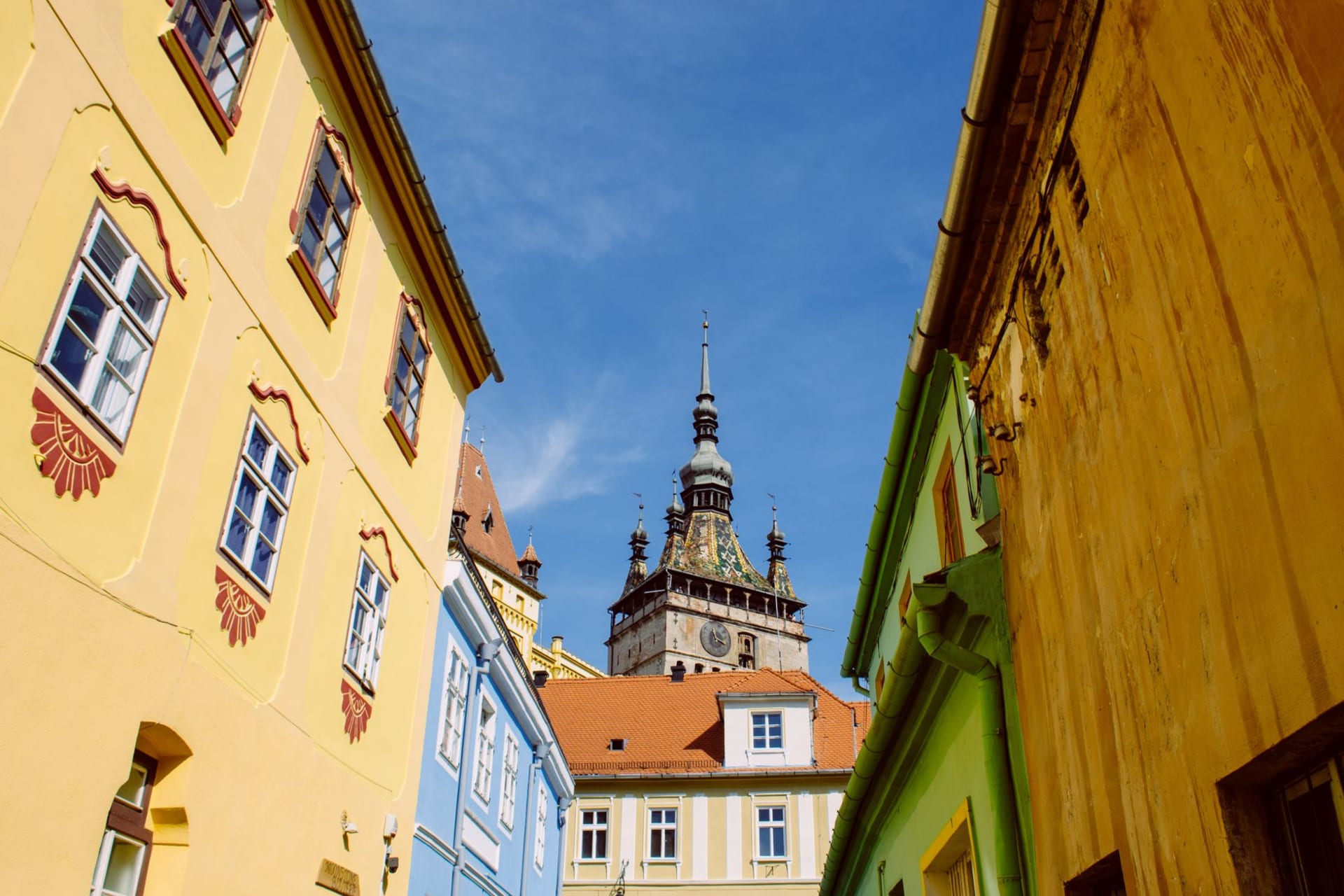
Sighisoara is the kind of place that makes you distrust your own reactions. It is objectively beautiful — a medieval Saxon citadel perched on a hill, with colored houses in ochre and rust and pale blue, a clock tower built in 1360 still keeping rough time, and streets so narrow you could touch both walls with your arms outstretched. It appears on more Romanian tourism posters than anywhere else in Transylvania. And yet somehow it hasn’t calcified. People live here. Dogs sleep on warm cobblestones. A woman argues with her phone in Romanian outside a house where Vlad II Dracul — father of the more famous one — was born in 1431.
The Climb to the Citadel
The citadel sits above the lower town and you reach it via covered wooden stairs, a roofed staircase of 175 steps that was built in 1642 so students could reach the hilltop school without arriving soaked. The wood is dark and worn smooth, and the stairs creak in a way that feels conspiratorial. At the top, the Scholars’ Staircase deposits you near the Church on the Hill, a Gothic structure that’s been Catholic, then Lutheran, that has a crypt packed with centuries of ornate German epitaphs, and a small cemetery behind it where the headstones lean at angles suggesting long argument with the soil. I spent an hour there reading names. The silence was the good kind.
Inside the Clock Tower
You can climb the Clock Tower for a modest fee, and you should, because the view from the top takes in the red tile rooftops of the lower town, the Tarnava Mare valley stretching south, and the forested hills surrounding the city on three sides. The mechanism room is particularly strange — exposed gears and counterweights from various centuries of repair, all the innards of timekeeping laid out without explanation. There’s also a small museum with exhibits on medieval torture and Saxon guild culture that exists in the slightly uncomfortable European tradition of combining both subjects in the same building.
What to Do with Dracula
The Vlad Dracul house is now a restaurant. I ate lunch there without apology. The food was decent — a hearty Transylvanian bean soup and a pork dish with horseradish — and the atmosphere was genuinely old rather than performed-old, low ceilings and thick walls that have been absorbing the smell of food for five centuries. Sighisoara leans into the Dracula connection with appropriate lightness: some gift shop fangs, some branded wine, but nothing grotesque. The real history is more interesting anyway. This was a Saxon merchant city, a Zünfte guild city, and its peculiar cultural DNA is visible in the building styles and the Lutheran church records that date back to the Reformation.
The Lower Town at Dusk
Lia discovered the lower town late in the afternoon when the day-trip buses had left and the citadel was briefly, genuinely quiet. The main square, Piata Hermann Oberth, has a fountain and several cafe terraces and a relaxed provincial rhythm that the upper citadel, busier and more photographed, never quite achieves. We ate mici — small spiced grilled sausages — from a takeaway counter and walked back up the stairs in the dusk, past a cat sleeping in a doorway, past a man watering a window box of geraniums.
When to go: June and September are ideal. July hosts the Medieval Festival, which is colorful and crowded in equal measure. Avoid peak summer weekends when day-tripper buses from Brasov and Cluj stack up by noon. Sighisoara in October, with the trees turning on the surrounding hills, is quietly spectacular.