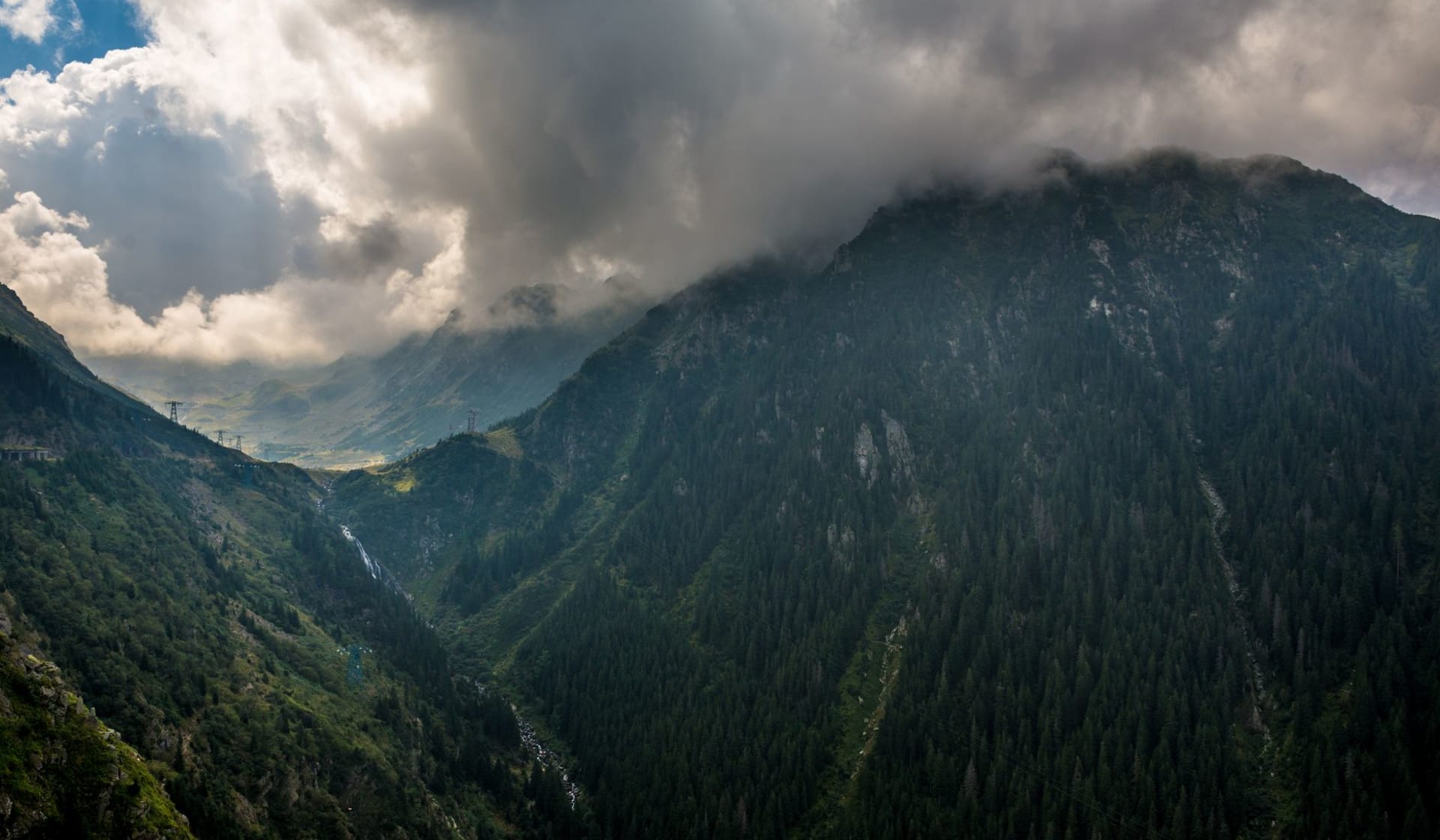
Fagaras Mountains
"The ridge was above the clouds and the clouds were above everything else."
The Fagaras are visible from half of Transylvania. You see them from Brasov, from Sibiu, from the train between the two — a wall of dark granite running along the southern horizon, the sort of mountain profile that makes you put down whatever you’re reading and stare. They’re called the Transylvanian Alps, which is accurate if slightly grandiose: the ridge is genuinely alpine in character, with glacial lakes, permanent snowfields into July, and technical terrain that has killed people who underestimated it. I am not a technical climber, but I am someone who walked for seven hours along the main ridge trail and came back a different person in ways I have not entirely processed.
The Transfagarasan Road
Before talking about the hiking, I should mention the road, because it is the thing most people know about the Fagaras. The Transfagarasan was built between 1970 and 1974 on Nicolae Ceausescu’s orders, ostensibly for military access over the mountains and more plausibly because Ceausescu wanted an infrastructure trophy. It crosses the main ridge at 2,034 meters through a tunnel and then descends in a series of switchbacks so extreme that the road essentially doubles back on itself eight times in a kilometer. When Jeremy Clarkson called it the best road in the world on Top Gear, tourism to the pass increased significantly, which is either a testament to his influence or a warning about it. I drove it in a rented Dacia. The car handled it fine. I was slightly nervous. The view from the pass, looking south across the reservoir of Balea Lake, is legitimately extraordinary.
Hiking the Ridge
The main ridge trail, marked in blue, runs the length of the Fagaras from east to west and takes several days to complete end to end. Mountain huts — cabane — are spaced along the trail at roughly day-hike intervals, offering basic dormitory beds and simple food. I joined the ridge at the Balea Lake cable car station and walked westward for a day, covering about fifteen kilometers along a trail that never quite lets you forget that you are on a narrow ridge with serious drops on both sides. The going was not always easy: sections of scrambling over loose rock, snow crossings in late June, wind that came from nowhere and pushed. Balea Lake itself, at the cable car terminal, is a glacial lake at 2,034 meters — grey-green, cold-looking, ringed by scree — with a small chapel carved entirely from ice each winter that melts each summer.
The Lakes Below
The southern slopes of the Fagaras hold a series of glacial lakes — Lacul Capra, Buda, Caltun — that are accessible by shorter day hikes from the Transfagarasan road. These are not easy strolls; the trail to Caltun Lake gains 600 meters in three kilometers and involves the kind of sustained effort that makes the moment you sit down at the water’s edge feel proportionate. The lakes are the color of old glass, cold and clear, surrounded by the grey cirque walls left by retreating ice. There were marmots in the rocks below the path. I heard them whistling before I saw them, which is always how it goes.
What To Know Before You Go
The Fagaras are real mountains with real weather. In summer, afternoon thunderstorms are routine and can develop faster than a trail map suggests. The ridge above 2,000 meters offers no shelter. I watched a thunderstorm develop from a clear sky in about forty minutes one afternoon and was grateful to be off the high ground. Mountain huts require reservations in summer and fill up. The trail markings are generally reliable but bring a GPS track. Water is abundant but should be treated. Bears are present; this is not theater.
When to go: July and August for snow-free ridge walking, though these months bring afternoon thunderstorm risk. Late June has lingering snow on north-facing sections but less crowding. September is ideal — stable weather, no snow, the ridge uncrowded, the light lower and more dramatic. The Transfagarasan road typically closes by November 1 and reopens in June.