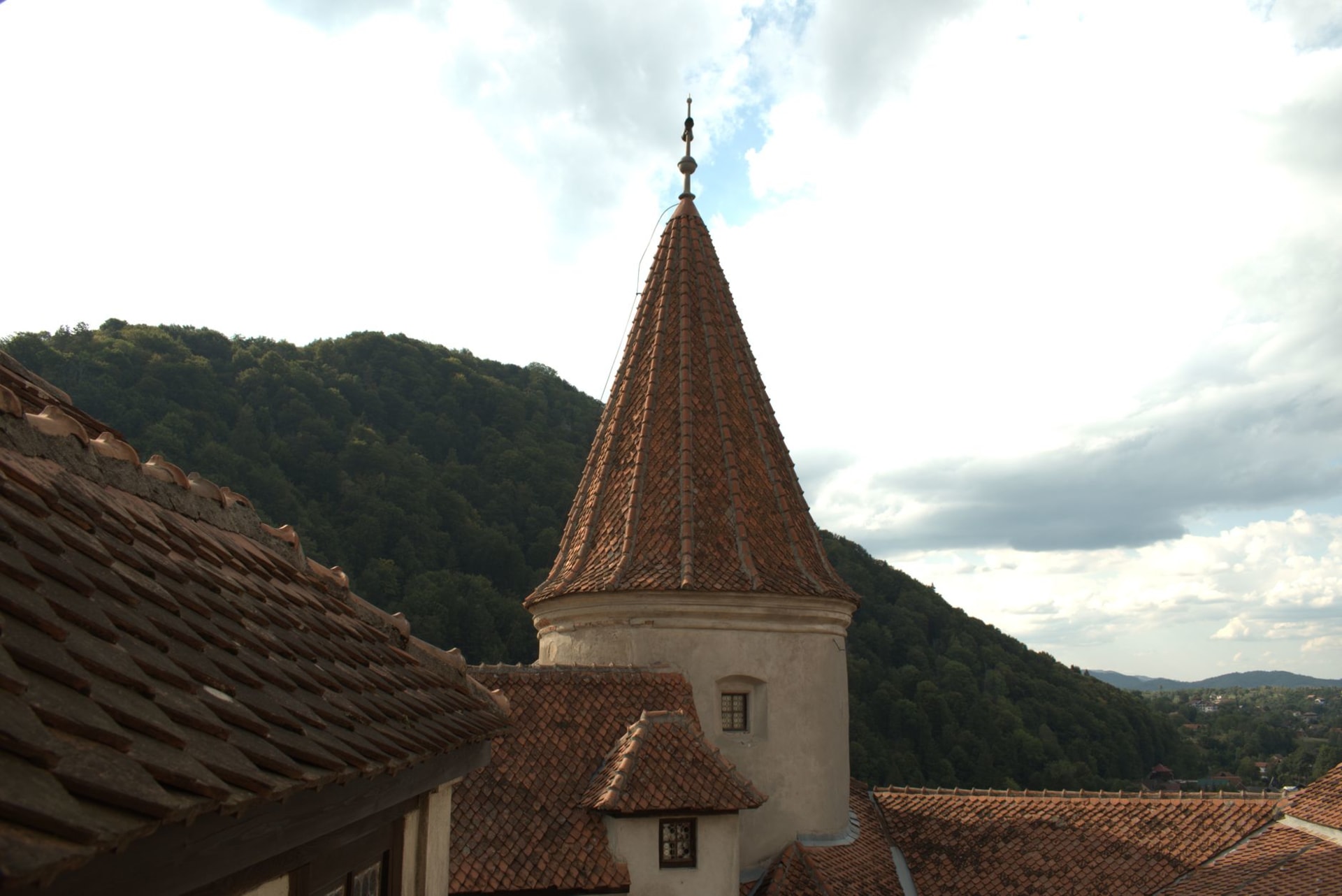
Bran Castle
"It didn't need the vampire myth. It was already doing something weirder."
Every guide book about Bran Castle feels obligated to mention, usually in the first sentence, that Vlad the Impaler almost certainly didn’t live here. The castle has some tenuous historical connection to Vlad II — he may have been imprisoned here briefly, he passed through the Bran Pass — but the Dracula branding is primarily a tourist invention grafted onto Bram Stoker’s novel, which was itself mostly set in a castle Stoker invented from a sketch and never visited. I went knowing all of this and was still, despite myself, impressed.
The Crag and the Approach
The castle sits on a limestone outcrop at the narrowest point of the Bran Pass, where the road between Transylvania and Wallachia has always been funneled through a gap in the Carpathians. From the parking area below, you walk up through a gauntlet of souvenir stalls selling wooden stakes and plastic fangs and Dracula magnets — this part is as bad as you’re imagining. Then the stalls end and the path curves and the castle appears above you and it is, unambiguously, dramatic. The whitewashed towers and steep terracotta rooflines rise from bare rock; the whole thing looks like it was dropped here by a film studio that knew exactly what it was doing.
Inside the Rooms
The interior is a maze of steep stairs, low doorways, and small rooms connected by a courtyard well and a network of passages that don’t go where you expect them to. The castle was extensively renovated in the early 20th century by Queen Marie of Romania, who used it as a summer residence and decorated it with a mix of antique furniture, Romanian folk art, and Transylvanian peasant textiles that has nothing to do with vampires and everything to do with a woman with serious aesthetic opinions and a large space to fill. Her rooms are the most interesting part. The secret passage inside the well that connects upper and lower floors is worth finding.
The Village Below
After the castle, the village of Bran itself is worth thirty minutes. The main street running toward the pass has a string of guest houses and small restaurants. I ate sarmale — stuffed cabbage rolls in tomato sauce, with sour cream — at a table outside one of them, looking back up at the castle, which kept appearing at the end of streets like something that had followed me from the previous paragraph. The Bran area is also the edge of the Rucar-Bran corridor, a traditional pastoral zone where shepherds still move flocks seasonally through the mountain passes. In May and September you can occasionally see the flocks on the road, which is both beautiful and a significant traffic problem.
What It Actually Is
Bran is not really a Dracula castle. It’s a medieval customs and military checkpoint that became a royal summer residence that became a museum and then a tourist attraction. This layered history is more interesting than the vampire story, and the castle tells it well if you read the placards rather than racing past them looking for something gothic. The view from the highest tower, across the Bran Valley with the Bucegi Massif to the east and the Fagaras ridgeline to the west, is straightforwardly magnificent. You don’t need Dracula for that.
When to go: Weekday mornings from May to September are the least crowded. The castle is closed Mondays. October is high season for obvious thematic reasons and crowds are substantial. Bran in winter, with snow on the crag and the souvenir stalls shuttered, is quieter and considerably more atmospheric.