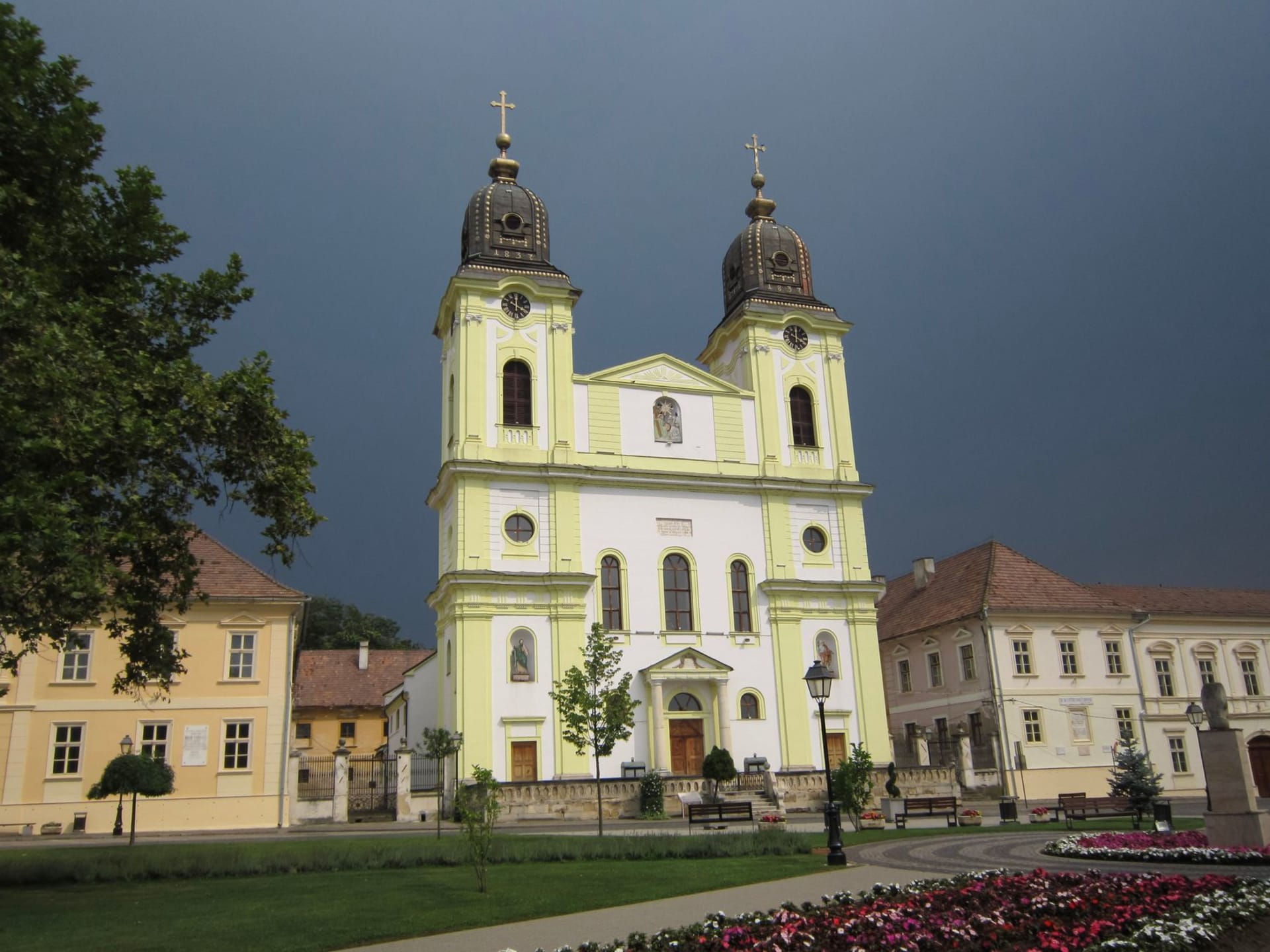
Alba Iulia
"The gates have stone eagles. Every single one. I stopped counting at six."
Alba Iulia has a problem that most cities would consider a luxury: too much history in too small a space. The fortress hill contains, in rough stratigraphic order: Dacian settlement, Roman provincial capital, medieval Hungarian royal city, Ottoman administrative center, Transylvanian principality seat, Habsburg fortification, and Romanian unification venue. Each layer left something visible. Walking through the star-shaped Vauban fortress built by the Habsburgs in the early 18th century, I kept bumping into Roman column fragments used as gate posts, medieval wall sections incorporated into later construction, plaques in three languages that disagreed mildly about what everything meant.
The Star Fortress
The Citadel of Alba Iulia was built between 1716 and 1735 by Habsburg engineers following the Vauban system of star-shaped fortifications with angled bastions designed to eliminate dead angles in defensive fire. It is enormous — the walls enclose roughly 70 hectares — and the gateways are baroque set pieces of stone carving, with Habsburg eagles, military trophies, allegorical figures, and armorial shields piled onto the lintels in a way that communicates something between military authority and art collection. Gate III, the main ceremonial entrance, has the quality of an elaborate stone argument about power. I walked through it three times.
The Cathedral and the Coronation
Inside the fortress, the Cathedral of the Coronation was built between 1921 and 1922 specifically to house the ceremony crowning King Ferdinand I and Queen Marie as monarchs of Greater Romania — the unified Romanian state created after World War I when Transylvania, Wallachia, and Moldova were joined for the first time. The building is neo-Byzantine, decorated in a program of mosaics and frescoes that reads as a conscious attempt to create a Romanian national visual vocabulary. The royal tombs are here: Ferdinand and Marie, whose heart is buried separately at Bran Castle at her request, which is either very romantic or a very complicated way to handle a marriage, possibly both.
Roman Apulum
The Roman ruins are visible in fragments throughout the fortress complex: mosaic floors in protective shelters, column drums serving as informal benches, the foundations of the Principia — the administrative headquarters of Legio XIII Gemina — exposed in an excavated zone near the main gate. The National Museum of the Union has a well-organized collection of Roman material, including a bronze she-wolf (a replica of the Capitoline Wolf, gifted by Rome in the 1920s as a statement about Daco-Roman continuity that was also a 20th-century political argument dressed as mythology). The argument was interesting. The bronze wolf was also good.
The Town Below the Hill
The modern city below the fortress hill is a medium-sized Romanian provincial town with nothing that demands your attention, but the short walk between the train station and the fortress passes through streets of Interwar apartment buildings and a central square with the usual post-Ottoman clock tower that earn thirty minutes of unhurried looking. There is a market near the station on weekday mornings where I bought a bag of garlic and a jar of rosehip jam and felt the satisfying anonymity of a tourist in a place that isn’t particularly used to tourists.
When to go: May and September are best. The fortress hosts Alba Iulia’s reconstruction of the Guard Change ceremony with soldiers in period uniform — theatrical, yes, but executed with enough seriousness to justify an hour of your time. December 1st is Romanian National Day and the city hosts major celebrations that draw large crowds; interesting to witness once.