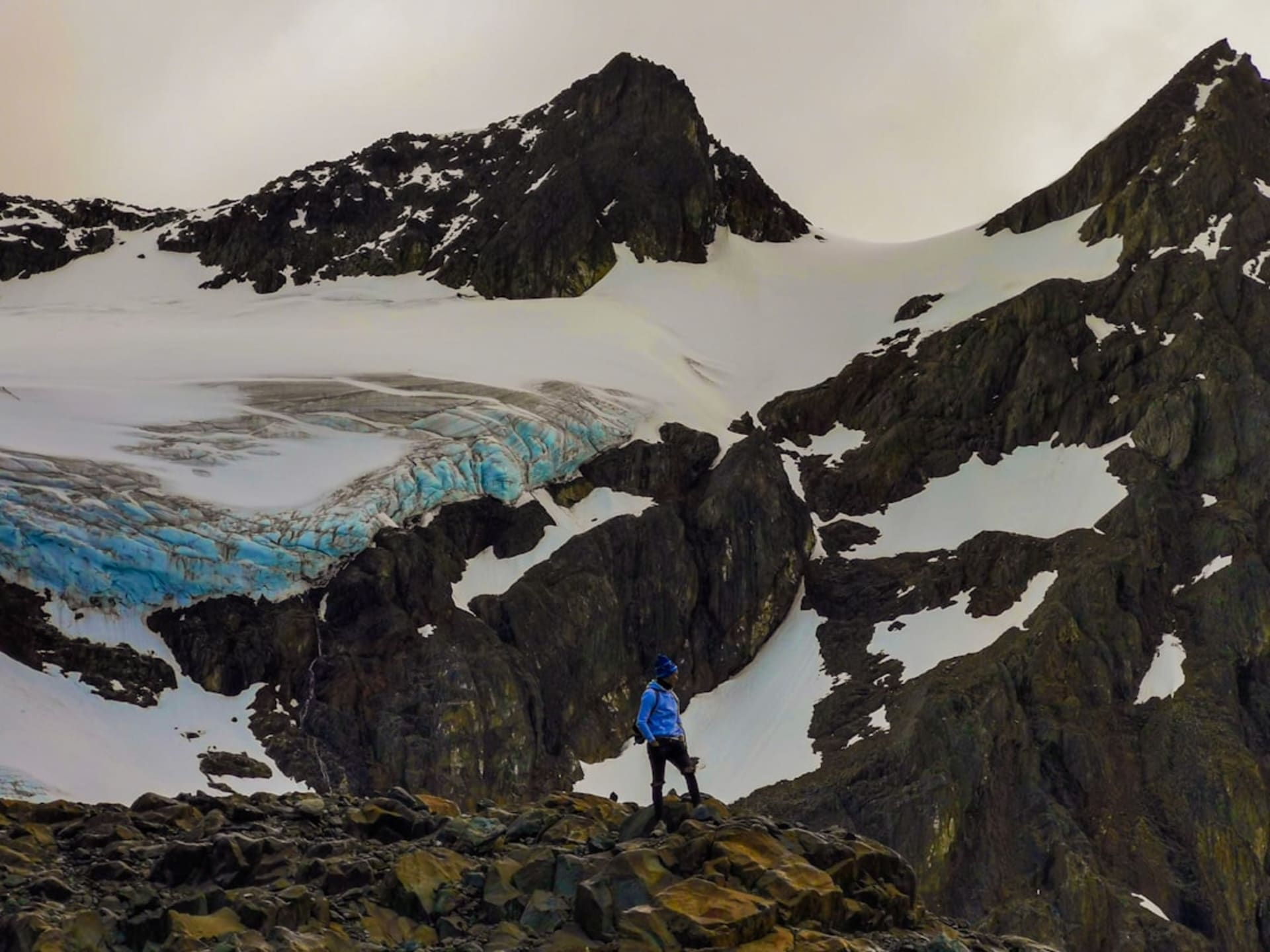
Tierra del Fuego National Park
"The trail signs say 'fin del camino.' I kept looking for the door."
Twelve kilometers west of Ushuaia, the national park begins where the last gas station ends. The road drops through lenga beech forest — those extraordinary southern beeches that turn brilliant orange and crimson in April before losing their leaves entirely — and opens onto Lago Roca, where the water is a color I have no good word for. Turquoise undersells it. Glacial milk isn’t quite right either. It is the color of something cold thinking about becoming blue.
The Lapataia Circuit
Most visitors follow the Senda Costera, the coastal trail that winds between Bahía Ensenada and Bahía Lapataia along the Beagle Channel shore. I did it in both directions across two days and found the southbound version more interesting — you end at Lapataia with the sensation of arrival rather than return. The trail weaves through coihue forest smelling of moss and wet bark, opens onto pebbled beaches where kelp piles in brown ropes, then climbs briefly onto headlands where the channel spreads out before you, the Chilean mountains blue and snowcapped on the far shore.
The birdlife along the Senda Costera is constant and varied: Magellanic woodpeckers hammering at dead trunks, steamer ducks on the water, austral thrushes calling from the forest edge in a song that’s too pretty for somewhere this severe. I stopped counting species after twelve and just walked.
Where the Road Ends
Lapataia Bay is the formal terminus of Ruta Nacional 3, the highway that begins in Buenos Aires and concludes here with a small painted sign that reads: Buenos Aires 3,079 km. A red mailbox stands nearby. Tourists mail postcards from it. I mailed one to my parents in France — partly for the joke of it, partly because it is genuinely the end of the road in a way that felt worth marking.
The bay itself is shallow and calm, a nursery of kelp and waterfowl protected from the channel winds by surrounding hills. Lia found a family of upland geese grazing the tidal flats, the male luminously white, and we stood watching them until a group of day-trippers from a cruise ship arrived with a megaphone guide and the geese walked unhurriedly into the forest.
Beaver Damage and Ecological Grief
North American beavers were introduced here in 1946 for the fur trade, which failed. What didn’t fail was the beavers’ enthusiasm for reengineering watersheds. They have no natural predators in Tierra del Fuego, and the damage to the lenga beech forests is visible from many trails: dead trees standing silver in flooded meadows, streams backed up behind mud dams, the peculiar sadness of a beautiful forest drowning slowly. Eradication programs have been underway for years with mixed success. Knowing this gave the park a bittersweet quality — extraordinary beauty and ongoing ecological catastrophe occupying the same geography.
I found myself rooting for the beeches.
When to go: The park is open year-round. October through March for hiking; April for the autumn color display in the lenga beech, which is one of the most underrated fall foliage experiences in South America. Winter (June–August) brings snow that transforms the trails into something genuinely remote and difficult — doable with the right gear, but plan for short days and pack accordingly.