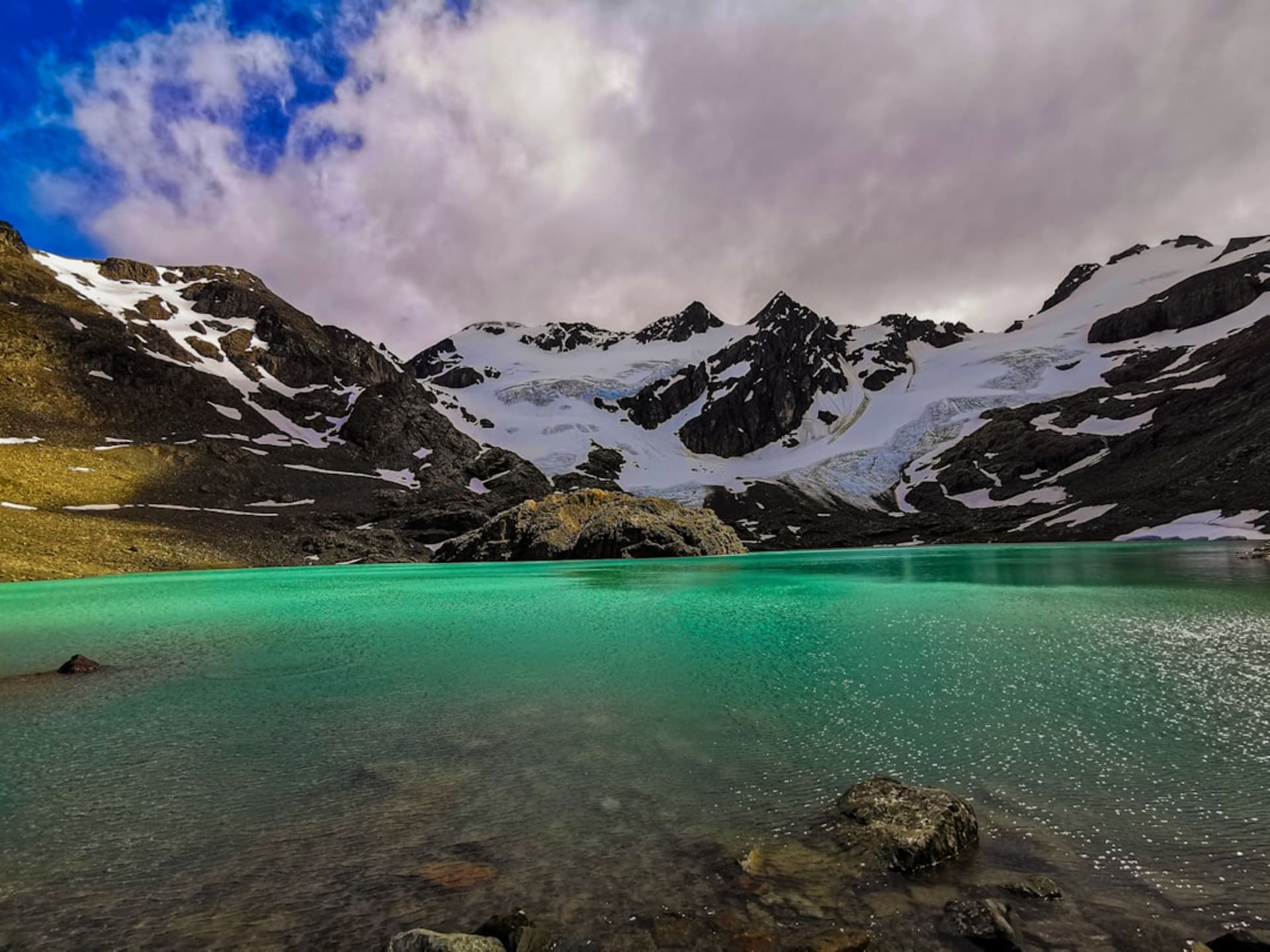
Lapataia Bay
"The highway sign says Buenos Aires is 3,079 kilometers away. It feels further than that."
I have been to the ends of things before — the western edge of Ireland, the northern tip of Norway, the easternmost point of continental Portugal. These places share a quality: the landscape cooperates with the drama of finality. Lapataia Bay does this well. The road ends at a gravel pullout between the lenga beech forest and the water, and there’s a sign, and there’s a red mailbox, and there’s the bay itself running west toward the channel, and beyond that the Chilean channels, and beyond those the Drake Passage, and beyond that Antarctica. You can trace the line of it from where you stand.
The Road That Started in Alaska
Ruta Nacional 3 begins (or ends, depending on your direction) at the Pan-American Highway in Alaska. By the time it arrives at Lapataia it has run through a dozen countries, crossed the Darién Gap in spirit if not in fact, and accumulated the entire length of two continents beneath it. The sign at Lapataia notes the distance to Buenos Aires: 3,079 kilometers. It does not note the distance to Prudhoe Bay, Alaska, from where this road originated. That number is closer to 25,000 kilometers.
I stood at the sign with two other travelers — a couple from Mendoza who had actually driven the entire Argentine stretch of the highway, Buenos Aires to Ushuaia, in a camper van. They photographed the sign with the exhausted satisfaction of people who have arrived after actually traveling to get here, not just flying into Ushuaia and driving twenty minutes. I felt appropriately humbled.
The Bay Itself
Lapataia is protected from the channel by a narrow peninsula, which makes it calm even when the Beagle Channel is rough. The water is shallow and brown with tannins leached from the lenga beech and peat bogs upstream. Kelp anchors to every rock below the tidal line; at low tide the bay becomes a maze of exposed weed and tidal channels where steamer ducks paddle with unhurried purpose.
The birdlife along the bay’s shore is exceptional even by national park standards. I counted six species of waterfowl from the parking area in thirty minutes without really trying: upland geese, kelp geese, steamer ducks, black-necked swans, South American terns, and a lone great grebe that sat in the middle of the bay looking personally aggrieved by my presence. The kelp goose female, almost entirely brown and easily missed, was foraging in the tidal wrack ten meters from where I stood.
The Castorera Loop
A short trail loops from the bay through lenga beech forest and along a beaver-dammed stream — one of the many casualties of the introduced North American beaver population. The dam itself is engineering that I found impressive despite my environmental reservations: a meter-high structure of interlaced branches and mud stretching thirty meters across the stream, holding back a hectare of flooded forest. The dead beeches stand silver in the resulting lake, their bare branches hosting nesting cormorants, which is either irony or adaptation depending on your perspective.
The loop takes about forty minutes and brings you back to the bay through a section of intact forest where the mushrooms on fallen logs are enormous and the ground is spongy with moss. The air smells of cold water and decomposition and something faintly sweet that I could not identify.
The Mailbox
You can mail a postcard from the red mailbox at the end of the road. I did not — I had nothing to write on — but watched other people do it with a sincerity that I found unexpectedly moving. The act of sending something from the end of the world to somewhere more central: an acknowledgment that the center and the edge are connected, that geography is not actually finality.
When to go: Lapataia Bay and the surrounding national park are best visited October through April. The bay is most vivid in autumn (March–April) when the lenga beech turns orange and gold around the water’s edge, the light goes golden in the afternoon, and the crowds of high summer have thinned. December and January offer the longest days for exploring the connecting trails. Avoid arriving at midday in January when tour buses from Ushuaia fill the parking area; mornings and late afternoons are dramatically quieter.