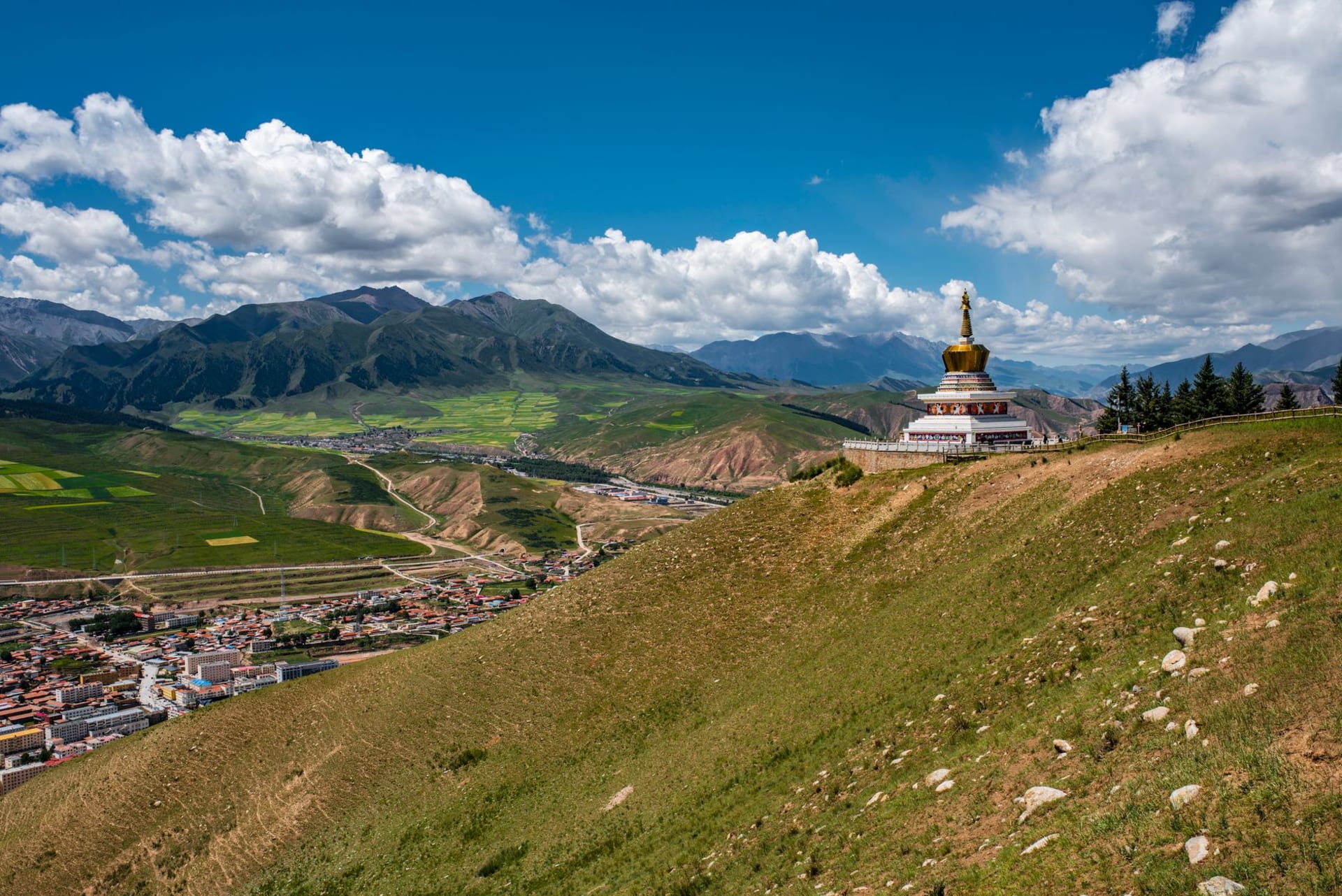
Every country has a place where it understands itself to have started. For Tibet, that place is the Yarlung Valley — a wide, green trough running south of the Tsangpo river where the first Tibetan kings held court, where the first monasteries were founded, where the conversion from Bön to Buddhism was negotiated over centuries of cultural turbulence. Coming here from Lhasa feels like moving backward through time in a way that isn’t metaphorical. The valley looks ancient because it is.
The drive from Lhasa takes about three hours. The landscape shifts: higher up on the plateau the ground is brown and mineral, but the Yarlung Valley floor is irrigated and agricultural, barley fields running in terraces up the lower hillsides, the river wide and silver in the middle distance. In late summer, when the barley is gold, the contrast with the grey-brown mountains above it is startling.
Yumbulagang
The small palace-temple on the eastern hillside above the valley is considered the oldest building in Tibet — tradition holds it was built in the second century BCE as the residence of the first Tibetan king, though the current structure dates mainly to later reconstructions. It sits on a narrow ridge and looks exactly as a fortress-temple built on a ridge above a sacred valley should look: compact, vertical, improbable, with prayer flags snapping from the rooftop in the wind that funnels up the valley sides.
I climbed to it in early morning before other visitors arrived. The view from the small roof terrace took in the full length of the valley — green floor, terraced fields, the pale glitter of the river, mountains closing the far ends. A monk was lighting lamps inside the main chapel. The smell of warm butter fat drifted out through the door.
Tradruk Temple
Down in the valley floor, Tradruk is one of Tibet’s oldest temples, founded in the 7th century as one of the geomantic “demon-suppressing temples” built to pin down a threatening landscape spirit. The building is modest from the outside — a low courtyard complex of whitewashed walls — but inside holds remarkable treasures: a 9th-century pearl thangka, an assembly hall lined with paintings that predate most Tibetan art styles. The thangka is kept behind glass in a darkened inner chapel and depicts a bodhisattva assembled from roughly 29,000 pearls, each individual pearl visible on close inspection. It’s an object that operates outside of most aesthetic categories.
Tombs of the Early Kings
On the western side of the valley, a field of earthen burial mounds marks the tombs of Tibet’s early kings — enormous tumuli overgrown with grass, scattered across the valley floor with the informality of something the landscape absorbed over time. There are no fences, no barriers. I walked between them freely. The scale of the mounds is impressive — some rise fifteen metres — and the silence around them is complete. A lone yak was grazing at the base of one. It looked entirely appropriate.
The Village of Tsedang
The nearest town, Tsedang, serves as the valley’s administrative centre and has a range of guesthouses and restaurants. It’s a functional place rather than a picturesque one — wide streets, concrete government buildings, a market. But the restaurant I ate dinner in served a Tibetan noodle dish I’ve been thinking about since: hand-stretched noodles in a dark broth with dried mushrooms and a quantity of chilli that I misjudged and suffered for pleasantly.
When to go: May through October. The valley’s lower elevation (around 3,550 metres) makes it more accessible and less physically demanding than higher Tibetan destinations. Late August and September are particularly appealing when the barley harvest is underway and the valley floor is gold.