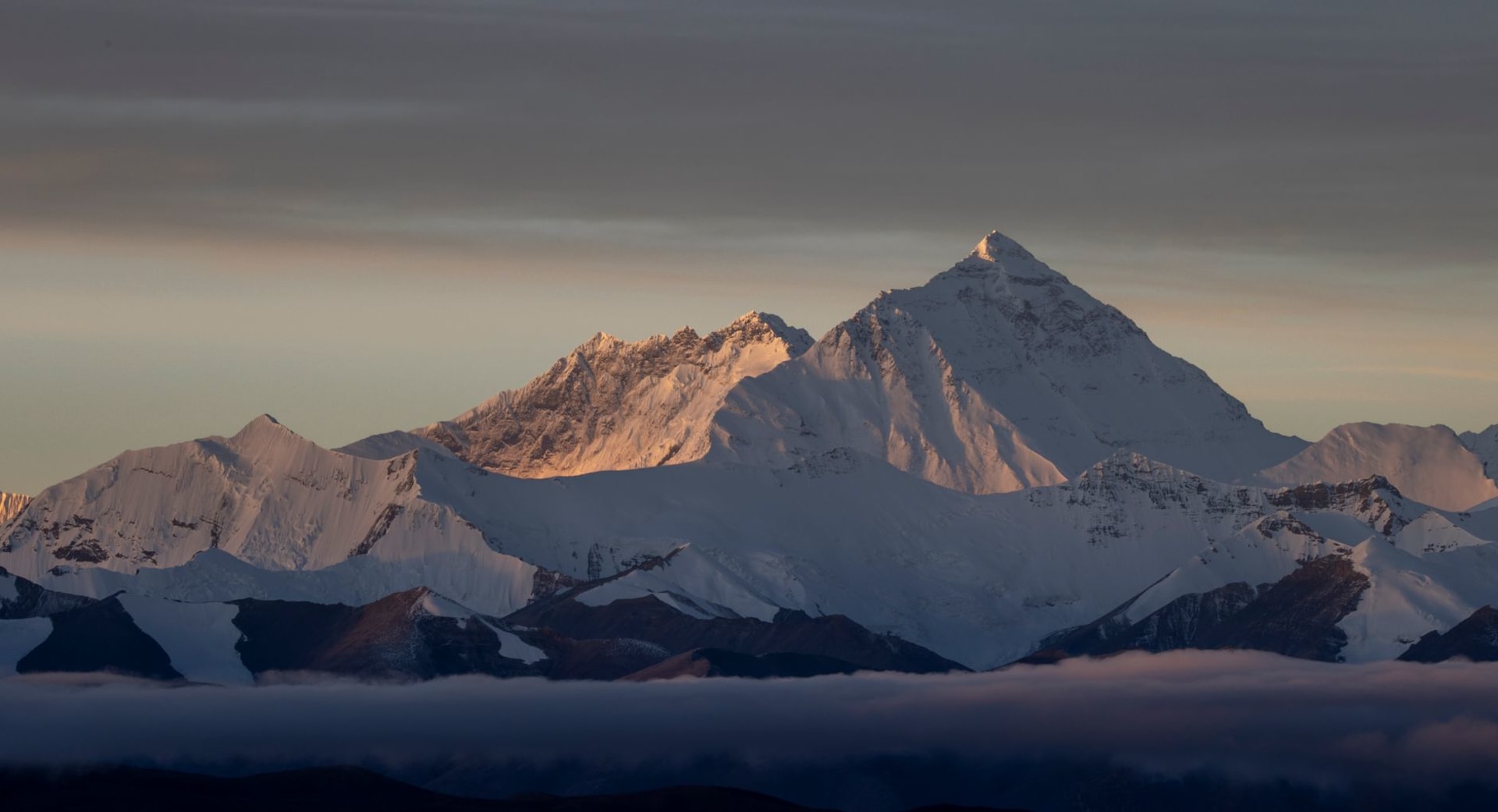
Everest Base Camp (Tibet)
"I drove to the foot of the world's highest mountain. That still feels absurd."
The absurdity of driving to Everest Base Camp takes a while to sink in. You’re in a Land Cruiser on a paved-then-gravel road, snacking on peanuts, watching the world’s highest mountain grow steadily larger through the windshield. By the time you stop at 5,200 metres and step out into the cold, thin air, the north face of Everest is right there — filling the upper third of your vision, the summit plume streaming east in the jet stream like the mountain is exhaling.
Nepal’s base camp is famous and crowded. Tibet’s is quiet by comparison, approached from the north via the Friendship Highway, and gives you something Nepal cannot: a clean, uninterrupted view of Everest’s full triangular profile without the obscuring ridgelines of the south approach.
The Road Through Tingri
The approach from Shigatse takes you across the Tibetan plateau on wide, empty roads. The landscape is the colour of hay and ancient stone, interrupted by turquoise lakes that appear without warning. Tingri is the last real town before the turn-off — a wind-scoured place of single-storey buildings and yaks ambling through unpaved lanes. I ate tsampa porridge at a roadside table with three truckers who regarded me with mild curiosity and then returned to their conversation. From Tingri the road climbs. You top a pass at over 5,000 metres and the entire Himalayan chain opens in front of you: Everest, Lhotse, Makalu, Cho Oyu, all of them queued along the horizon like a wall of white teeth.
Rongbuk Monastery
Three kilometres before base camp sits Rongbuk Monastery, the highest monastery in the world. It was founded in the early 20th century and its monks and nuns live year-round at 4,980 metres, which I find both admirable and slightly baffling. The monastery is small and orange-red against the brown hillside. I spent an hour inside watching a young monk arrange butter lamps — pressing each one into the sand of a wide offering trough with practiced precision, lighting them with a long match, moving on. The lamplight threw orange shadows against thangkas painted with fierce protective deities. Everest was framed in the doorway behind me the whole time.
Base Camp at Dawn
Lia and I woke at 4 a.m. and walked the dirt track from our tent camp to base camp in the dark. The cold was absolute — the kind that doesn’t so much bite as simply occupy your body. We arrived before sunrise and stood there with three other visitors and a lot of silence. Then the light came: first a pink strip along the ridgeline, then a wash of orange that climbed Everest’s face from the base upward until the summit caught fire. We didn’t say much. There wasn’t much to say. The mountain makes speech feel fussy.
What to Expect
Chinese and Tibetan authorities have clamped down on independent trekking beyond the base camp viewpoint; the summit push areas are restricted to registered expeditions. But the viewpoint itself is fully accessible and the view is not diminished by fences. The permit system means you’re visiting with a guide and a fixed itinerary, which actually helps at this altitude — someone else handles the logistics while your body adjusts to breathing nothing.
When to go: April–May and September–October are the pre- and post-monsoon windows with the clearest skies. Summer monsoon (July–August) brings afternoon clouds that often obscure the summit. Winter is bitterly cold and most guesthouses close. April offers the best chance of catching expedition teams at base camp if you want to see the mountain in full expedition mode.