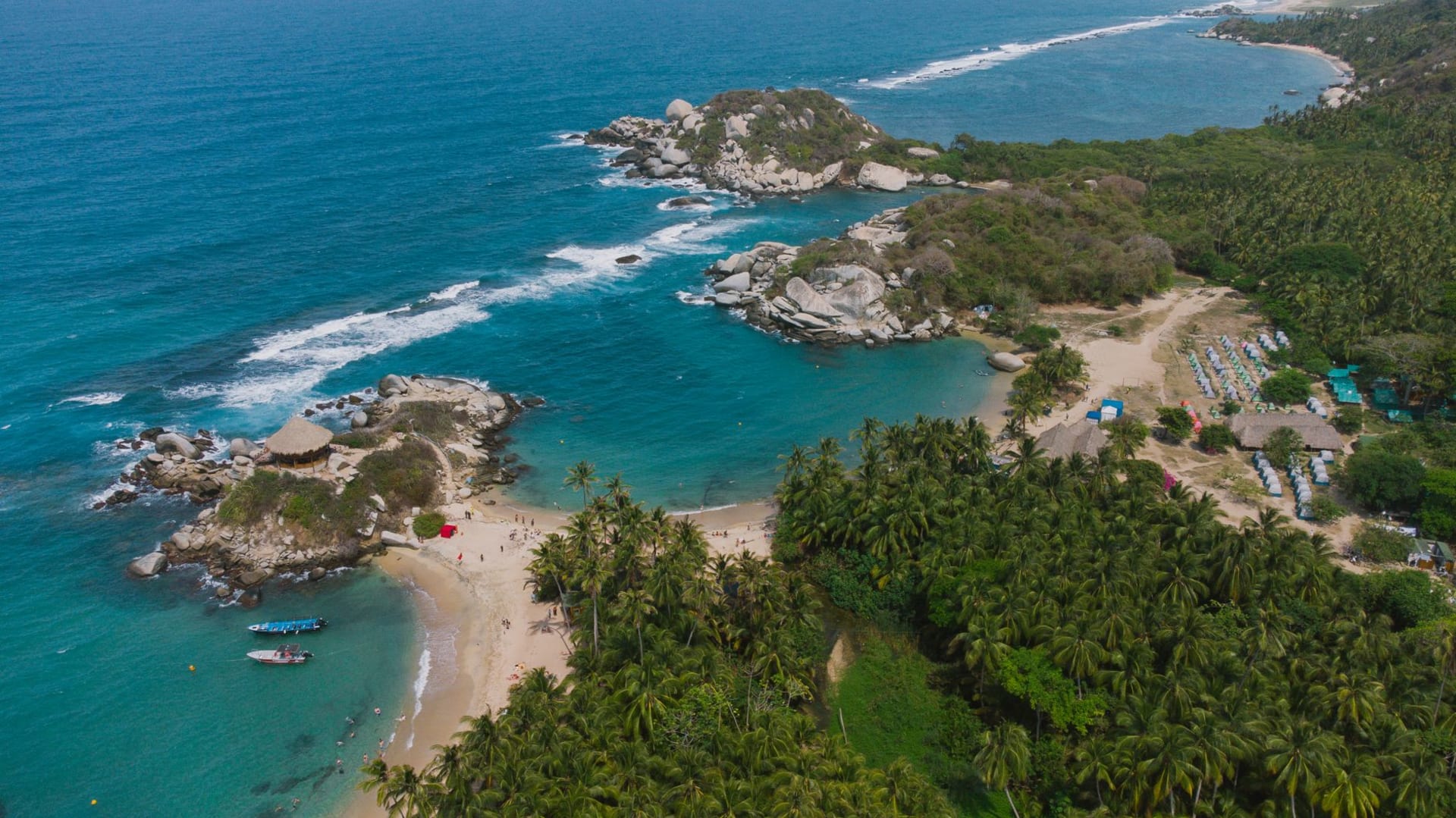
Boca del Palomino
"The river doesn't ask permission — it just walks into the sea and lets the physics sort itself out."
The Palomino River rises somewhere in the Sierra Nevada de Santa Marta, in the indigenous territories of the Kogi and Arhuaco, in cloud and high-altitude wetness, and descends through roughly eighty kilometers of progressively warmer jungle before arriving at the Caribbean with considerable momentum. At the mouth — Boca del Palomino — it pushes a visible plume of brown, cold, mineral-rich freshwater into the warm blue-green sea. You can see the seam from a distance. You can feel it with your legs when you cross it.
I first arrived at Boca del Palomino in an inner tube, which is the standard approach. The tubing run deposits you directly at the river mouth — the current carries you without asking for input, delivers you to the sea, and then the Caribbean takes over. Standing waist-deep with cold water on one side and warm on the other is a small physical surprise I’d recommend experiencing at least once, even though I’m aware it sounds like I’m describing a temperature test.
The River Mouth Itself
The mouth shifts with the season and with rainfall. In dry months the river is lower and the sandbar at the mouth grows wide enough to walk across in places, creating temporary islands that pelicans and egrets use as staging grounds. In the wet season the river runs higher and faster and the mouth is more muscular, the freshwater pushing further into the sea before being absorbed.
The beach on either side of the mouth is good in different ways. West toward the town of Palomino: a long stretch of palm-shaded sand, the waves manageable, a few beach bars and small restaurants coming to life in the late morning. East of the mouth: progressively wilder, the built environment falling away within a few hundred meters, coast that extends toward the Guajira peninsula with no major tourist infrastructure for a long stretch.
The Upstream Approach
The tubing route starts about forty-five minutes upstream by foot, at a put-in point where the river runs fast and clear over a gravel bed. The walk through the jungle to the put-in is itself worth the effort — the river alongside you the whole way, egrets lifting from the shallows ahead, the temperature dropping as the canopy thickens.
The inner tubes are rented in Palomino town, usually through your accommodation or from a stand near the river bridge. The price is nominal. The rubber is occasionally questionable — inspect yours before committing your afternoon to it. On my second tubing run I discovered a slow leak about halfway down and spent the back section increasingly at water level, which added an unexpected dimension to the fish-spotting.
The Convergence as Metaphor
I’m generally suspicious of landscape metaphors but the Boca del Palomino earns its. Here’s the Sierra Nevada — this enormous, isolated, indigenous-protected mountain range rising from the Caribbean coast — sending its water down through a week’s worth of altitudinal zones to arrive at the sea. The river carries the chemistry of snowfields and cloud forest and agricultural slopes into the salt water, and the sea simply absorbs it. There’s something about the matter-of-factness of that transaction that I found unexpectedly moving the first time I sat at the mouth and watched it.
The pelicans weren’t moved by it at all. They had fish to assess.
When to go: October and November bring the highest river levels and fastest tubing — exciting, but the water is murkier and the path to the put-in is muddy. January through March is the dry-season sweet spot: clear water, reliable weather, and the sandbars at the mouth are at their most dramatic. Avoid holiday weekends when the river path gets crowded.