Strahan
"The river runs black and still and ancient, and you feel the weight of millions of years in the silence."
Getting to Strahan is part of the point. The town sits on the west coast of Tasmania, and the west coast of Tasmania is not on the way to anything. You come over the mountains from Queenstown — a former copper-mining town whose treeless, acid-orange hills are their own kind of extraordinary — and drop down to the harbor through dense rainforest, the road hairpinning until the glint of Macquarie Harbour appears below you like a secret.
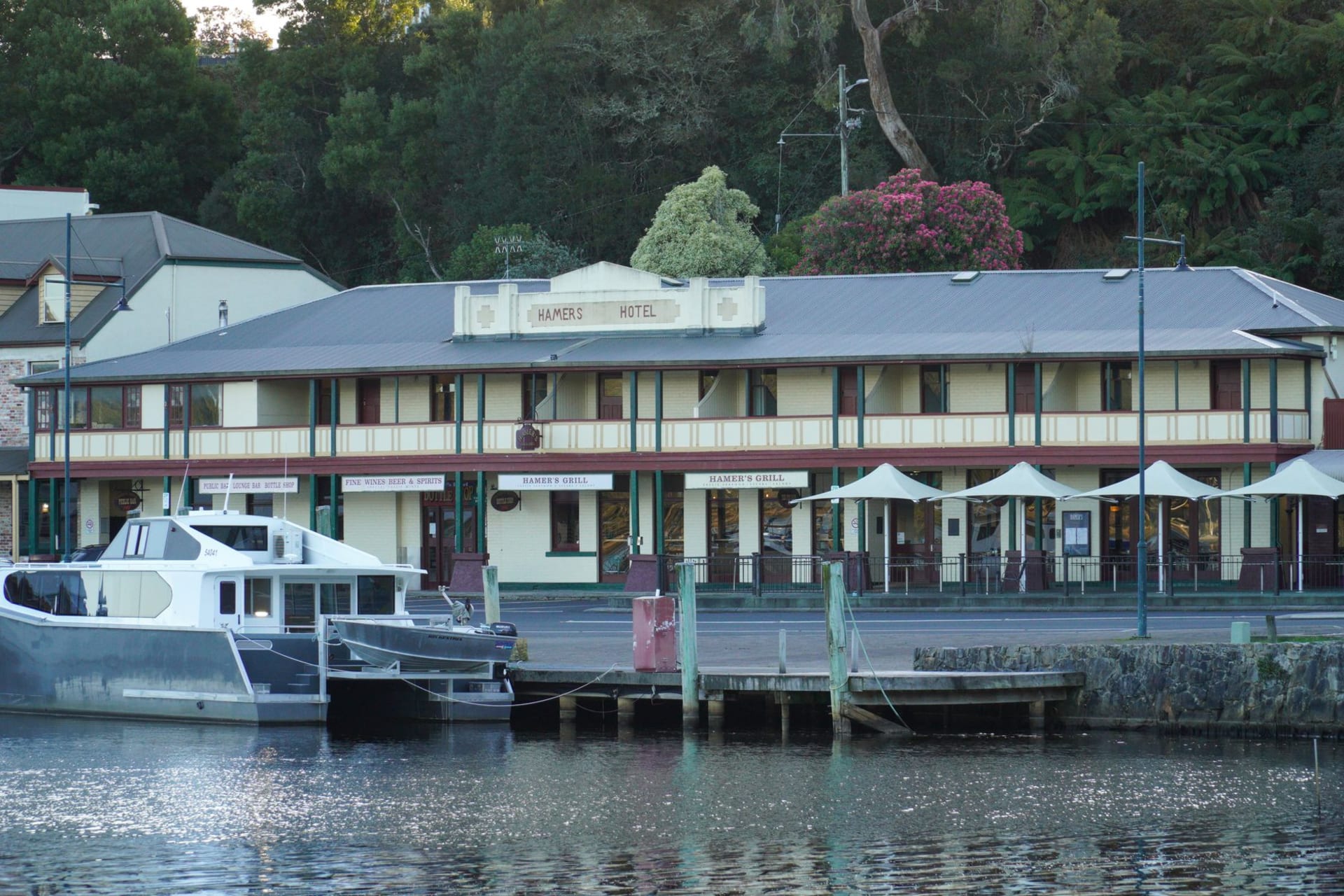
The harbor is enormous — five times the size of Sydney Harbour — and the town at its edge is tiny: a few hundred people, one main street, a small fleet of boats. The disproportion between the body of water and the settlement is part of what Strahan is.
The Gordon River
The reason people come to Strahan is the Gordon River, which flows south through the Southwest Wilderness into Macquarie Harbour. The only practical way to see it is by boat: a day cruise from the Strahan wharf that moves through the harbor, out through the notorious Hell’s Gates — the narrowest, most turbulent harbor entrance in Australia — and then into the river itself.
The Gordon is dark. The tannins from the button grass plains and rainforest floor leach into the water and turn it the color of strong tea, but the clarity is extraordinary — you can see three to four meters down into perfect blackness. The rainforest on both banks is unbroken, dense, ancient. Huon pines line the lower river, some of them over a thousand years old, with bark that peels in long orange strips and a timber so dense it doesn’t rot. The boat moves slowly. No one talks very much.
There’s a small boardwalk stop on the river where you step off the boat and into the forest and the silence is immediate and complete. The canopy closes overhead. The ground is deep with moss. The smell is wet and green and ancient in a way that is distinct from any other forest smell I know. I stood in that silence for five minutes and thought about nothing, which doesn’t happen often.
The Franklin Fight
Macquarie Harbour and the Gordon River are inseparable from the Franklin Dam controversy, which played out here in the early 1980s when the Tasmanian government proposed damming the Franklin River — a wild river that feeds the Gordon — for hydroelectric power. The campaign against the dam became one of the founding moments of Australian environmental activism. Protesters blockaded the river from small boats. David Bellamy was arrested. Bob Brown went to prison. The “No Dams” campaign produced the most recognizable political image in Australian environmental history.
The Franklin was saved in 1983 when the federal government intervened. The southwest wilderness became a World Heritage Area. The Gordon River still runs free. Knowing this history as you sit on the boat watching the unbroken forest slip past gives the silence a different texture.
Strahan Itself
The town is compact enough to walk in twenty minutes end to end. There’s a good bakery, a marine pub with local craft beer, the wharf with its fishing boats and cruise vessels, and an amphitheater that hosts “The Ship That Never Was,” a long-running theatrical retelling of a convict escape from Macquarie Harbour — reputedly the world’s longest-running play by audience numbers, which is the kind of strange distinction that a remote Tasmanian harbor town earns.
I ate flathead and chips sitting on the seawall, watching the harbor go dark at dusk, the water turning the color of the river that fed it. The cold came in fast from across the water. I stayed until I couldn’t feel my fingers.
When to go: November through April, with the river cruises running daily in summer. The west coast receives some of the highest rainfall in Australia — go in the drier end of the summer window (January–February) for the best chance of calm water on the harbor crossing.