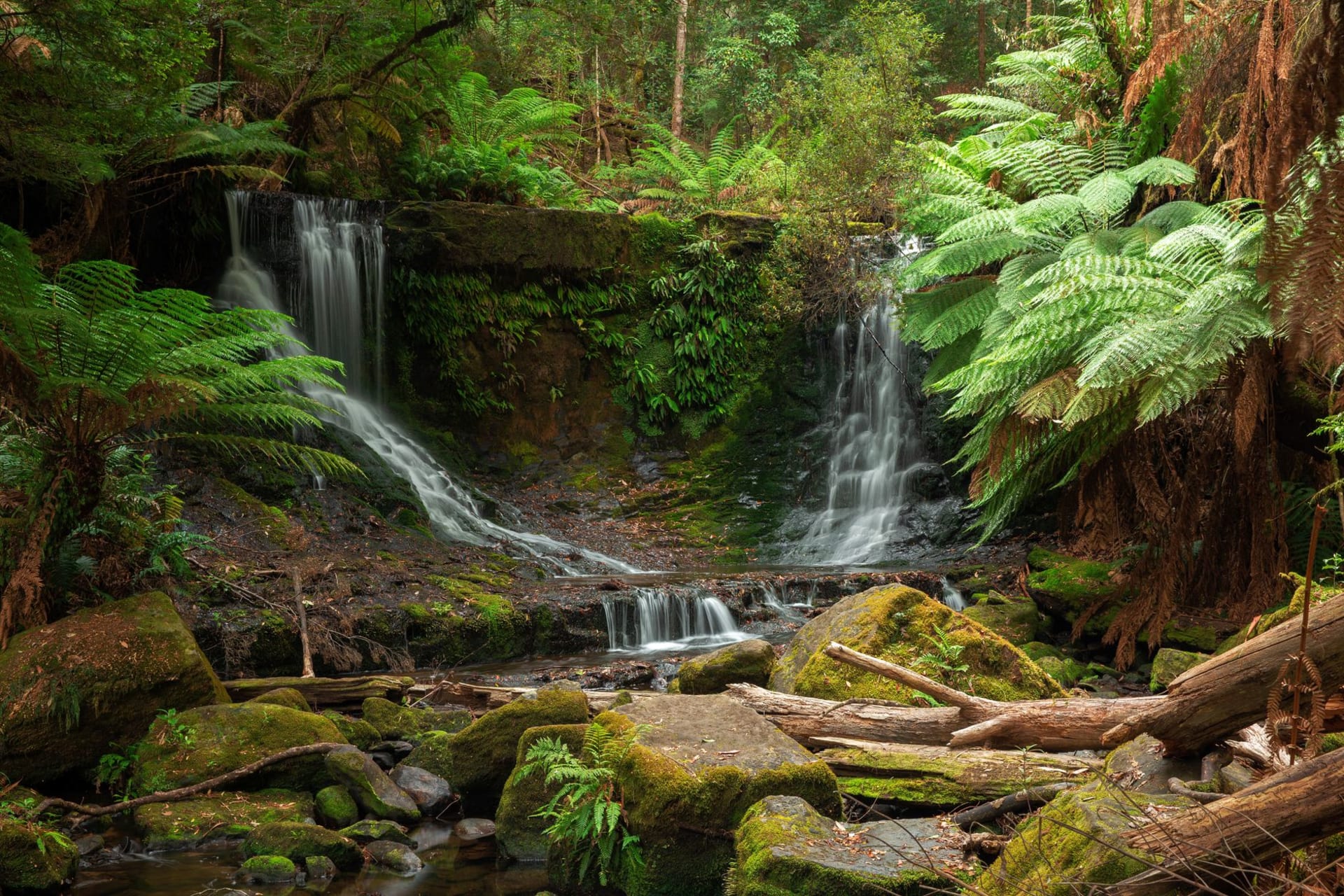
Mount Field National Park
"The tree ferns were taller than buildings and the waterfall sounded like rain inside a library."
Mount Field was declared a national park in 1916, which makes it Tasmania’s oldest, and it has the peculiar quality of a place that has been visited continuously for a century and yet still delivers on its promise. The Russell Falls are the headline, and headlines exist because they’re usually accurate. You walk fifteen minutes from the car park through increasing forest darkness — the swamp gums taller with each turn of the path, the tree ferns denser, the light more filtered — and then the falls appear: three tiers of white water dropping through a world that looks assembled by someone who wanted to demonstrate what the word “primordial” means.
Russell Falls
The falls are sixty-five meters of water falling through three separate shelves of volcanic rock, and the forest around them is the reason they matter as much as the water. The swamp gums here are among the tallest flowering plants on earth — eighty, ninety meters of straight trunk rising to a canopy far above — and the tree ferns at their feet are a species that has been doing exactly this since the Jurassic. Standing in that space, looking up through the fern fronds to the gum canopy to a pale circle of sky, produces a specific kind of dislocation, as if scale has been rearranged while you weren’t paying attention.
The path is paved and accessible and the falls receive a lot of visitors, but the forest absorbs sound so effectively that it rarely feels crowded. The damp air has a smell — green and cold and slightly fungal, the smell of things decomposing and growing simultaneously — that is completely distinct and has stayed with me more persistently than the visual memory.
The Lake Dobson Road
Above the falls, a road climbs sharply through increasingly cold air to Lake Dobson and the alpine plateau above. At the lake level, the vegetation has changed completely: the rainforest gives way to alpine ash and then to subalpine scrub — scoparia, cushion plants, alpine yellow gum. The air is colder and thinner and the colors shift from the dense green below to something more austere and open.
The plateau above Lake Dobson is summer skiing territory (one of very few places in Australia) and in the off-season it’s open heathland with dolerite tors and panoramic views across the surrounding valleys. The light up here is different from the light below — brighter, harsher, nothing filtered. The Pandani Grove Trail, which passes through a stand of giant pandani palms (the world’s tallest heath plant, looking improbably prehistoric), is one of the better half-hour walks I’ve done anywhere.
Slow Walkers and Deep Time
What distinguishes Mount Field from most national parks I’ve visited is that you can calibrate the experience completely to your energy. The falls are a half-hour return walk on flat boardwalk. The Tall Trees Circuit adds another hour and takes you past the tallest trees. The Lake Dobson circuit adds a full day and the alpine landscape. The Rodway Range overnight takes you completely above the treeline and into a landscape that requires a map.
I’ve done the first three across different visits and the third is where the park shifts from beautiful to seriously impressive. The further you get from the car park, the older and stranger the landscape becomes. There are cushion plants on the plateau that are hundreds of years old and look like green foam. There are lakes that have no outlet. There are moraines left by glaciers that retreated ten thousand years ago.
The Salmon Ponds
On the way out, stop at the Salmon Ponds at Plenty — the oldest trout hatchery in the Southern Hemisphere, established in 1864. The ponds are fed by a clear spring, and the trout holding in them are large and visible. You can buy fish food from a vending machine. This is a significant step down in wilderness grandeur from what you just left, but the place has a particular charm: the Victorian-era infrastructure, the calm water, the trout rising for pellets like something out of an English countryside painting. It makes a satisfying bookend to the prehistoric tree ferns.
When to go: Year-round, but the falls are most dramatic in winter and spring when rainfall is highest. The alpine plateau is accessible and best November through April; in winter the road to Lake Dobson may be closed or require chains. Late afternoon light in the falls area, particularly in autumn, is extraordinary.