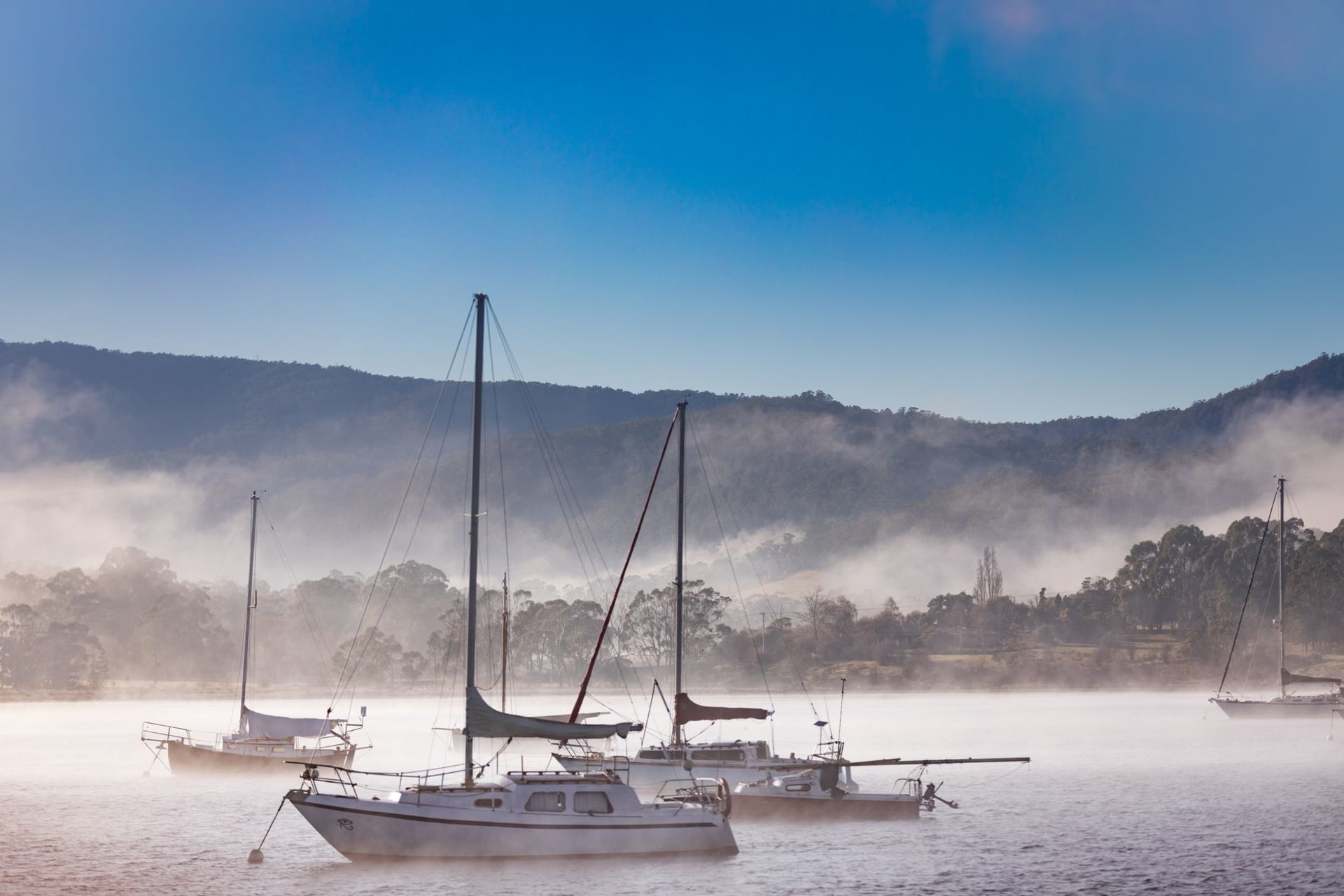
The Huon Valley opens south of Hobart along the Huon Highway, and for the first hour the landscape is quiet pastoral: green hills, the river appearing and disappearing, small towns with one general store and a bakery that closes at noon. Then the valley narrows and the forest on the hillsides gets darker and older and you realize you’re now somewhere different — further south, deeper in, the kind of landscape that produces silence as a natural byproduct.
This is apple country. Has been since the 1820s, when early settlers figured out the climate was exceptional for pome fruit. At the peak of the industry, Tasmania was shipping apples to England in refrigerated ships. The old orchards still run on the flats of the valley, and in spring the blossom is relentless.
The Orchards in Season
I drove through the valley in November, which is late blossom time. The trees were heavy with white and pink flowers and the smell came through the car window as something thick and sweet and slightly narcotic. I stopped on a flat stretch of road where an orchard ran right to the road’s edge, got out, and stood in the middle of it for ten minutes. Bees. The smell. The mountains behind the trees wearing cloud.
The Heritage Orchard at Ranelagh maintains varieties that were nearly lost — old cultivars with names like Rokewood, Huon Queen, Cox’s Orange Pippin, varieties developed here and nowhere else and now kept alive partly as historical artifact, partly because they taste better than anything that gets mass-produced. The apple you pick off one of these trees in March, when they’re ripe, has a complexity that the modern commercial apple traded away for shelf life.
Cider and Pommeau
The valley’s cideries have come into their own in the last decade. Willie Smith’s, operating out of a converted oast house near the town of Grove, has been making heritage cider from its own orchard for years and produces something genuinely serious — dry, tannic, sour in places, nothing like the sweet commercial ciders that give the category a bad name. I tasted six varieties in the cold interior of the barn and left with a case that required reorganizing the car to fit.
The Pommeau — apple juice fermented with apple brandy, aged in oak — is the best version of that drink I’ve found outside Normandy, which is where the technique comes from. It’s amber and sweet-edged and complex and about the last thing you want to be drinking if you have any driving ahead. I had a glass at the tasting bar at noon and sat with it for twenty minutes, looking out at the orchard.
The Deep South: Geeveston and Beyond
The town of Geeveston sits at the point where the valley begins to give way to serious wilderness. It has a forestry museum (less dull than it sounds), a pie shop, and serves as the gateway to the Hartz Mountains National Park, where subalpine vegetation and dolerite formations start appearing at low elevation. The drive further south toward Southport and beyond — toward Cockle Creek, the most southerly point accessible by road in Australia — passes through forest that gets progressively older and undisturbed.
I drove to Cockle Creek once, on a grey afternoon, and walked to the headland at the end of the track. The sign says the next stop south is Antarctica. The beach is wide and empty and the water is the deep grey-green of very cold ocean. A small pod of dolphins moved through the bay while I stood there. I drove back through the forest in the rain feeling the kind of quiet that takes a few days to fully leave.
The Huon Pine
The Huon River is named for the pine that grows along it, one of the slowest-growing and longest-lived trees in the world. Trees that were already old when the first Europeans arrived are still standing. The timber is extraordinarily durable — naturally oily, rot-resistant — and has been used for boat-building since colonization. You can see old Huon pine dinghies at the Apple Museum in Huonville, their hulls still tight and sound after a century.
When to go: October and November for blossom. February and March for the fruit harvest, when you can pick directly from orchards. The valley is worth visiting year-round, but the spring blossom is the thing that earns its own trip.