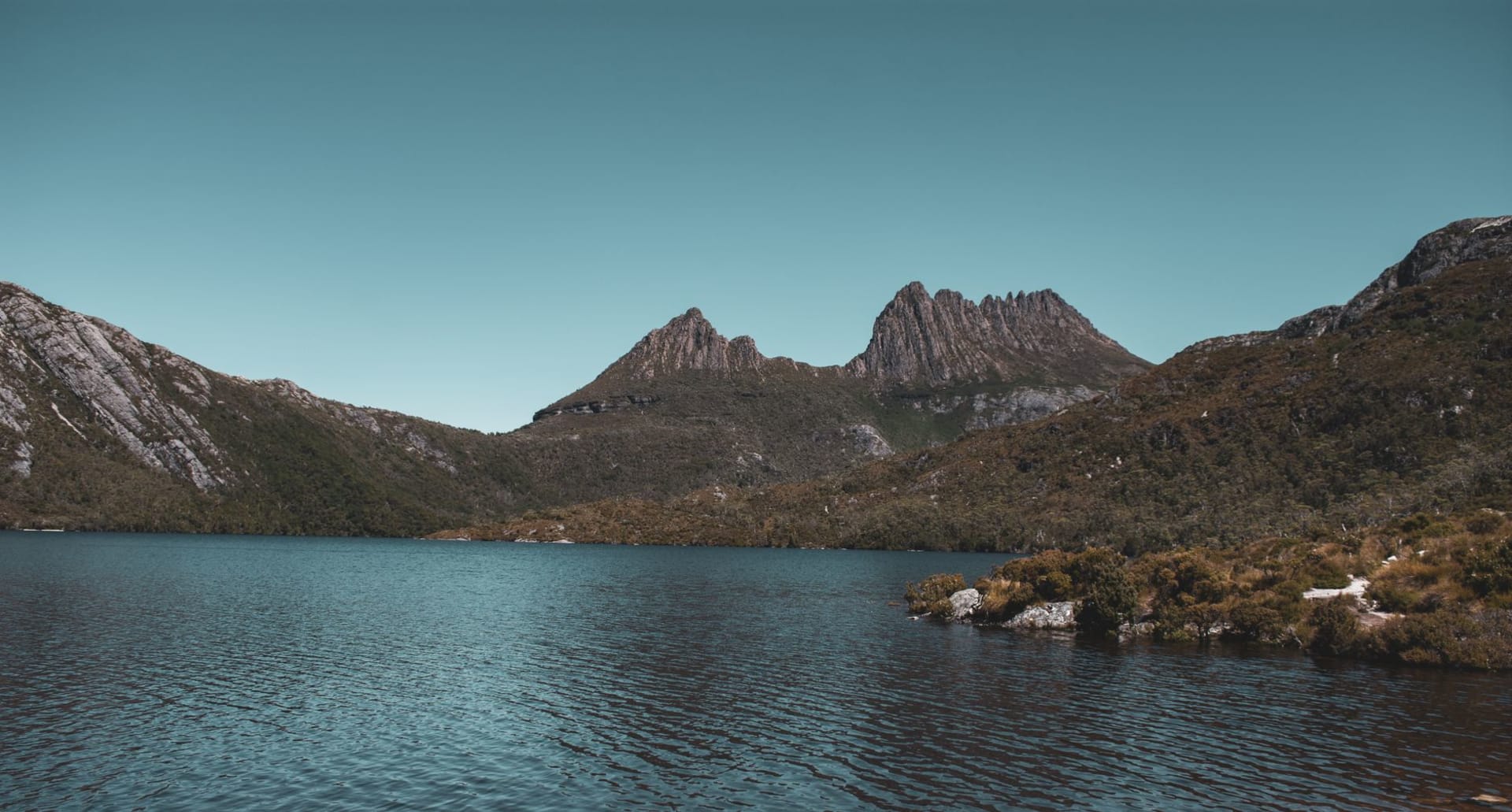
Cradle Mountain
"The mountain doesn't care how prepared you are, but it rewards you anyway."
I read about Dove Lake before I got there, which was a mistake. Reading about it built an expectation, and expectations are the enemy of a particular kind of experience — the kind where you round a bend and something stops you dead. Which is exactly what happened. The lake is ringed by buttongrass and pencil pines, and the mountain rises behind it in two uneven serrated peaks that look almost hand-drawn against the sky. I stood at the trailhead for a full minute before I remembered to start walking.
The Geometry of Dolerite
Cradle Mountain is about 65 million years old and looks it. The rock has cracked and split along perfectly geometric planes, stacking itself into columns and blades that turn different colors depending on the angle of light — blue-grey in the morning, almost purple when cloud shadow crosses. Walking the Dove Lake circuit, you get the mountain from every side, and it never looks quite the same twice. The geometry shifts. New shadows appear. I kept stopping to see what the light was doing.
The track itself is mostly boardwalk now, which protects the fragile soil and also makes it genuinely accessible without requiring serious hiking gear. I walked it in trail runners with a rain jacket stuffed in my pack. The rain came, as it does, and passed in twenty minutes. That’s the rhythm up here — weather arrives and departs on its own schedule, not yours.
Pencil Pines and Deep Time
The pencil pines along the lake edge are among the oldest living things in Tasmania. Some of these trees are over a thousand years old. They grow at a pace so slow that a tree as thick as my forearm might be four hundred years old. They’re not tall or dramatic — they’re narrow, almost austere-looking, with dark foliage and straight trunks. But knowing their age changes how you look at them. I found myself walking quietly, not because anyone asked me to, but because it seemed right.
The smell of the forest here is specific: wet eucalyptus bark, something mossy and vegetable, the cold mineral edge of the lake water. It’s the smell that I’ve been trying to reconstruct since leaving.
Wombats at Dusk
This is the thing no one warns you about adequately: at dusk, wombats emerge from the buttongrass to graze along the road into the park and around the lodge area. Not one or two — many. They’re the size of a substantial dog, low-slung, utterly unconcerned by human presence. They graze with their heads down and their round backsides in the air and they move at a pace that suggests they have nowhere to be.
I watched four of them in the fading light for thirty minutes, standing perfectly still on the gravel road. They didn’t look at me. I found this deeply reassuring.
Getting Above the Cloud
If the weather cooperates — and you’ll need to accept that it might not — the walk up toward the summit plateau opens into bare alpine landscape that feels like a different planet. Above the treeline, the world compresses into rock and low scrubby heath and sky. The cloud sits in layers below the peaks, filling the valleys. The silence up there is enormous.
I didn’t summit on my trip. The weather closed in at noon and I made the sensible call. I don’t regret it. The circuit was enough. The mountain gave me what it had available that day and I was grateful.
When to go: Late November through April for the best weather window, though “best” is relative — expect four seasons in one day regardless. January and February see the most visitors; go in late November or early April for thinner crowds and the same light.