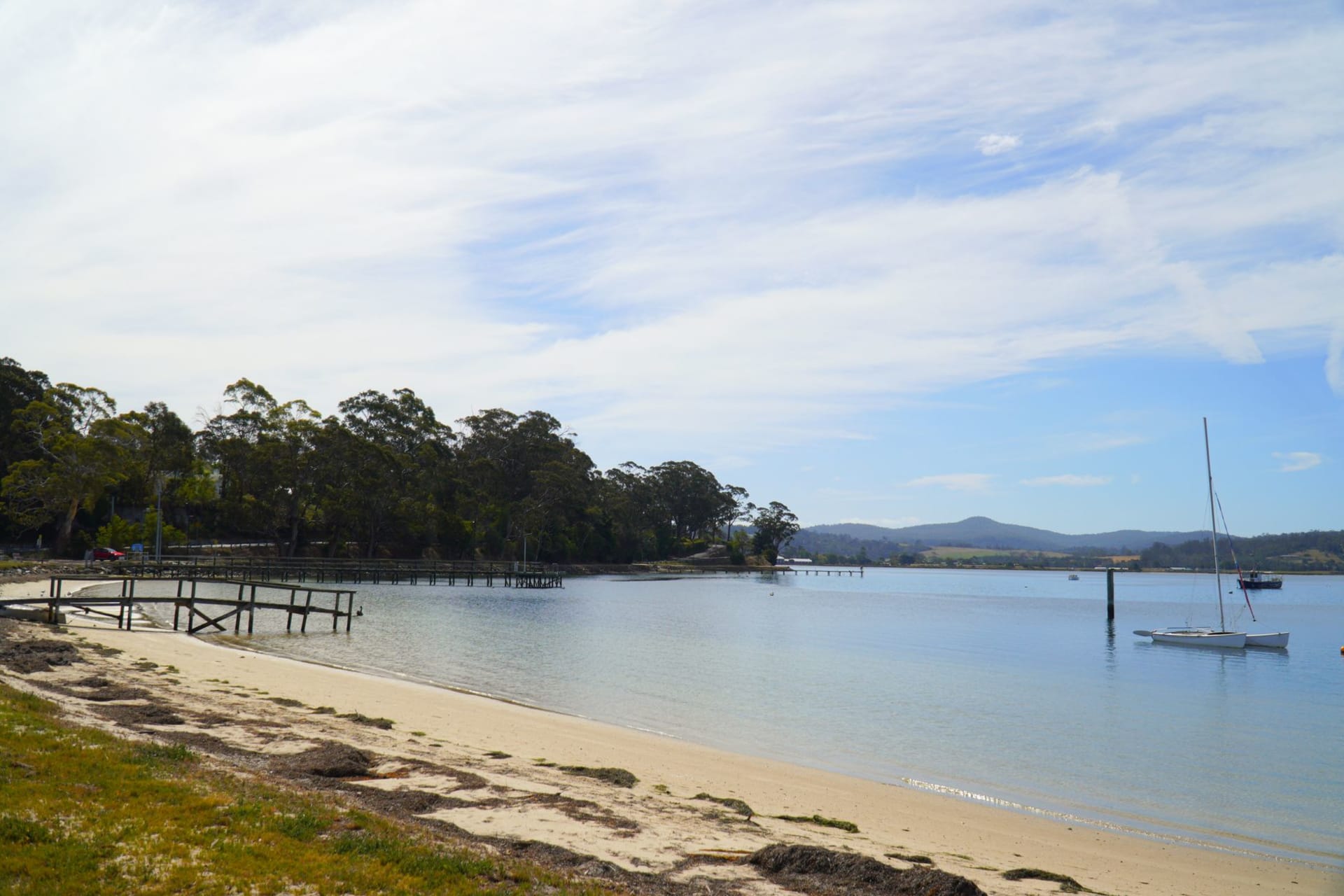
The ferry from Kettering to Bruny is twelve minutes of water crossing and ninety minutes of headspace adjustment. By the time you drive off the ramp onto the island, something has shifted. The pace changes. The mobile signal weakens. The road narrows. Bruny Island is forty-five minutes and a conceptual continent from Hobart.
The island is actually two islands connected by a slim isthmus of sand called The Neck — a strip of land narrow enough that you can see the channel on both sides simultaneously from the lookout above it. On that lookout, if you arrive at the right season, the little penguin colony comes ashore at dusk. They’re smaller than you expect, commuting up from the water in groups of three and four, entirely unbothered.
Oysters at the Source
Bruny Island’s oysters are what the island is known for beyond its own coastline, and for good reason. The water temperature, the salinity, the particular mineral character of the bay — it all produces an oyster with a clean brininess that finishes slightly sweet. I ate them at Get Shucked, which is exactly what it sounds like: a shed near the oyster lease with a small table outside, cold local beer in a can, and oysters opened in front of you.
We sat in the cold November air eating oysters until our fingers were numb, and neither of us suggested stopping. This is what food tourism should feel like: you’re eating the best possible version of something, at its source, in conditions that amplify the taste. The cold made the oysters sharper. The shed’s informality made them feel like we’d stumbled onto something private.
The South Bruny Wilderness
South Bruny National Park takes up the southern portion of the lower island and is almost entirely undeveloped. The walk to South Bruny’s southern tip passes through dense eucalyptus forest that smells of oil and wet bark, opens onto heath with views across the Southern Ocean, and delivers you eventually to cliffs that drop straight into water that has come directly from Antarctica. The wind here has traveled thousands of kilometers without encountering land.
I stood on those cliffs for a while. The sound the ocean makes against vertical rock is specific — rhythmic, deep, without echo — and it has a quality that I find simultaneously calming and slightly terrifying. There is nothing between this cliff and the ice shelf. I kept thinking about that.
The Cheese and the Smoke
Bruny Island Cheese Company operates out of a simple building on a farm and makes cheese with milk from their own herd. The tasting counter is exactly as low-key as that implies. I ate something washed-rind and pungent with crackers and a glass of Tasmanian pinot and considered whether this qualified as a complete meal. I decided it did.
The island also smokes salmon at a small operation near Adventure Bay. I carried a vacuum-sealed side back to Hobart and ate it slowly over three days, rationing. It had a cold-smoke character — not aggressive, not sweet — that was about as Tasmanian as anything I brought home.
Moving Slowly
Bruny rewards the unhurried. The ferry schedule provides a natural structure: first boat, last boat, and the island in between. I spent a full day there and still didn’t get to the north of the island or to the lighthouse properly. This didn’t bother me. There’s a particular quality of being somewhere without finishing it that I’ve come to appreciate. The island stays incomplete in memory, which means there’s something to go back for.
When to go: October through April. The penguin arrivals at The Neck are most reliable October through December. Summer gets ferry queues — go midweek if possible. The cheesery and oyster shed are open year-round, so even a winter day trip makes sense if you’re primarily there to eat.