Rameswaram
"I crossed a bridge over shallow turquoise water and arrived somewhere that felt like the end of a very long story."
Crossing to the Island
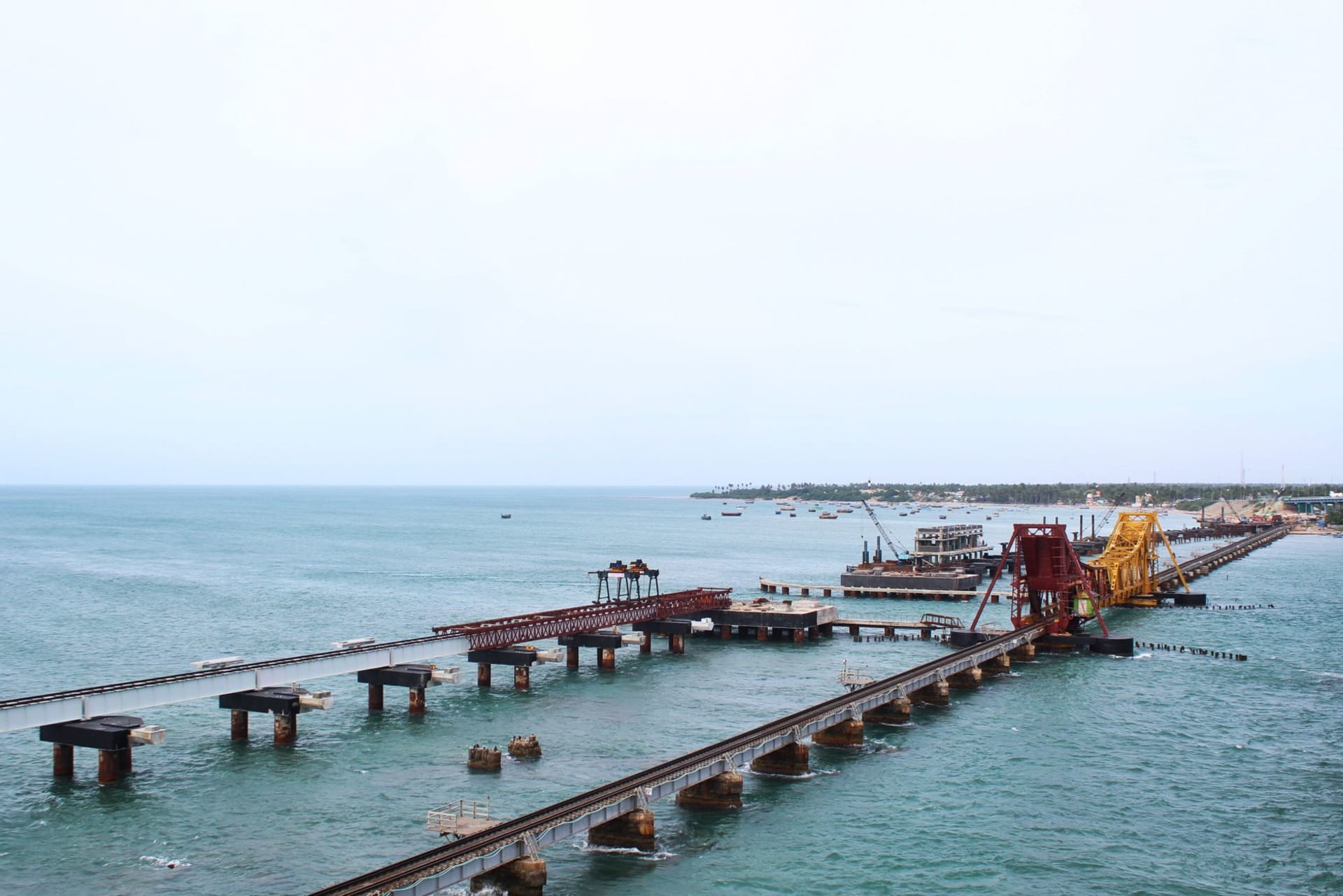
You cross to Rameswaram over the Pamban Bridge, a two-kilometer cantilever rail and road crossing over the Palk Strait. On the bus I took, the approach was gradual — mangroves, salt flats, then open water on both sides, glittering and shallow and impossibly clear. The bridge was the longest sea bridge in India when it was built in 1914 and still looks improbable from close up: thin iron spans over water that barely seems deep enough for boats.
The island is flat, windswept, the air thick with salt and something floral I couldn’t identify. The light has a quality that’s different from the mainland — sharper, more coastal, everything slightly bleached. Rameswaram town itself is austere. The pilgrim infrastructure dominates: lodges, flower sellers, shops selling devotional items. It’s not a resort town. It has one purpose and that purpose is spiritual.
The Temple Corridors
The Ramanathaswamy Temple is one of the twelve Jyotirlinga sites in India and one of the most important pilgrimage destinations in Hinduism. What I wasn’t prepared for was the corridors. The outer prakaram — the covered walkway running around the inner sanctum — is 197 meters on each side. Lined with 1,212 pillars. The longest temple corridor in India.
Walking it as a pilgrim means walking it in bare feet on smooth stone, the air smelling of incense and water, the sound of bells and chanting reverberating between columns. Pilgrims are expected to bathe in 22 sacred wells inside the complex — the water from each supposedly carried from a different holy river — and to be doused from large containers between the bathing points. I did not undertake the full ritual but watched it happening and understood immediately why people travel from across the country to do it.
Dhanushkodi and the Edge
Dhanushkodi is where the story becomes geological. At the island’s eastern tip, a ghost town destroyed by a 1964 cyclone stands in the surf: the ruins of a railway station, a post office, some residential buildings, all salt-bleached and slowly being swallowed by sand. The town was once a ferry crossing to Sri Lanka. Now there’s nothing here except the ruins, the sea, a few fishermen, and a sandbar that stretches toward the Sri Lankan coast in a nearly unbroken line — what Hindus identify as Rama’s Bridge, the causeway described in the Ramayana.
The light out here at the end of the day turns the water between the two coasts a succession of colors — turquoise, then green, then deep blue, then gold. I went with a shared jeep from the main town and arrived at the ruins as the sky was clearing after a brief afternoon rain. The combination of the wrecked town, the sacred geography, and the two seas meeting — Bay of Bengal on one side, Indian Ocean on the other — was one of the more disorienting and beautiful places I’ve stood.
Eating Light, Sleeping Simple
Rameswaram is not a place for elaborate dining. The food around the temple is simple and good — rice, sambar, coconut-based curries, fresh fish at the small restaurants near the shore. The guesthouses range from basic to basic with air conditioning. This is fine. The place doesn’t need ornamentation.
When to go: October through March is the window — the weather is tolerable, the sea is calm, and the light in the early mornings is extraordinary. Avoid summer (April–June) when the heat and humidity are extreme. The cyclone season (October–November) can bring storms off the Bay of Bengal; early November can be rough, but December through February is stable and genuinely pleasant.