Pondicherry
"I ordered café au lait in Tamil Nadu and nobody thought this was strange."
The French Quarter and the Canal
Pondicherry — officially Puducherry, but everyone still says Pondi — is divided by a canal that once marked the boundary between the French colonial quarter to the east and the Tamil town to the west. The division still shows in the streetscape. The French Quarter has wide, tree-lined boulevards, painted colonial houses in shades of yellow and terracotta and white, wrought iron balconies, a seafront promenade with benches facing the Bay of Bengal, and the slightly unreal quality of a film set. The Tamil Quarter has none of this — it’s dense, chaotic, alive in the way Indian cities are alive, temples and markets and noise and color.
Both halves are interesting. The French Quarter is quieter and more beautiful and easier to photograph. The Tamil Quarter is where most people actually live and where the food is better and cheaper. I spent mornings in one and afternoons in the other and found the contrast — rather than disorienting — the main point of Pondicherry.
Aurobindo and Auroville
The Sri Aurobindo Ashram has been a presence in Pondicherry since 1926 and shapes the town significantly: the ashram complex extends over several buildings in the French Quarter, there’s a guest dining room serving subsidized meals, and the contemplative mood that spills out into the surrounding streets is palpable. I’m not a spiritual tourism person by disposition but the ashram’s bookshop has one of the better collections of Indian philosophy texts I’ve encountered, and I spent a useful hour in it.
Auroville is twelve kilometers north: a utopian township founded in 1968, now home to about 3,500 people from 60 countries, organized around a gleaming geodesic meditation sphere called the Matrimandir. The concept is idealistic in the specific way of the late 1960s and the execution is genuinely interesting — a township that has been building itself for fifty-five years, largely out of recycled materials, in a landscape it has reforested from barren laterite. The Matrimandir itself is closed to casual visitors but visible from a designated viewpoint that frames it adequately.
The Seafront and the Promenade
The Promenade along the seafront is Pondicherry’s social spine. In the early morning it belongs to joggers and yogis and old men doing the slow systematic exercise of people who have been doing the same thing at the same hour for decades. By evening it fills with families and ice cream vendors and couples and the general sociability of a town that knows how to use its public space.
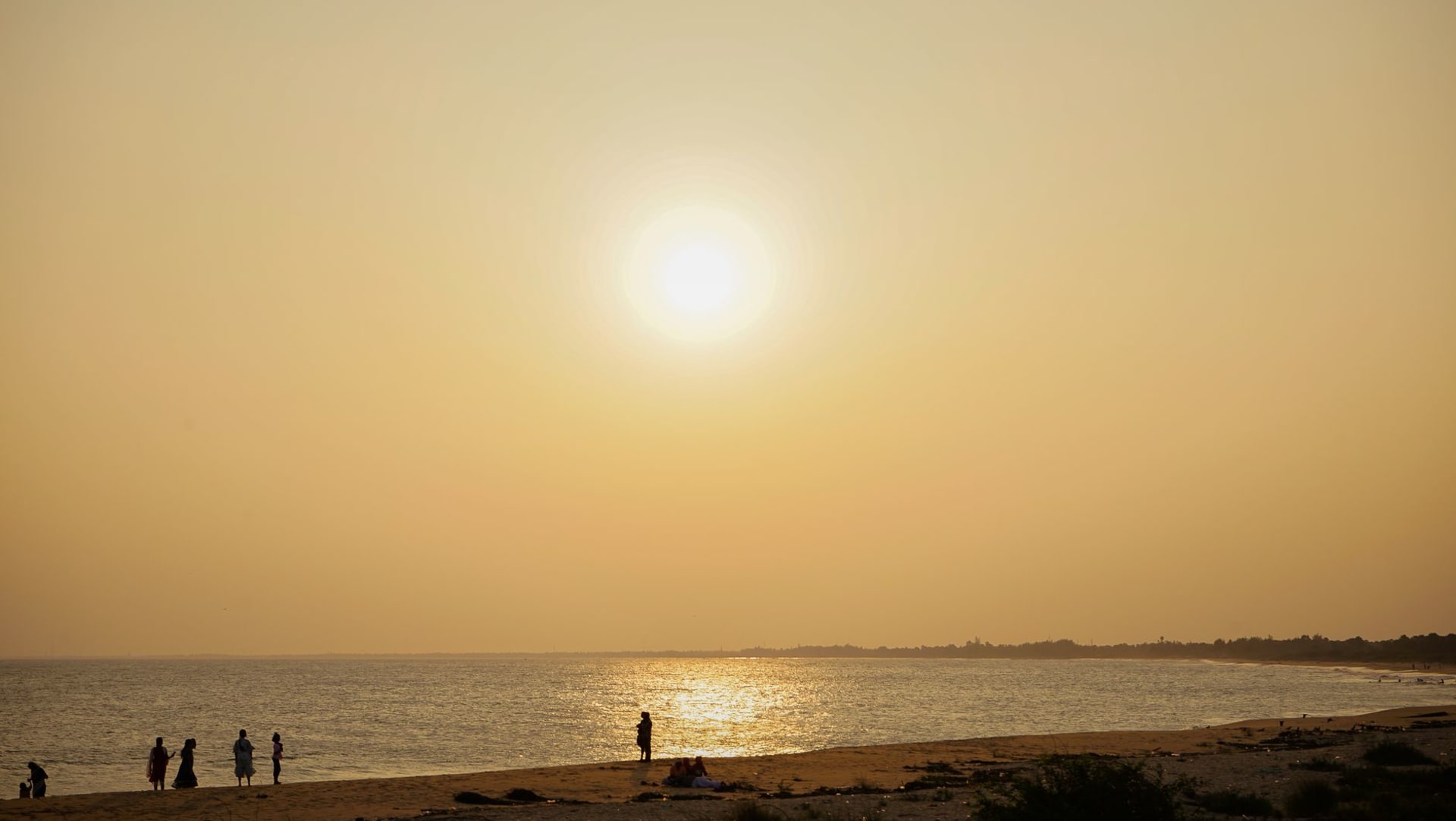
The sea here is not swimmable at most points — the waves are heavy and the currents strong — but the light on the water at dusk is consistently excellent. The Alliance Française and the French consulate are still here, still running, and the cafés near the French Quarter serve decent croissants and espresso in a context that is Tamil Nadu but reaching across an old colonial distance.
Eating and the Pondicherry Kitchen
The restaurant scene in Pondicherry punches above the town’s size. French-inflected South Indian cooking appears at a handful of places — not fusion in any irritating sense, just Tamil cooks who learned something from the French colonial kitchen and kept it. The seafood here is excellent: fresh, abundant, cooked with coconut and tamarind. The banana flower dishes, the prawn curries, the grilled barracuda — I ate very well in Pondicherry for very little money.
When to go: October through February is the standard recommendation and it holds. The northeast monsoon can bring heavy rain in October–November — not necessarily a problem, but cyclone risk is real. December through February is dry, breezy, 25–28°C, and the French Quarter in particular is at its most pleasant: warm in the day, cool enough at night for an open window.