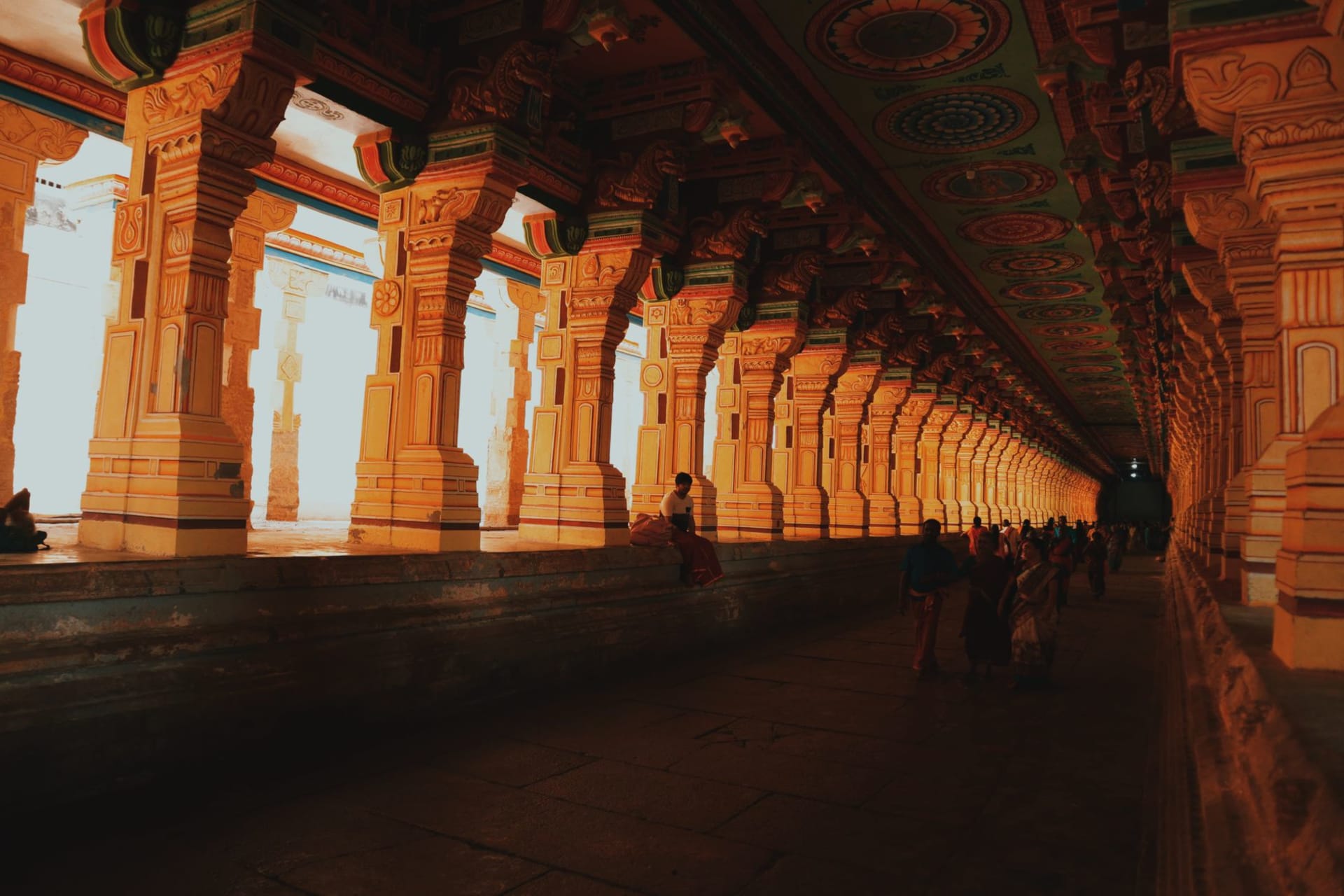
The Temple That Runs the City
Madurai is organized around the Meenakshi Amman Temple the way medieval European cities were organized around cathedrals — except here the institution never lost its centrality. The temple hasn’t closed in centuries. It feeds thousands, employs hundreds, and pulls pilgrims from across Tamil Nadu on every auspicious day of the year. When I arrived on a Tuesday evening the outer corridors were thick with people and the air tasted of camphor and marigold and ghee from a thousand oil lamps burning in the half-dark.
The gopurams — the soaring gateway towers — are the thing in every photograph. Fourteen of them, encrusted with polychrome sculptures of gods, demons, celestial musicians, animals, and cosmological scenes stacked up to twelve stories. Up close they’re almost hallucinatory: too much information for the eye to process at once. I kept stopping to focus on one small section and finding another world within it. A sculptor has spent a lifetime on something no single pair of eyes will ever fully see.
City of Jasmine
Madurai is called the “city of jasmine” and I’d dismissed this as tourist-brochure language until I actually arrived. The jasmine trade here is staggering. Early mornings near the flower market I watched women weaving strings of it at a speed that seemed impossible, threading blossoms onto lengths of thread without looking, talking, not breaking rhythm. The smell is overwhelming — sweet, medicinal, alive — and it follows you through the bazaar lanes of the old city all day.
The market area around the temple is chaotic in the best sense: narrow lanes stacked with silk, silverware, bronze figurines, sandalwood, incense. A man sold me a small brass Ganesha wrapped in newspaper and spoke to me in Tamil and then in French — apparently he’d had practice. I still don’t know how that came about.
Eating in the Old City
Tamil food in Madurai is more aggressive than Chennai’s. The spice is more present, the preparations less apologetic about heat. The banana-leaf thali served at the restaurants near the temple gate is the thing to eat: rice arrives first, then servers work the row of diners in relay, adding sambar, rasam, a rotating series of vegetable dishes, papad, pickle. You eat with your right hand. I’d avoided this approach for years out of misplaced self-consciousness and spent approximately two minutes figuring out why it works better.
The jigarthanda is Madurai’s other obsession — a cold drink of milk, almond resin, rose syrup, and sarsaparilla ice cream that exists somewhere between a dessert and a religious experience. In the heat of a Madurai afternoon, it becomes necessary.
Evenings on the Rooftop
The guesthouses near the temple advertise rooftop views and the views deliver — the gopurams lit up gold and pink at dusk with bats spiraling around the towers and the city noise rising from below, softer from this height. Lia and I sat up there with tea until it was genuinely dark, watching the city work out its evening, and I thought about the people who’d been doing some version of this same thing for two thousand years.
When to go: October through March, when temperatures sit around 28–32°C rather than the brutal 38–42°C of summer. The Chithirai Festival in April–May is Madurai’s biggest cultural event — immense processions, elaborate rituals — but the heat is serious and crowds are extreme. December and January are ideal for wandering the old city without suffering.