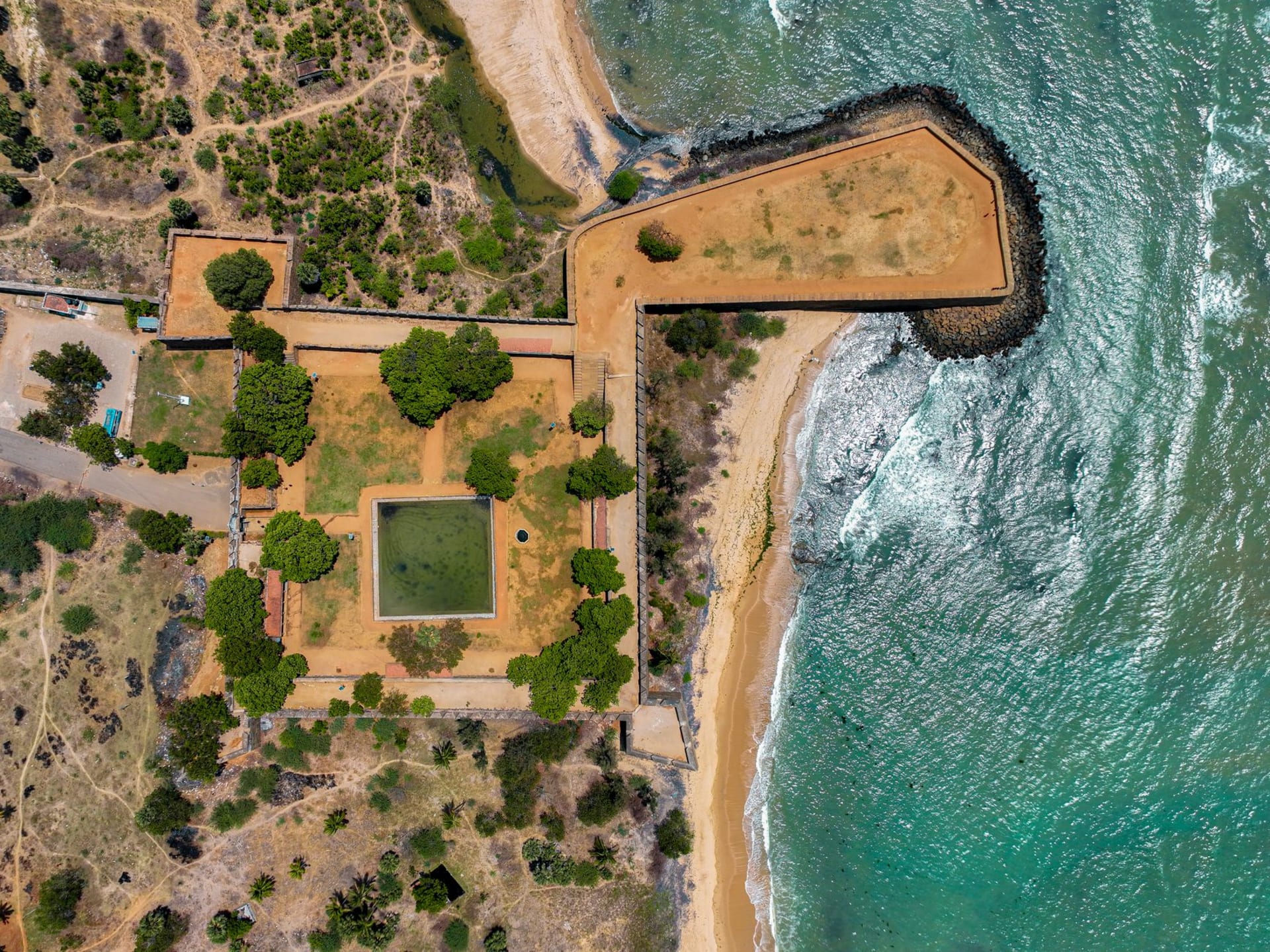
Kanyakumari
"I stood at the end of a country and watched three seas argue about where one ends and the next begins."
There is something faintly absurd and entirely irresistible about going to the literal end of a landmass. Kanyakumari is the bottom of India — the point past which there is nothing but open water until Antarctica — and the whole town is organised around that single geographic fact. People come here to stand at the tip and look south, and so did I, and so did Lia, and so did several thousand Indian pilgrims and honeymooners who had clearly decided the same morning that this was the correct place to be.
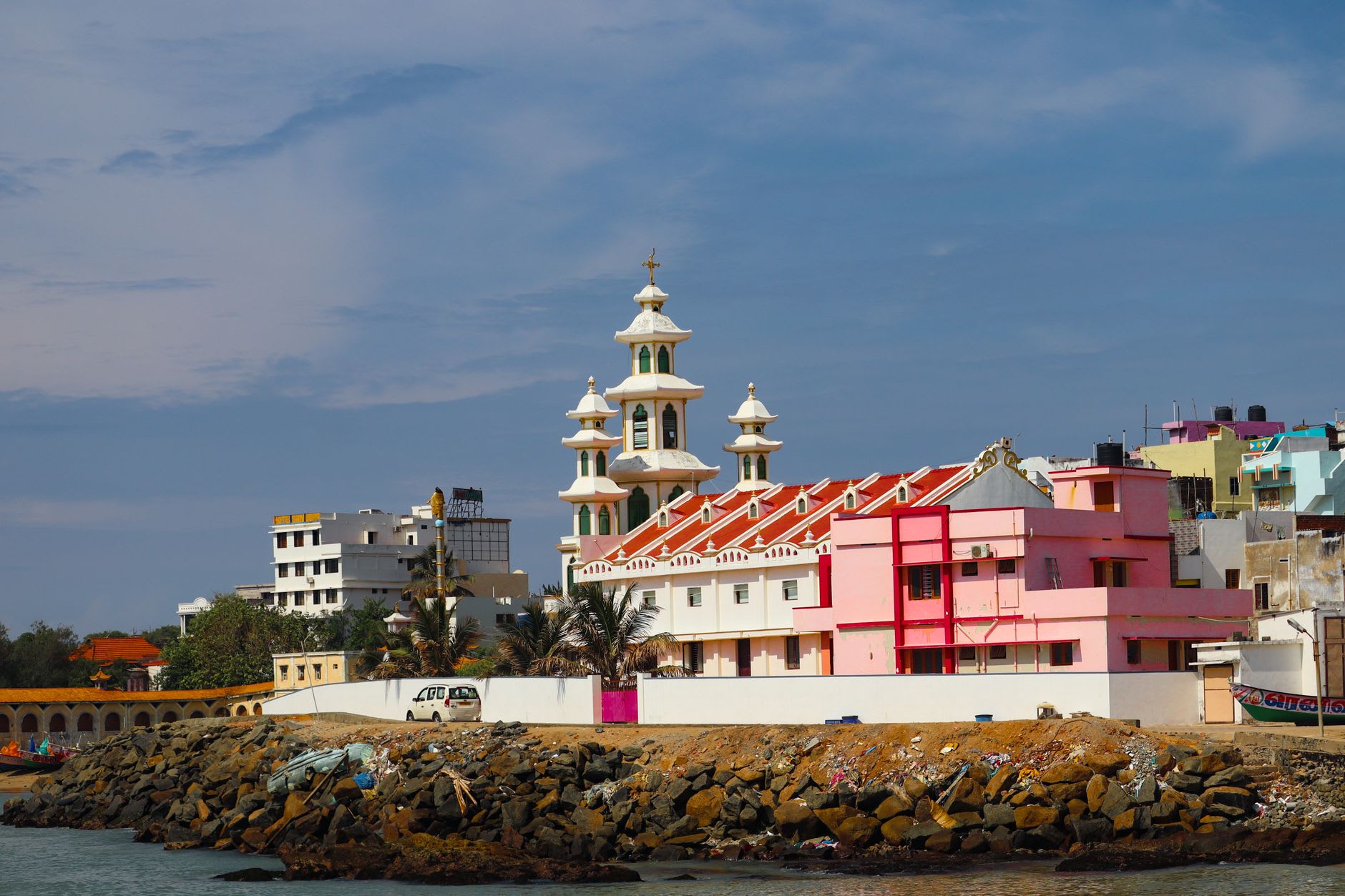
We arrived the evening before, on a bus that smelled of diesel and jasmine garlands, and the town first appeared as a string of guesthouse lights against black sea. I’ll be honest: my first impression was of a place slightly worn down by its own fame. Concrete hotels, plastic chairs, vendors selling seashell trinkets that no shell ever volunteered for. But Kanyakumari isn’t about the town. It’s about what the town is pointed at.
The meeting of three seas
The pitch is that three bodies of water converge here — the Bay of Bengal to the east, the Arabian Sea to the west, the Indian Ocean stretching south — and that you can see them meeting. I was sceptical. Water is water. But standing on the rocky point at dawn, I understood what people mean. The sea genuinely behaves differently in different directions: choppy and grey-green on one side, a flatter blue on the other, the currents colliding in a churned seam that you can actually trace with your eye. Whether the geography textbooks fully endorse the tidy three-ocean story is beside the point. The water looks confused, and that confusion is the show.
Lia, who has a higher tolerance for crowds than I do, threaded us through the dawn throng to a spot on the rocks where we could sit. The sunrise itself was the kind that makes a thousand people fall silent at once, which is its own rare phenomenon. The disc came up enormous and orange straight out of the Bay of Bengal, and for about ninety seconds nobody sold anything, nobody honked, nobody spoke. Then a man behind us answered his phone and the spell broke, but ninety seconds is more than most sunrises get.
Two figures on the water
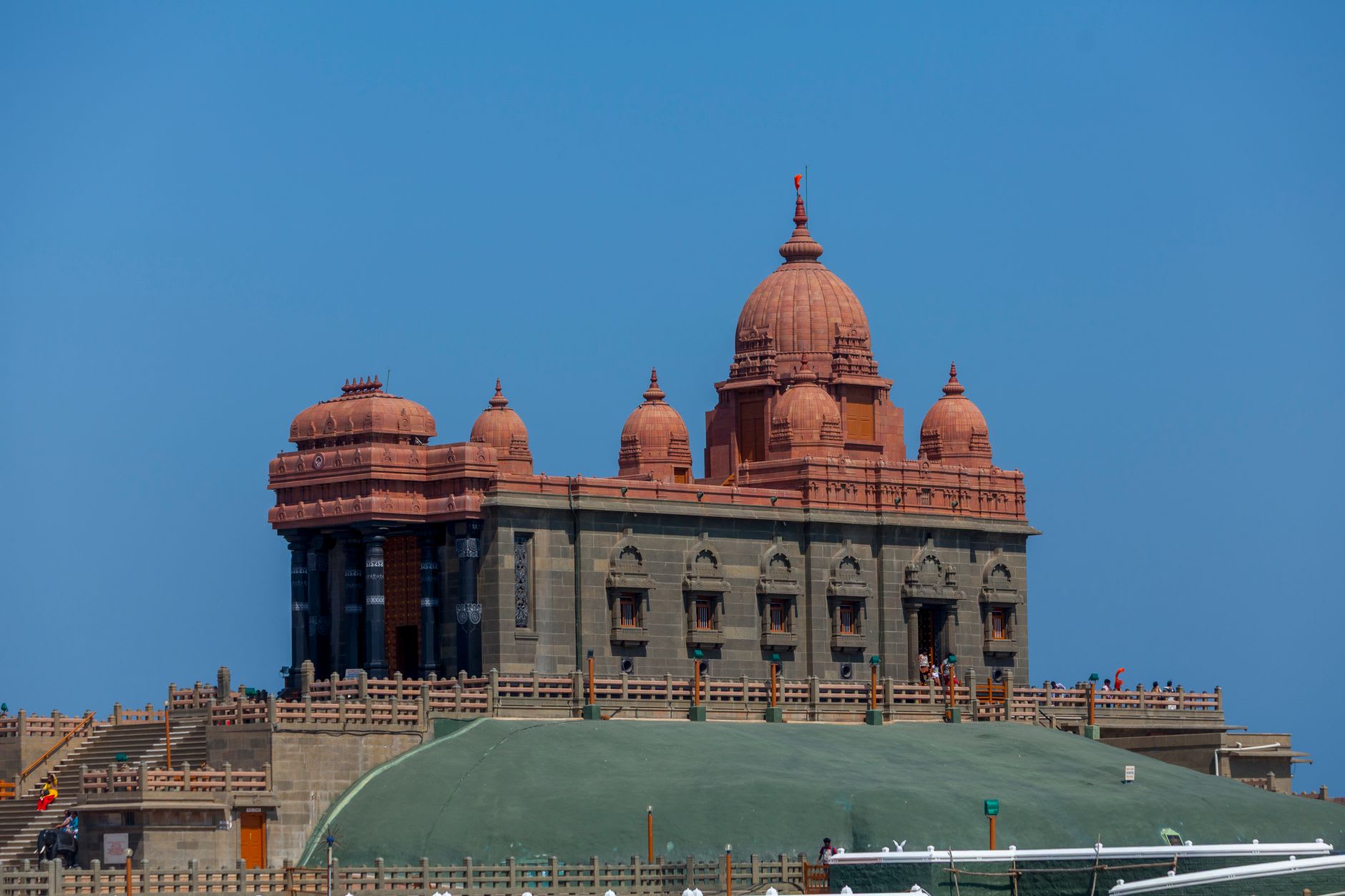
Just offshore sit the two structures that define every photograph of this place. The Vivekananda Rock Memorial stands on an island where the philosopher Swami Vivekananda is said to have meditated in 1892 before deciding to take his ideas to the world. Beside it rises the Thiruvalluvar Statue — a 41-metre stone figure of the ancient Tamil poet-philosopher, the height chosen to match the number of chapters in one section of his great work, the Thirukkural. I appreciate a monument with a footnote.
The ferry over is short, crowded, and gloriously chaotic. The memorial itself is calmer than the queue suggests — a meditation hall where the noise drops away and people sit with their eyes closed, the sea audible through the walls. From the base of the Thiruvalluvar statue the view back to the mainland shows the whole town stacked up against the morning light.
The cape after dark
What surprised me most was the evening. The same point that hosts the sunrise scrum empties out, and the local families come down to walk along the front with ice cream and salted mango. We ate at a tiny place near the fish market where a woman fried fresh seer fish in a red masala that left my lips genuinely numb, and I ate it anyway and asked for more. Kanyakumari is not a refined destination. It is a loud, salt-stained, deeply earnest place where a whole country comes to look at the edge of itself. I found that strangely moving, and I’d go back.
When to go: October to February, when the heat is bearable and the skies are clear enough for the sunrise and sunset to deliver. Avoid the monsoon months unless you enjoy watching weather rather than horizons.