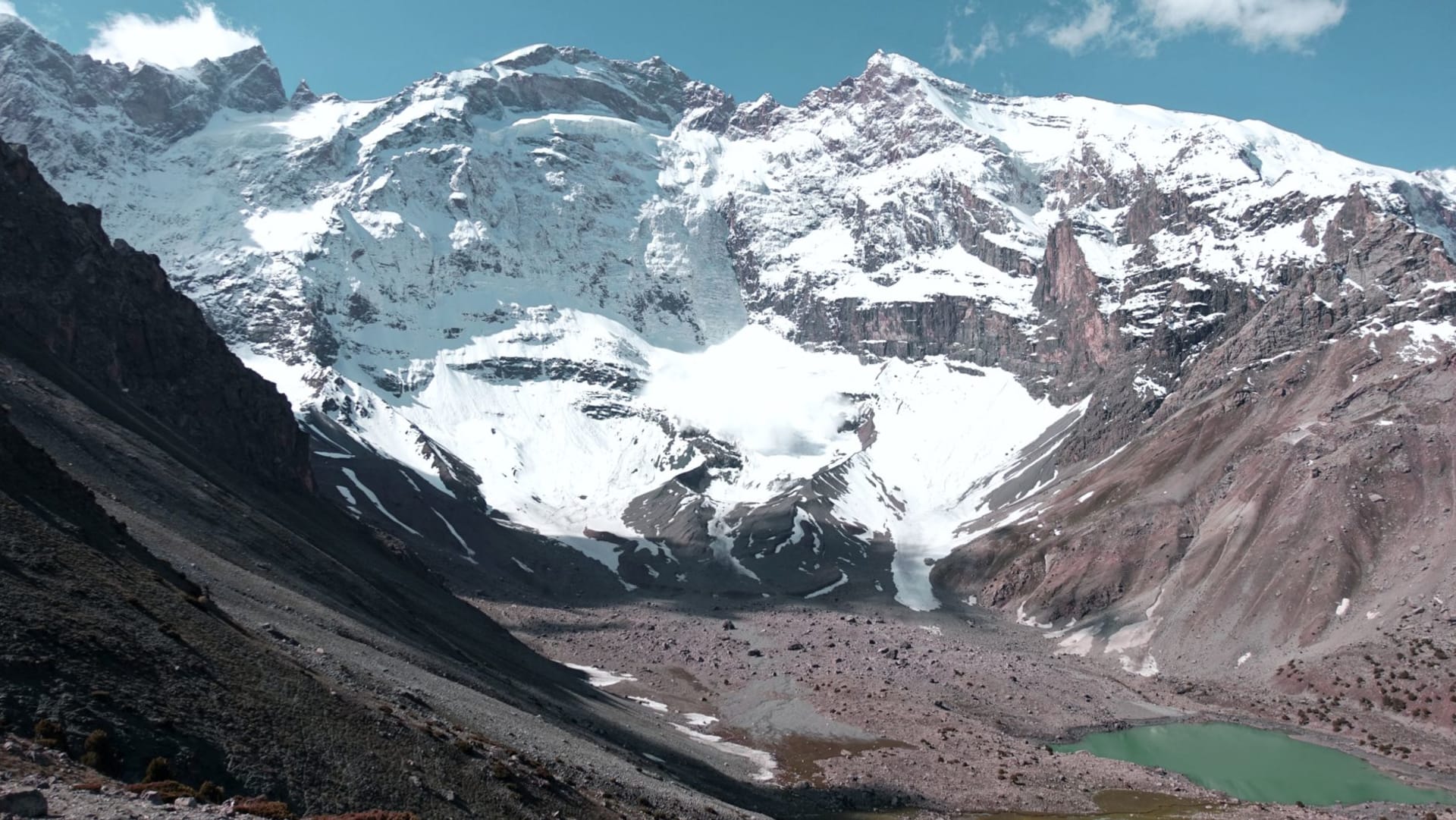
Yagnob Valley
"The language they spoke here was already old when the Arab armies arrived."
There are roughly four hundred people left in the Yagnob Valley who speak Yaghnobi — a direct descendant of ancient Sogdian, the lingua franca of the Silk Road from the 4th to 8th centuries CE. The Soviet authorities forcibly relocated the valley’s population to the Tajik lowlands in 1970, in a resettlement program that was catastrophic in human terms. Some families eventually returned. Their language returned with them, surviving not through any institutional preservation effort but simply through use — mothers talking to children, neighbors negotiating, the ordinary weight of daily life.
I made the trip in partly because of this linguistic fact and partly because the valley has a reputation among the small community of people who track remote Central Asian destinations, and I was curious whether the remoteness justified the effort. It does, though not straightforwardly.
Getting In
The road into the Yagnob Valley branches north from the Anzob road between Dushanbe and Khujand, and its condition is the first thing you learn about the valley’s character. I hired a 4WD in Dushanbe with a driver experienced on the route — which exists in the form of a riverbed, a track carved into a cliff face, and then a series of suggestions — and we reached the first inhabited village, Pskon, in about five hours from the turnoff. An alternative is to walk in from the Anzob area over a high pass, which takes two days and is its own experience.
The Villages
The inhabited villages are small — sometimes a handful of families — and the architecture is unmistakably old: flat-roofed stone houses built into the hillside in ways that blur the line between building and terrain. The Yagnobis who have returned to the valley do so with the full knowledge that it is harder here than in the lowlands. There’s no consistent electricity, no medical clinic, no school past primary. What the valley offers is theirs: the pastures and apricot orchards that sustained their families before the Soviet displacement.
The welcome I received was genuine and slightly wary — the valley gets visitors occasionally, not frequently, and my arrival required explanation. Once the explanation was accepted, the hospitality was total. I stayed two nights with a family in an upper village, sleeping on mats in a room that smelled of smoke and animal and dried herbs, eating bread and yoghurt and a vegetable soup that had clearly been cooking since morning.
The Language
I asked my host about the Yaghnobi language, gesturing at my notebook in a way that was probably transparent. He spoke some Tajik and used it with me, but when his wife and daughter spoke to each other the sounds were markedly different — rounder in some places, sharper in others, with syllable patterns that didn’t match Tajik rhythm. Linguists who’ve worked here describe Yaghnobi as remarkably conservative, preserving features of Middle Iranian that disappeared elsewhere over a millennium ago. To be in a conversation between two people speaking a language older than Islam in the region is an unusual experience.
Practical Considerations
The Yagnob Valley is not set up for casual tourism. There are no guesthouses in the formal sense, no restaurants, no guides waiting at a trailhead. You need to arrange your own transport, carry enough food for contingencies, and approach the valley with the understanding that you’re a guest in a community rather than a customer in a destination. A fixer or guide from Dushanbe who has existing relationships in the valley makes the experience significantly smoother and more respectful.
When to go: June through early September. The valley road is impassable in winter and the high-pass trekking approach requires snow-free conditions. Late June and July are optimal — the apricots are ripening, the pastures are green, and the days are long enough to reach the upper villages with daylight to spare.