Murghab
"Murghab is the kind of place where a cup of hot tea feels like an achievement."
Murghab exists because the Pamir Highway needs a settlement large enough to sell fuel and bread and dried noodles, and because people have been living on this plateau for long enough that stopping now would feel like giving up. At 3,600 meters, it’s the highest town in Tajikistan and one of the highest in Central Asia. The air has that specific Pamir quality — dry, thin, and luminous — that makes everything look slightly too sharp, like a photograph with the contrast pushed.
The Town Itself
There is not much to say about Murghab’s architecture that couldn’t be expressed as a list of materials: Soviet concrete, corrugated metal, mud brick, blue painted wood. The buildings are low and the streets between them are unpaved and the wind moves through constantly, picking up grit. What makes Murghab interesting is not its buildings but its context: the plateau stretching away in every direction, the yak herders who come into town on market days, the Kyrgyz population that distinguishes this corner of Tajikistan from the Persian-speaking majority elsewhere.
The Sunday market is the social event of the week. Herders come down from summer pastures with animals and dairy products and the whole flat market ground fills with the sound of negotiation in Kyrgyz and Tajik and Russian simultaneously. I watched a transaction over a yak that took forty-five minutes and seemed to involve at least six people who were not, as far as I could tell, principals to the deal.
The Plateau as Subject
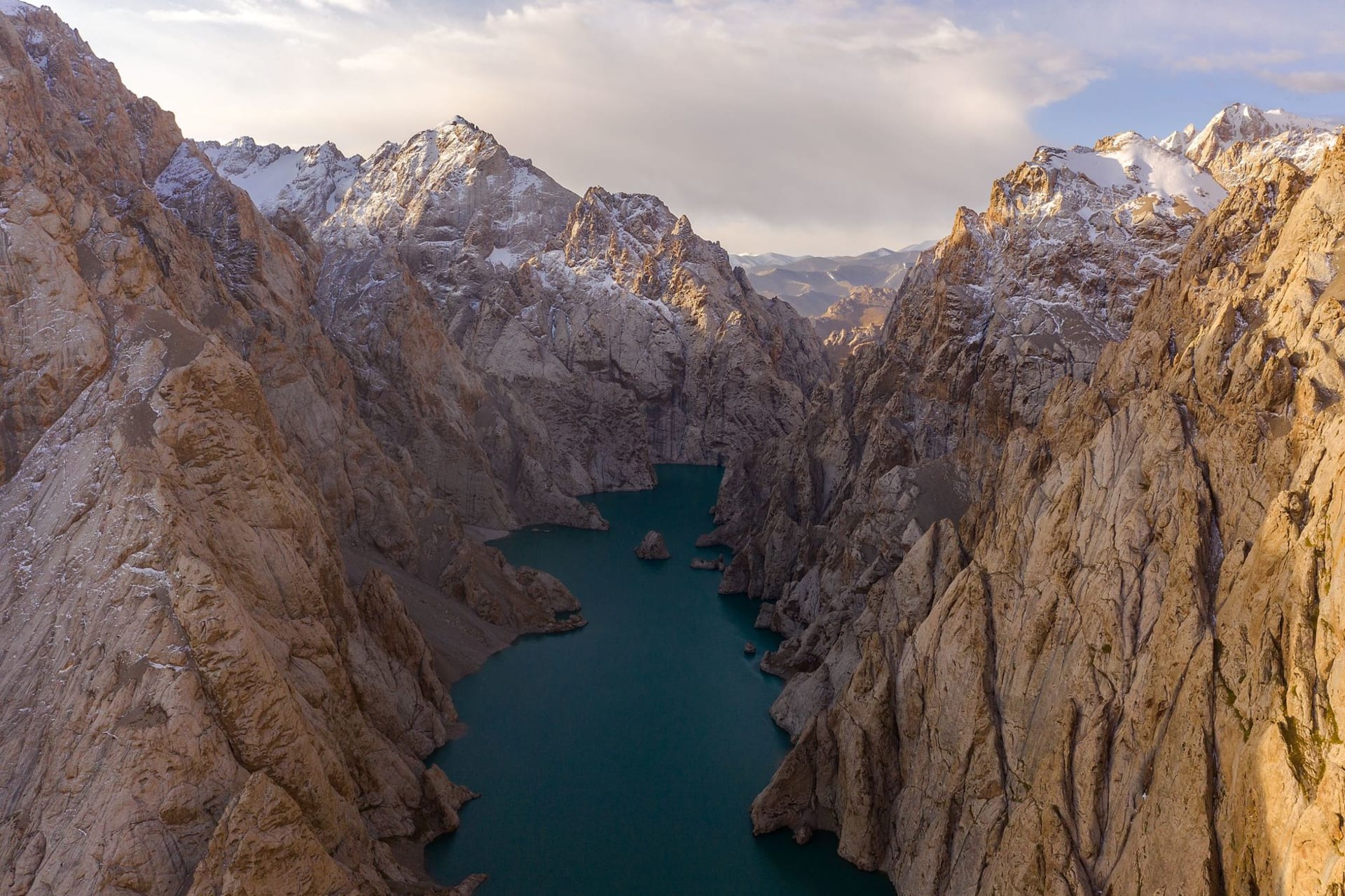
The Pamir Plateau around Murghab is one of the few places where I’ve felt genuinely small in a landscape, rather than just intellectually aware of being small. The distances are geological in scale. From any high point outside town — and every point outside town is a high point — you can see mountain ranges that are not close. The brown of the plateau is not uniform: ochres and rusts and a particular dusty sage where the sparse vegetation holds on. At dawn, before the light stabilizes, the colors go through a sequence that has no equivalent lower down.
I rented a Chinese-made motorcycle from a guesthouse owner and drove out onto the plateau for three hours with no particular destination. I stopped where the road met a dry riverbed and ate bread and cheese and listened to nothing happening. The silence at altitude has a different quality than silence at sea level — it’s not empty, exactly; it has texture.
The Cold
Even in July, Murghab’s nights require real insulation. I was unprepared for this the first night, using a sleeping bag rated to temperatures that made sense at lower altitudes and waking at 3 a.m. cold enough to put on every piece of clothing I owned. By the second night I’d negotiated a second blanket from the guesthouse and slept fine. The cold is part of what makes the plateau feel serious — it insists that you take the altitude’s terms rather than your own.
Getting In and Out
Shared taxis connect Murghab to Khorog (roughly eight hours) and to the Kyrgyz border at Karamyk, from which you can continue to Osh. The fuel situation is the main logistics concern: fill up wherever you find it. The guesthouses are basic but run with genuine warmth — the proprietors in this part of the world seem to have a specific affection for people willing to travel to somewhere this remote.
When to go: Mid-June to mid-September, strictly. The high passes close with snow on either end, and winter at 3,600 meters is not a tourist experience. July offers the best weather but is also when most overland travelers pass through. Early September is quieter and the light turns spectacular.