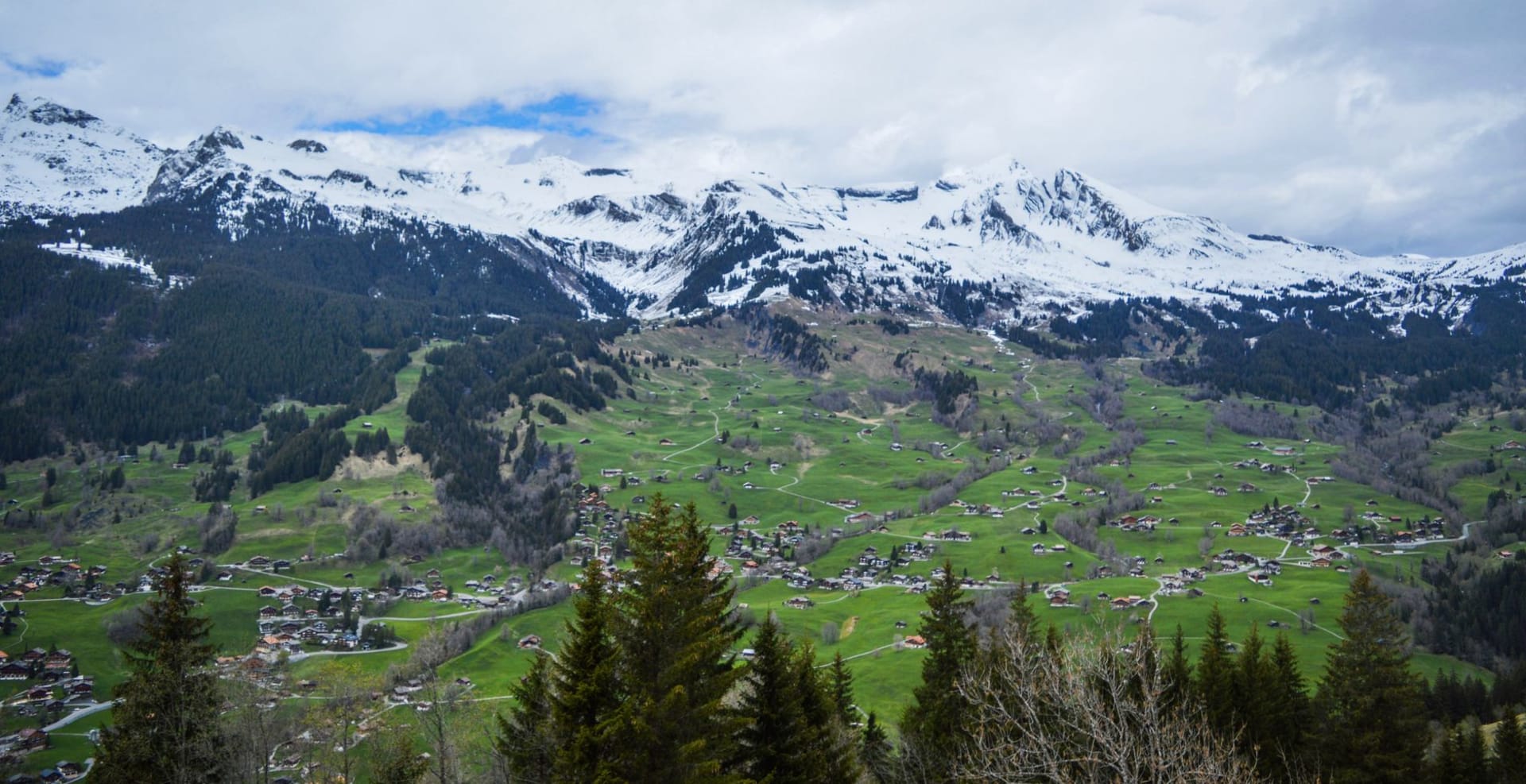
Wengen
"No cars, no engines, just cowbells and the occasional avalanche somewhere far off."
You cannot drive to Wengen. This is the first thing anyone tells you, and it turns out to be the whole point. The village sits on a green shelf high above the Lauterbrunnen valley, reachable only by a cog railway that grinds slowly up through meadows and forest, and the moment you step off the train onto a platform with no road behind it, something in your shoulders drops. Lia noticed it before I did. We had come down from a few noisy days in Interlaken, and Wengen received us with a silence so complete that the loudest sound on our first evening was a single cowbell working its way across a hillside below the chalets.
A Village Without Engines
The car-free thing is not a marketing gimmick layered onto a normal resort. There simply is no road up. Supplies arrive by train, electric carts buzz quietly between the hotels, and the steep lanes belong to walkers, sledges, and the occasional indignant cat. The effect on the atmosphere is profound. You hear conversations, footsteps on gravel, water running off the heights, and underneath everything the deep alpine quiet that most mountain towns lost to traffic decades ago.
Wengen itself is a tidy cluster of old timber chalets and a few grand belle-époque hotels left over from the days when the English practically colonized this corner of the Bernese Oberland for winter sport. There is a faintly old-fashioned dignity to the place — afternoon cake taken seriously, a small church, geraniums in every window box. We took a room with a balcony facing the valley, and I spent an embarrassing amount of the trip simply sitting on it, watching the light move across the Jungfrau massif directly opposite, the snow turning gold and then pink and then a cold blue as the sun went.

Up to Männlichen and Down the Trails
Wengen is a launch pad. A cable car climbs from the edge of the village to Männlichen, a ridge with one of the most absurdly generous panoramas in the Alps — the Eiger, Mönch, and Jungfrau lined up across the valley like a wall of teeth, and the green trench of Lauterbrunnen plunging away beneath your feet. From the top we walked the gentle ridge path toward Kleine Scheidegg, a route so easy and so spectacular that I kept feeling we were getting away with something. Below us, paragliders drifted off the slopes; above us, the north face of the Eiger did its grim, famous thing.
In winter the whole area becomes serious ski country, and Wengen hosts the Lauberhorn, the longest and one of the most storied downhill races on the World Cup circuit. We came in summer, when the pistes are pasture again and the cows are back, but the village still carries that mountaineering pedigree lightly under its flowers and cake.
The valley itself is worth a day on its own. Drop down to Lauterbrunnen and you are surrounded by waterfalls pouring straight off the cliffs — the Staubbach Falls alone falls nearly three hundred meters in a long pale ribbon. We hiked along the valley floor with our necks craned upward until they ached, then took the cog railway back up to Wengen, climbing out of the shadowed gorge into our quiet sunlit shelf again.
Practical Notes
Park your car in Lauterbrunnen and take the train up — there is no alternative, which is exactly why you should. Stay at least two nights to let the silence do its work. Summer is for hiking and wildflowers, winter for the Lauberhorn and the slopes. Either way, give yourself one slow afternoon on a balcony doing absolutely nothing. The mountain is the entertainment.
