The Valley That Ends Here
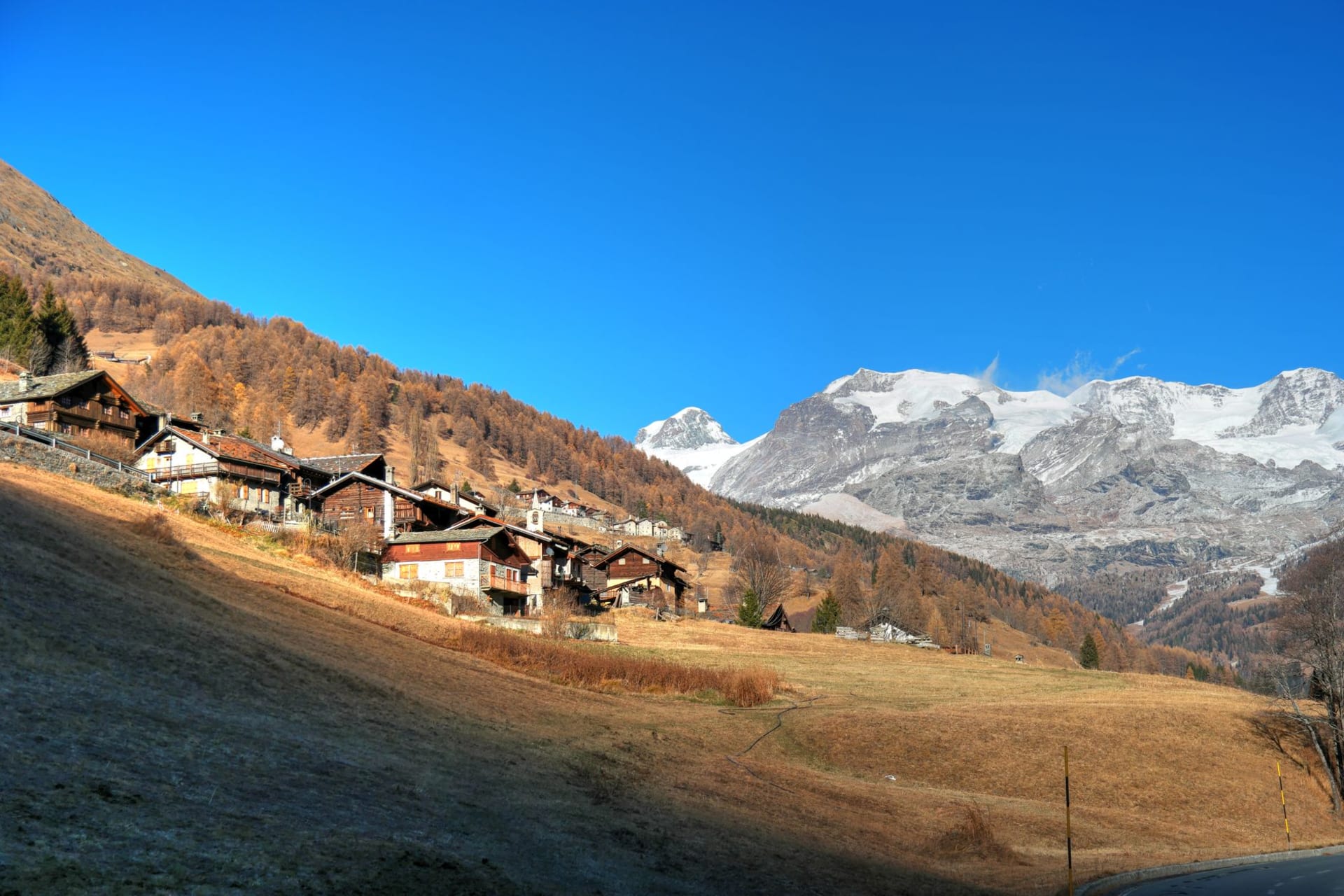
Saas-Fee sits at the end of the Saastal — a valley that narrows progressively until it simply stops, the road finishing in a car park at the village edge. Cars are banned inside. The village has electric carts and horses and silence. I arrived in October on a afternoon that smelled of woodsmoke and something faintly mineral, glacial meltwater from the Fee Glacier, which hangs visibly above the village between two dark ridges. You can see the ice from the main square. It is not a small amount of ice.
The Fee Glacier was once the reason climbers and alpinists came here. In the early twentieth century they called it the “Pearl of the Alps.” The glacier is smaller now than it was — this is true of all of them — but it’s still present enough to define the atmosphere. The light that bounces off the ice into the village in the early afternoon is diffuse and blue-white and slightly unreal.
Thirteen Four-Thousanders
The Saas-Fee area is ringed by thirteen peaks above 4,000 meters: the Dom, the Täschhorn, the Alphubel, the Allalinhorn — a density of high summits that makes this one of the most significant mountaineering areas in the Alps. The Allalinhorn at 4,027 meters is considered one of the more accessible four-thousanders for guided ascents, and the metro Alpin underground funicular at Mittelallalin is the world’s highest revolving restaurant, at 3,500 meters.
I’m not a climber, but I walked the Höhenweg 2500 — a high traverse trail at roughly 2,500 meters that circles most of the valley with constant views of the summits above and the village below. It took about six hours at a reasonable pace. I ate lunch on a rock with my feet dangling over a steep meadow and watched a marmot eat something about three meters away. It didn’t care about me at all. That’s the right arrangement.
Quieter Than It Should Be
What surprises people about Saas-Fee is that it’s relatively uncrowded given how beautiful it is. Part of this is that it lacks the single iconic image of Zermatt’s Matterhorn — there’s no one frame, no logo-peak. The beauty here is distributed across the whole valley and requires you to look around slowly rather than just up.
The village has a generous number of good restaurants for its size. Fletschhorn, about a kilometer from the center, has held a Michelin star and serves food that takes the alpine larder seriously — local cheeses, lamb from the valley, herbs I couldn’t name. I ate there once with Lia on a trip we splurged on, and it remains one of the better meals I’ve had in a mountain setting. The wine list leans heavily toward Valais producers, which is the correct decision.
Summer Skiing on the Glacier
Saas-Fee is one of a handful of Alpine resorts with reliable summer skiing on the glacier. From late June through September, a section of the Allalinhorn snowfield stays open for training and leisure skiing. Seeing people in shorts on the village streets and others coming down off the lifts in ski boots and helmets is a pleasantly absurd collision of seasons.
When to go: July and August for the full summer hiking season — trails open, wildflowers out, glacier skiing available. Late December through March for winter skiing with reliable natural snow. October is my personal preference: the larches in the valley below turn gold, the crowds are almost gone, and the air smells like autumn even at altitude. Avoid May and June — transitional, muddy, and half the lifts off.