Champéry
"The Dents du Midi have seven summits. On a clear day they all try to get your attention at once."
The Seven Teeth
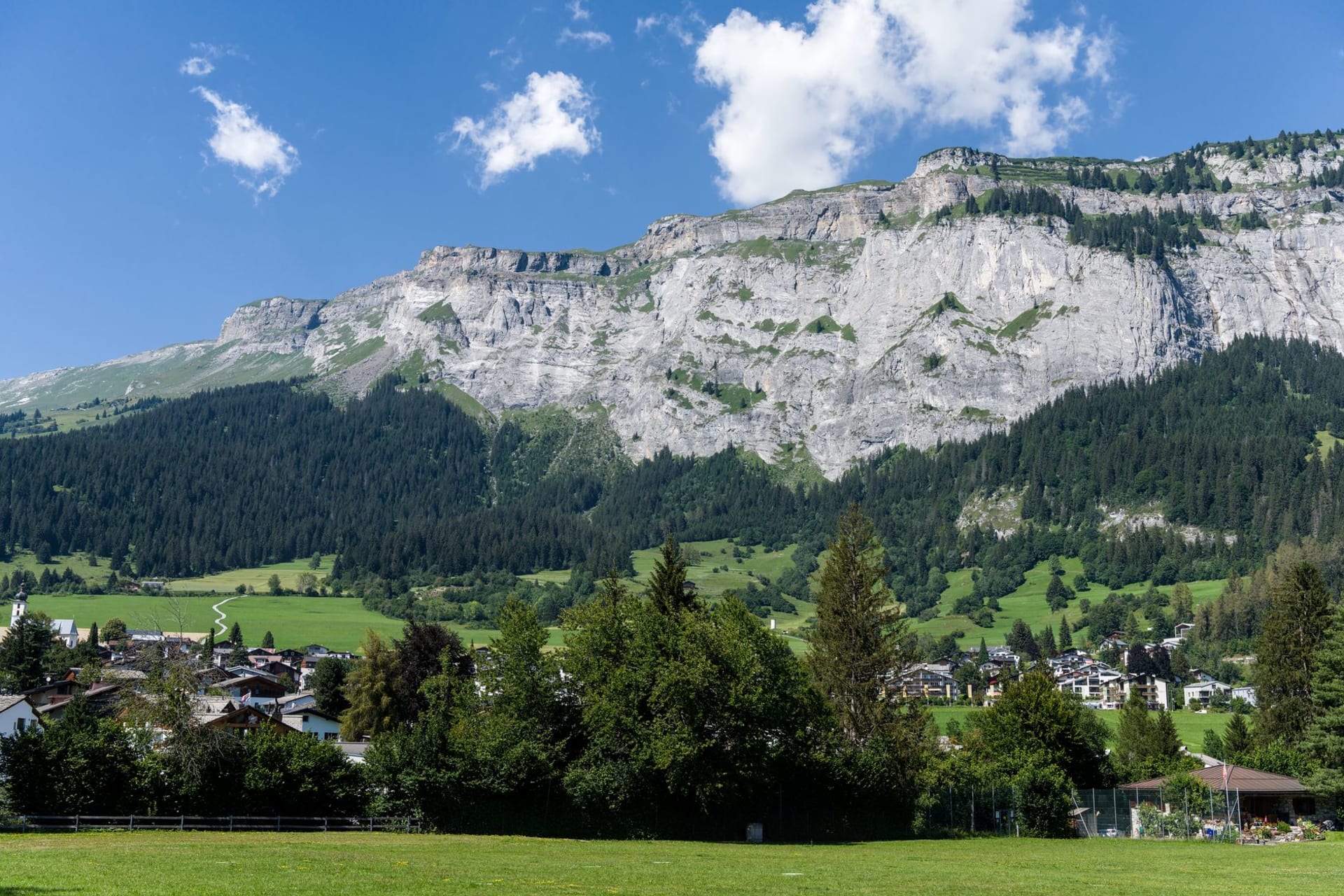
The Dents du Midi rises directly above Champéry — seven limestone summits arranged in a serrated row between 3,000 and 3,257 meters. The name means “Teeth of the South,” and from the valley below the silhouette really does look like something a cartographer would draw to indicate danger. Victor Hugo painted them. The Lumière brothers filmed them in 1900 in what is possibly one of the earliest mountain films ever made.
I arrived in Champéry by train from Monthey — the Mont-Blanc Express narrow-gauge railway, which sounds more romantic than it looks but delivers you into the center of the village twelve meters from a very good cheese shop. The main street is a single lane of wooden chalets, mostly dark-stained larch, with the kind of geranium-window-box aesthetic that is either charming or relentless depending on your disposition. I found it charming.
Into France Without Noticing
The Portes du Soleil connects twelve resorts on both sides of the Swiss-French border, totaling 600 kilometers of marked runs. Champéry is the main Swiss entry point. From the cable car above town you can ski — or at least attempt to ski — from Switzerland into France across the Col de Cou and into Châtel without showing a passport or changing your boots.
The domain is enormous and somewhat overwhelming to navigate on a first visit. What I did: rented equipment in Champéry, took the Croix de Culet cable car up, and then spent three days exploring progressively further from the home base, using the piste map less as a guide and more as confirmation of where I’d ended up. The French side has better lift infrastructure in some areas. The Swiss side has better fondue at the mountain restaurants. There are worse frameworks for choosing which direction to ski.
The Swiss Wall
A piece of local lore: somewhere above Avoriaz on the French side there is a mogul field called the Swiss Wall — a black run of approximately terrifying steepness that you have to descend to get back into Switzerland from certain parts of the domain. I skied it on day three with significantly more adrenaline than grace. At the bottom my legs were shaking and a French skier of about seventy watched me arrive and said something that I didn’t understand but chose to interpret as sympathetic.
The Swiss Wall is not actually Swiss in the sense of being on Swiss territory. It gets its name because of the direction it faces. This information would have been useful before day three.
Champéry Itself
The village is small enough to walk end to end in ten minutes but has several restaurants and hotels of quality above what its size would suggest. The Hôtel de Champéry is a nineteenth-century wood-paneled institution. The Farinet restaurant has a terrace with views of the Dents du Midi and a raclette that involves a proper half-wheel of Valais cheese and a blade, not a table-top electric machine. I’m willing to eat bad raclette when circumstances require, but the Champéry version made me realize I’d been accepting compromises.
The village comes alive for a short window in winter. In summer, Champéry is a hiking base — the Dents du Midi offer serious ridge walks for experienced hikers, and the lower trails through the Illiez valley are pleasant and underpopulated. The thermal spa at Val-d’Illiez, twenty minutes by bus, is a reasonable option for a rest day.
When to go: Mid-December through March for the Portes du Soleil skiing — the domain requires snow at multiple altitudes, so January and February are most reliable. July and August for hiking, particularly the Dents du Midi trails that require guides above about 2,500 meters. September offers clear views and empty trails at lower altitude. The train from Monthey runs year-round and the village is pleasant off-season if quiet is what you want.