Central Suriname Nature Reserve
"I have wanted to disappear into a forest my whole life. This is the one."
The Central Suriname Nature Reserve is not a destination you stumble into. Access requires a small plane from Paramaribo to an airstrip in the interior, followed by river travel by dugout, followed sometimes by days of hiking on trails that exist because someone cut them with a machete and will overgrow again the moment maintenance stops. The reserve covers 1.6 million hectares. There are no roads in. The logistics are the point.
I went in with a small group organized through one of the handful of legitimate operators who work in this territory — four days in total, flying to Kayser Airstrip in the center of the reserve and moving by river from there. The cost is not trivial. The experience is not comparable to anything else I’ve done.
The Airstrip Arrival
The flight in from Paramaribo takes about an hour in a light prop plane, and for most of that hour you look out the window at forest. Unbroken, continuous, green in every direction to the horizon. The occasional river cuts through it. Nothing else. The Kayser Airstrip appears as a narrow clearing, red laterite against all that green, and you land and climb out into an air that smells like vegetation and water and something metabolically active that I can only describe as the smell of things growing faster than elsewhere.
The Rivers
The interior reserve is navigated by river — the Coppename, the Saramacca, tributaries that don’t have names on most maps. The water is clear and cold at depth, tea-colored at the surface, and the banks come right to the edge of the forest. Giant river otters are common enough here that our guide stopped bothering to point them out after the third sighting. Tapirs come to the bank at dusk. Black caiman surface in the narrows.
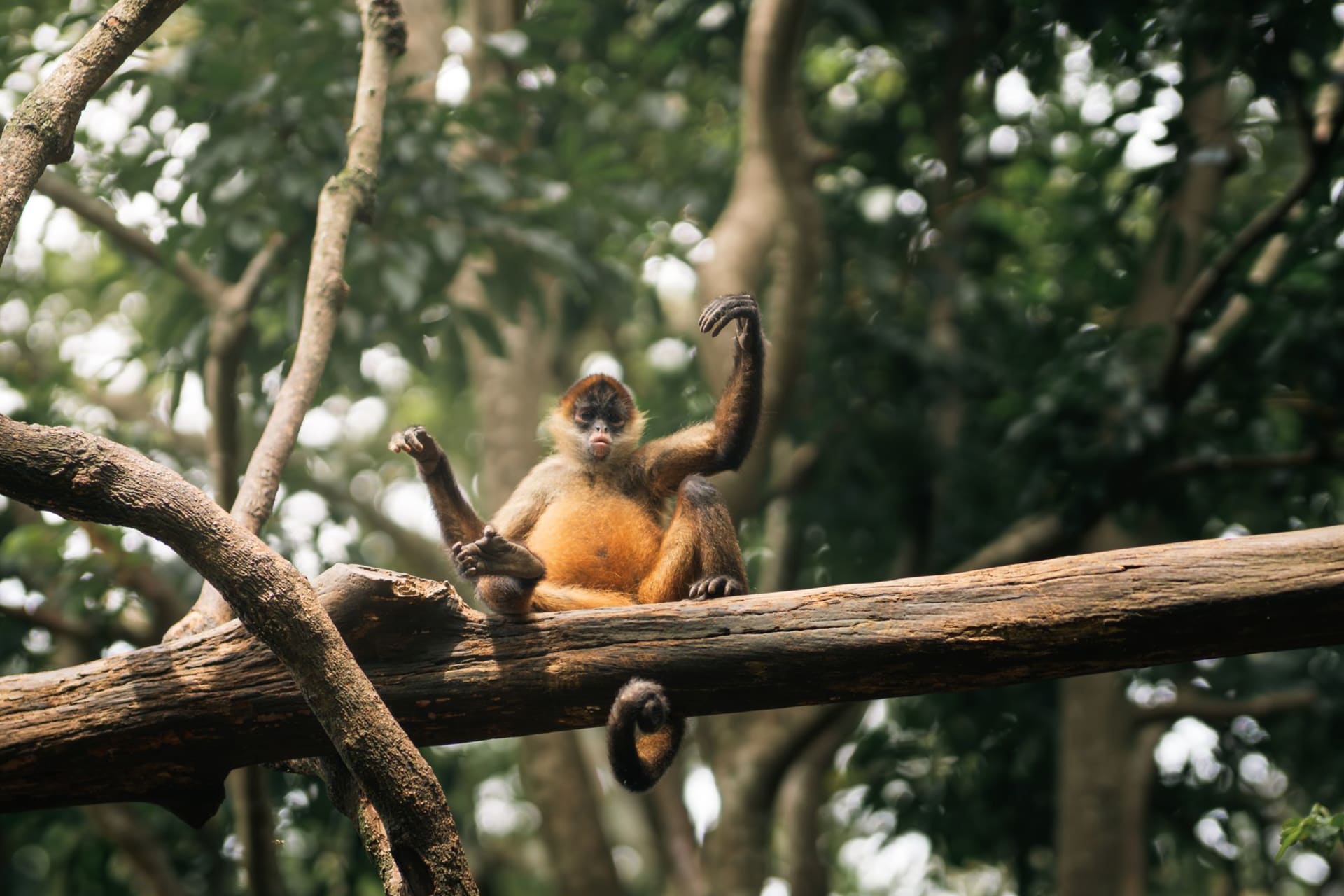
The biodiversity metrics for this reserve are the kind that start to feel abstract: over 5,000 plant species, 400 bird species, 200 mammals. What these numbers actually mean, on the ground, is that something is always moving, calling, feeding, or dying in your peripheral vision.
Voltzberg
The reserve’s signature hike is to Voltzberg, a granite dome rising 240 meters above the forest canopy, accessible from the Raleighvallen area. The climb takes you up bare granite in full sun with no shade and no mercy, and at the top you stand above the canopy and see the reserve extending in every direction to the horizon with nothing in it but more forest. Cock-of-the-rock — brilliant orange birds that look painted — nest in the boulders at the base of the dome.
The view from the top is legitimately staggering. It is also, I should say, extremely hot, and I spent about fifteen minutes at the summit before starting back down.
The Night
The reserve at night is a different place entirely. The temperature drops a few degrees, the insects intensify, and the soundscape shifts into something denser and more layered. Frogs I never saw made sounds I couldn’t locate. Twice I woke at 3am to a sound that my guide, in the morning, cheerfully identified as a jaguar doing rounds.
I didn’t see the jaguar. But knowing it was there, walking around the camp perimeter in the dark — that information changed something about the place and about me in it.
When to go: The short dry season (February–April) is ideal for interior travel — rivers are navigable, trails are passable, and the Voltzberg climb is feasible without wading through mud. Book months in advance through a certified operator, as access is tightly managed and group sizes are small. Independent travel is not permitted.