Brownsberg Nature Park
"The jungle here doesn't feel like a backdrop — it feels like the actual point."
The road up to Brownsberg is the kind that makes you reconsider your rental agreement. Steep, rutted, punishing in the wet season, it climbs through secondary forest before the vegetation thickens into something older and more serious. By the time you reach the plateau at roughly 500 meters, the air has cooled just enough to notice, and everything smells of wet earth and something faintly floral that I never managed to identify.
Brownsberg Nature Park sits about 130 kilometers south of Paramaribo, and it’s the most accessible serious jungle in Suriname. Accessible being a relative term — you still need a four-wheel drive, a modest tolerance for basic lodging, and some willingness to be eaten alive at dusk if you forget the repellent.
The Overlooks
The park’s signature views are the overlooks above the Brokopondo Reservoir — a vast, silver-grey lake created in the 1960s when the Suriname River was dammed for a hydroelectric project. From the Mazaroni and Irene lookout points, you can see the dead tree trunks still standing in the water decades later, ghost forests preserved perfectly in the still surface. It’s eerie in a way that photographs don’t quite capture. The reservoir stretches to the horizon and the flooded trees make it look like something is just beginning to emerge from the water, or just finishing sinking into it.
I sat at the Mazaroni overlook for most of a morning. A blue-and-yellow macaw worked its way along the cliff edge below me, apparently indifferent.
The Trails
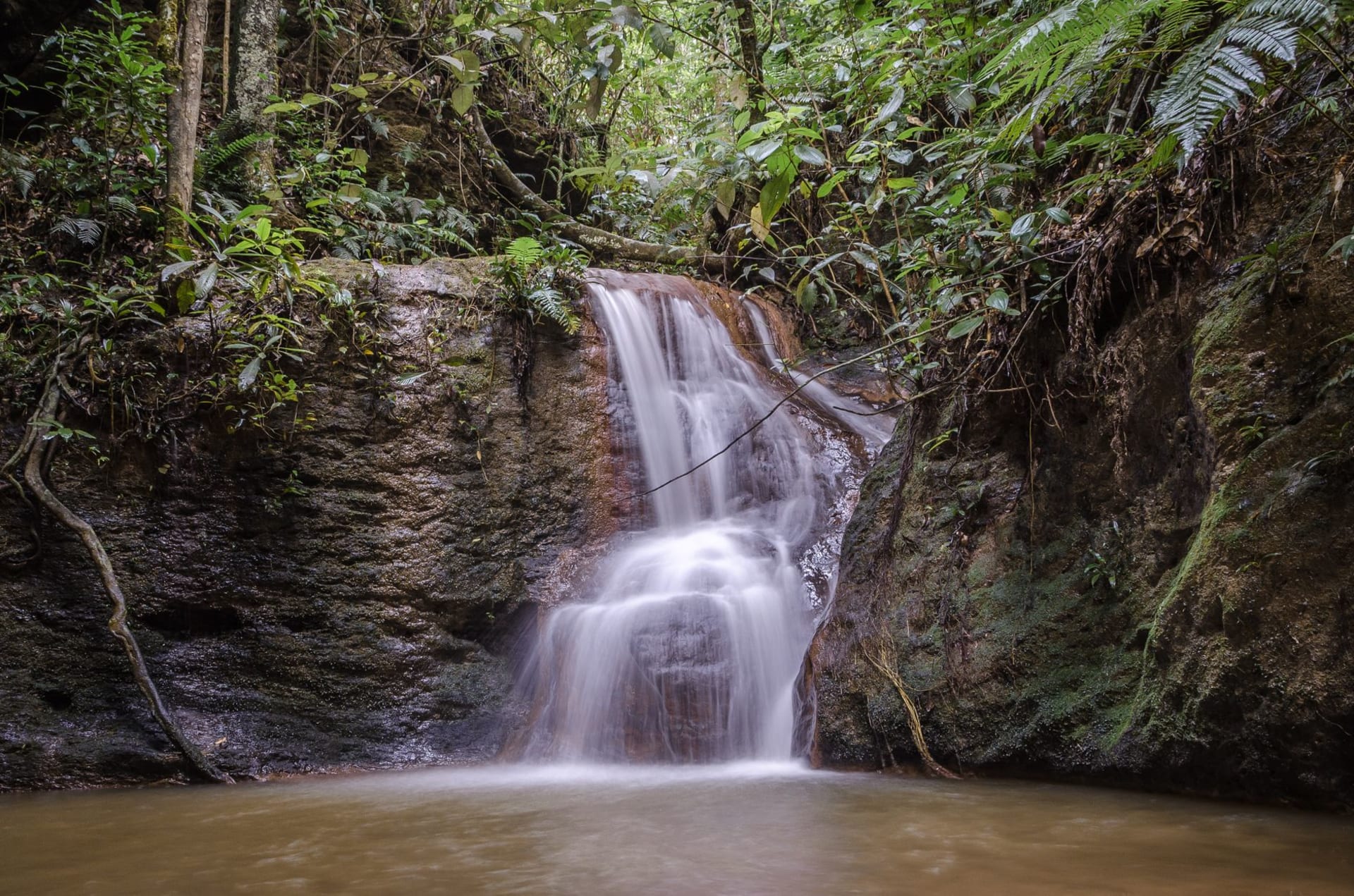
The trail network is manageable — a few well-marked routes ranging from a gentle stroll to a proper half-day descent to a waterfall. The Irene Falls trail takes you steeply down through forest so dense that you lose the light even at midday, the undergrowth closing in on both sides. The falls themselves are modest, but the pool at the bottom is cold and clear and after the climb down, feels enormous.
What the trails offer more than dramatic scenery is density of wildlife. I logged toucans, several species of tanager, leaf-cutter ants crossing the path in an unbroken stream for what seemed like twenty minutes, and one distant rustling that my guide identified as a tapir without looking particularly concerned. He was right — we never saw it, but we saw the prints afterward.
The Night and the Dawn
Staying at the park’s basic lodge means waking before light for the most interesting hours. The dawn chorus here is not background music — it’s a specific, layered noise that takes a few minutes to disentangle into its component species. Howler monkeys make their low, foghorn-like calls from somewhere below the plateau edge. Birds I couldn’t name answered from the canopy above.
Lia made me drag her out at 5:30 one morning to catch the mist in the valley before the sun burned it off. She was correct. The reservoir below disappeared entirely into white, and just the tips of the dead trees broke the surface like pins.
Getting There
Most visitors come on day trips from Paramaribo, but that means missing the evenings and mornings entirely, which is a mistake. The drive takes about two to three hours depending on conditions. A local guide is worth the cost — not just for wildlife identification but for navigating the park’s trails, which are well-marked but benefit from someone who knows where the animals actually are.
When to go: The short dry season (February to April) offers the clearest skies and most reliable road conditions for the ascent. August to November is also good. Avoid the long wet season (May through July) when the road up can become impassable and the trails turn to mud.