Pyramids With No Ticket Lines
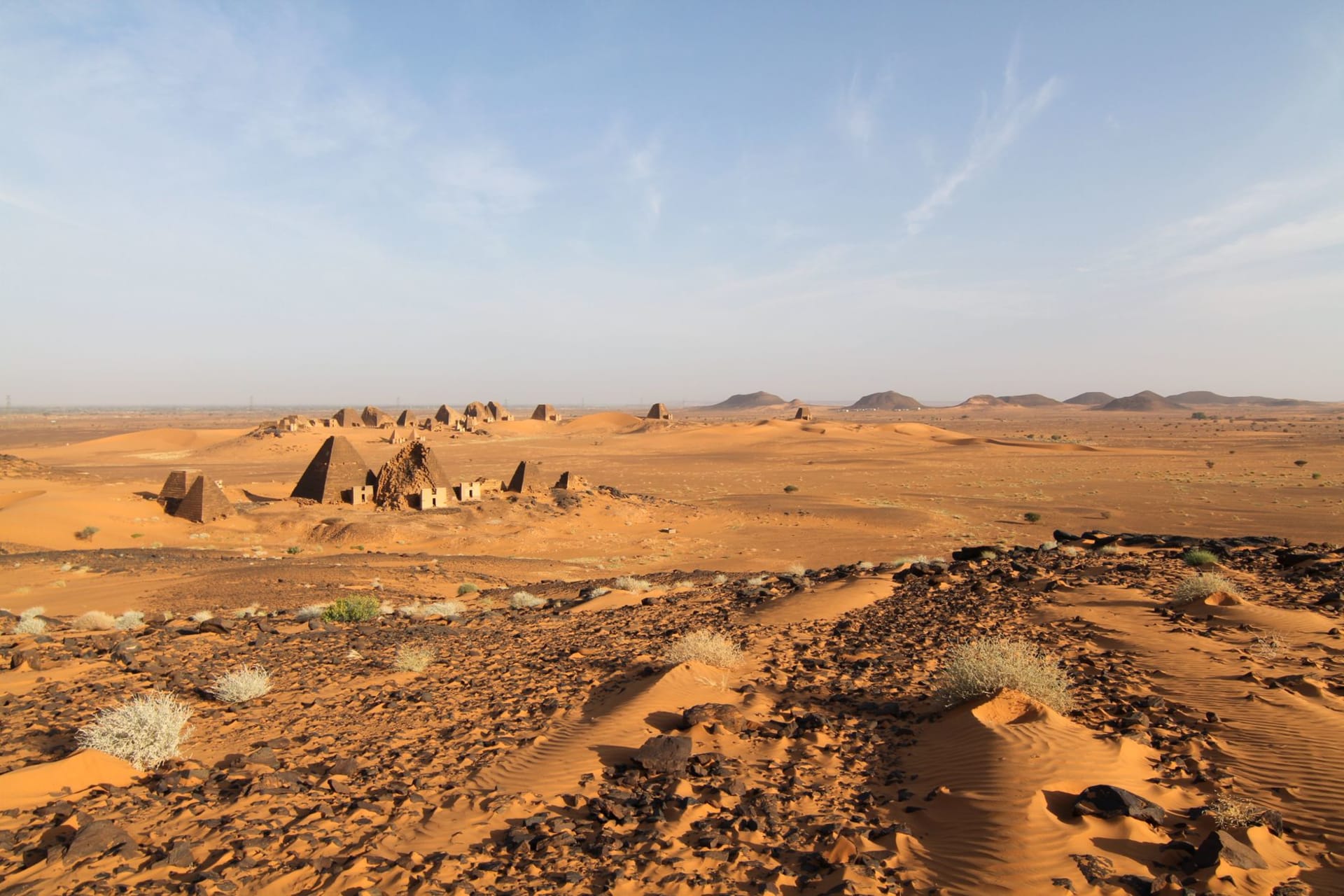
The first thing that hit me was the silence. At Giza you hear bus engines and vendor calls before you even step off transport. At Meroe, the only sound was wind moving through the desert, and the faint crunch of my own boots on compacted sand. There are around two hundred pyramids here — built by the rulers of the Kushite kingdom between roughly 300 BCE and 350 CE — and on the morning I arrived, I counted three other visitors in the entire site.
These pyramids are nothing like Egypt’s. They’re steeper, narrower, almost spike-like against the sky, their angles closer to 65 degrees than the gentle 52 of the Great Pyramid. Most have small funerary chapels attached at the base, carved with relief scenes that catch the low morning sun in remarkable ways. The stone is a warm sandstone that goes nearly orange at dawn, and at dusk it deepens to something closer to ochre.
The Light Is the Point
I’d been warned to arrive early or stay late, and that advice turned out to be an understatement. At noon, under the full Sudanese sun, the site is beautiful but harsh. At six in the morning, with the light raking in from the east and every carved surface throwing a precise shadow, it became one of the most quietly overwhelming places I’ve visited. I sat on a low dune between the northern and southern groups and didn’t move for almost an hour.
Some pyramids were damaged in the nineteenth century by an Italian explorer named Ferlini who smashed off the tops searching for treasure. The blunt, truncated stumps he left behind have their own melancholy geometry. It’s the kind of detail that makes you angrier the longer you stare at them.
Riding Out From Kabushiya
The nearest town is Kabushiya, about four kilometers from the site. Most travelers stay in the small cluster of guesthouses that have grown up around the site itself — some are little more than a room with a cot and a fan, but all of them are run by people who will make you tea at any hour. I rented a camel for the afternoon from a man named Hassan who’d been doing this for thirty years and communicated everything through gestures and an extremely expressive face.
Riding out into the desert behind the pyramid field, with the monuments shrinking behind me and nothing ahead but flat scrubland fading to haze, I felt something I can rarely find at ancient sites: actual solitude. No roped-off paths. No recorded commentary bleeding from a speaker somewhere. Just the animal moving under me and a sky the particular deep blue that the Saharan atmosphere produces when you’re far from any city.
The Southern Group at Dusk
The southern group is smaller and less visited even than the northern, and worth the walk. Several of the chapels still have relief carvings in good condition — figures of gods, royal processions, offerings. A guard who appeared from nowhere walked beside me for a while without speaking, then pointed at a particular carving of a Kushite queen with a firm nod, as if confirming something we’d both been thinking.
I bought a small clay scarab from a boy selling them outside the entrance on my way out. It sits on my desk in Mexico City now. Every time I look at it I think about that silence.
When to go: October through February for manageable heat — daytime temperatures in this period hover around 25–35°C rather than the punishing 45°C+ of summer. Dawn visits in December are extraordinary. Avoid May through September entirely unless you thrive in serious desert heat.