Jebel Barkal
"The mountain had a pillar on its face that looked like a crown. I understood immediately why people had built temples here."
A Mountain That Demanded Religion
Jebel Barkal is 98 meters tall. In the context of the surrounding desert — absolutely flat, extending in every direction to the horizon — it might as well be Everest. The ancient Kushites and Egyptians considered it the home of Amun, the chief god of the Egyptian pantheon, and the sandstone pillar on its southern face — roughly 75 meters of separate rock that leans slightly outward from the main cliff — was read as the uraeus, the royal cobra that sat on the brow of pharaohs. Once I’d been told this, I couldn’t unsee it. The pillar does look like a cobra rearing up, and it wears what the light makes into a crown.
The town of Karima sits right at the mountain’s foot, and you can walk from the town’s edge to the temple complex in fifteen minutes. No shuttle bus. No park entrance queue. I arrived at seven in the morning and the site was completely empty. A guard materialized, stamped my entry slip, and disappeared again.
The Temples at the Base
There are multiple temple structures built against the base of the cliff, most dating from the Kushite 25th Dynasty — the period when Nubian rulers actually conquered and ruled Egypt, a fact that tends to surprise people unfamiliar with this part of history. The temples were dedicated primarily to Amun and are oriented toward the mountain’s pinnacle in ways that were clearly deliberate and astronomically calculated.
The interior rooms still have painted relief carvings on the walls, some in remarkable condition given their age. The colors — red, ochre, blue — survive in the deeper chambers where sunlight doesn’t reach. A particular carving of the god Bes, the Egyptian dwarf deity of protection, appeared in a lower chamber and I hadn’t been expecting it. These things surprise you when you’re wandering without a guide and a schedule.
The Pyramid Field at El-Kurru
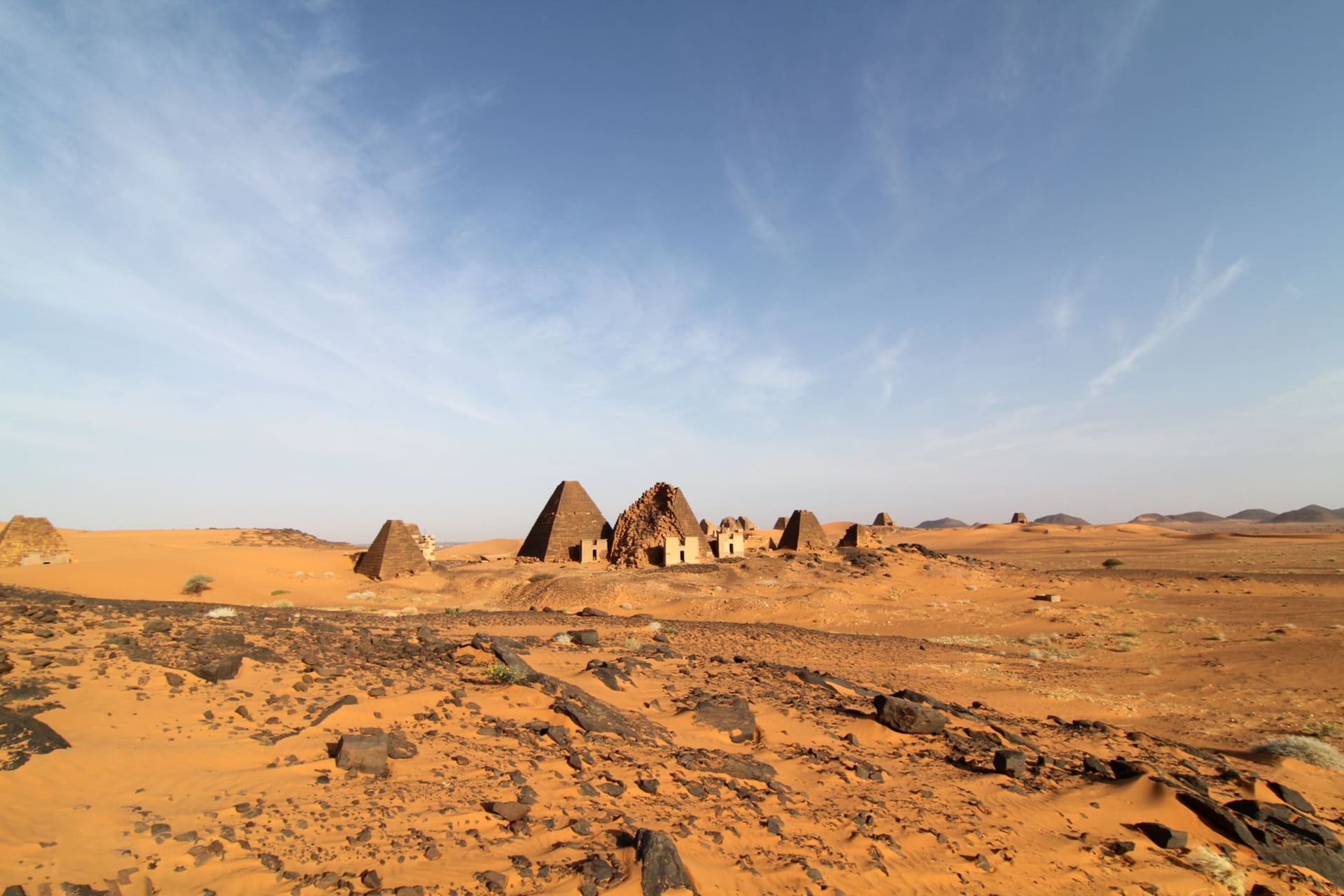
About fifteen kilometers south of Karima is El-Kurru, a smaller pyramid site containing the tombs of the earliest Kushite kings, including Kashta and Piye — the rulers who launched the conquest of Egypt. Several of the tombs are accessible underground, reached by steep staircases cut into the rock. The interior walls are painted with scenes from the Book of the Dead, and in the available light from a flashlight they glow.
I visited on a morning when a school group from Karima was also there, and the sound of children’s voices echoing up through the staircase while I descended past three-thousand-year-old paintings was one of those odd temporal compressions that travel occasionally produces. I’ve thought about it several times since.
Karima and the River
Karima itself is a slow town on a bend of the Nile, with date palms along the riverbank and a covered market where merchants sell dried dates in grades I quickly learned to taste the differences between. The Nile here is wide and moves with a deliberate authority. In the early mornings, before the heat builds, men fish from simple wooden boats and women wash fabric on the flat rocks at the water’s edge.
I stayed three nights, which felt like the right amount — long enough to walk back to Jebel Barkal twice and see what the afternoon light did differently to the pinnacle than the morning had. The answer is: everything.
When to go: November through February. The Karima region is hot by any standard but genuinely manageable in the winter months, with daytime temperatures around 25–32°C and cool nights. The site has no shade and desert sun is unforgiving — bring more water than you think you need. Dawn and late afternoon visits to the temple complex are both dramatically better than midday.