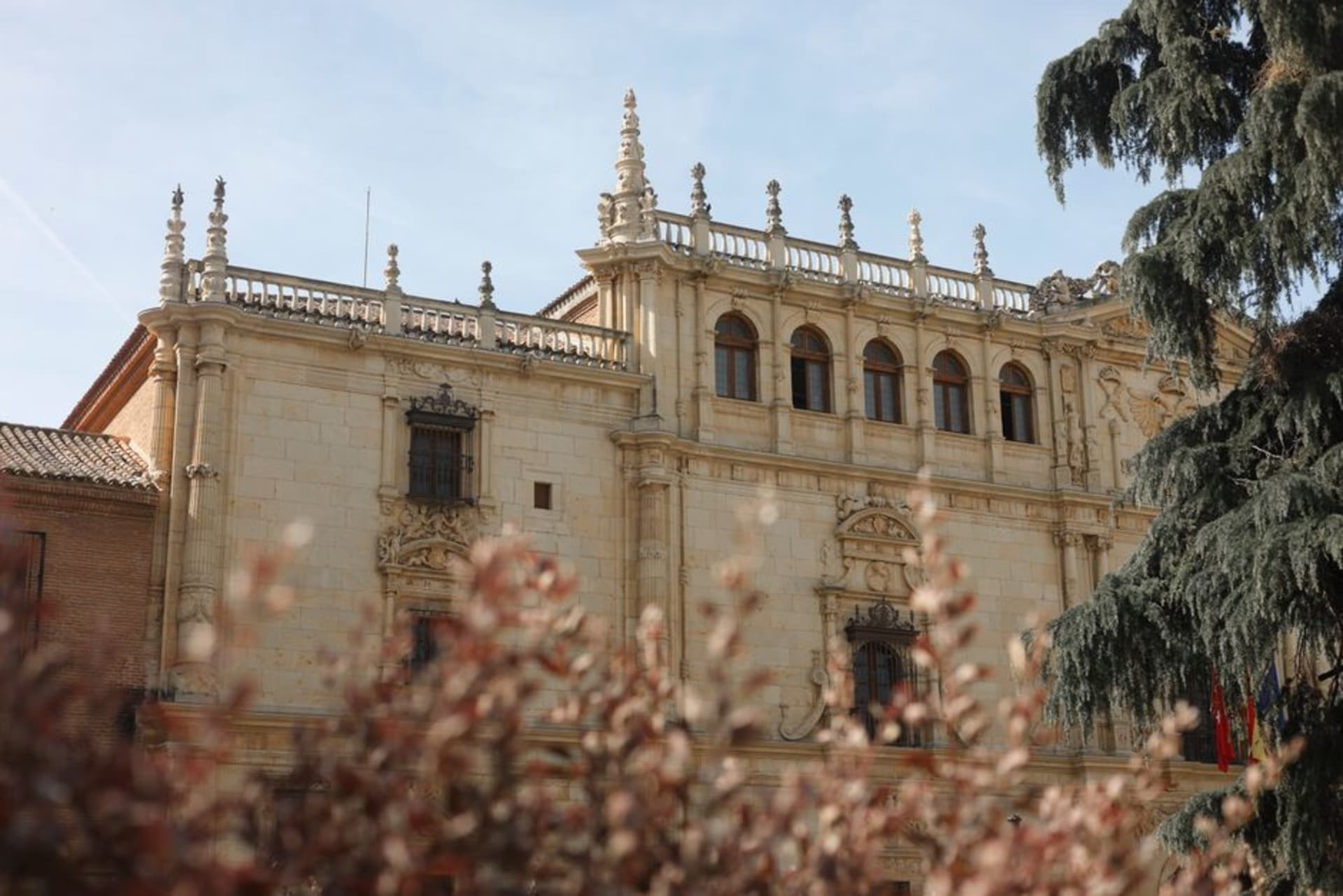
Alcalá de Henares
"Every Spanish-speaking writer owes something to this town, and this town knows it, and somehow still isn't insufferable about it."
The university town where Cervantes was born and where Don Quixote's ghost seems to sit on every café terrace along the Calle Mayor.
Alcalá de Henares is a half-hour commuter train from Madrid Atocha, close enough that I almost skipped it as too easy, too obviously a day trip. I’m glad I didn’t. This is the birthplace of Miguel de Cervantes — the house where he was reputedly born in 1547 is now a modest museum, the Casa Natal de Cervantes, arranged around a plain interior courtyard that gives you almost nothing of the man and everything of the era he grew up in. But the real weight of Alcalá isn’t the birth house. It’s the university that shaped the whole town around it centuries before Cervantes was born, and that university’s fingerprints are on more of the modern Spanish-speaking world than most visitors realize.
A University That Rewrote a Language
Cardinal Cisneros founded the Universidad Complutense here in 1499, and under its patronage scholars produced the Complutensian Polyglot Bible — the first printed polyglot edition of the complete Bible, with parallel columns in Hebrew, Greek, Latin, and Aramaic, a project so ambitious it took fifteen years and assembled some of the era’s finest linguists in one town. The university itself, with its extraordinary plateresque facade on the Colegio de San Ildefonso, became a model copied across the Spanish empire — the universities of Mexico City, Lima, and Manila all trace their institutional DNA back to Alcalá’s charter. UNESCO recognized the whole historic complex, university and old town together, as a World Heritage Site in 1998, specifically citing it as the first city in the world purpose-planned around a university ideal.

Storks, Students, and Don Quixote
What I didn’t expect was the sound of the place — a constant, dry clattering from white storks nesting on nearly every tower, spire, and rooftop ledge in the historic center. Alcalá has one of the densest urban stork populations in Spain, and their huge stick nests crown the cathedral, the university tower, even the old chapel roofs, giving the skyline a slightly wild, unmanaged edge that contrasts nicely with all that Renaissance planning below. I sat on the Calle Mayor — a long arcaded street, one of the oldest continuously commercial streets in Europe — and watched students cut through on bikes past bronze statues of Don Quixote and Sancho Panza seated on a bench, a monument locals treat with the casual affection of an old joke rather than reverence.

Every October 9th, on Cervantes’s baptism anniversary, the town holds El Día de las Letras with readings of Don Quixote in the Corral de Comedias — Spain’s oldest surviving public theater, still in continuous use since 1601, tucked just off the Plaza de Cervantes. I wasn’t there for that, but even on an ordinary Tuesday the town felt saturated with the same unhurried, bookish confidence: a place that produced the most translated novel in history after the Bible and never felt the need to shout about it twice.
When to go: April and May bring mild weather and stork nesting season in full swing; October adds the Cervantes literary festival around the Día de las Letras on the 9th.